Fans of the TV show The Office may remember the episode when Michael gets “koi ponded.” Michael is obliviously walking through the lobby of a fancy office building that has koi ponds in the floor when a misstep, accompanied by Jim’s lack of help, lands him fully dressed in white collar attire at the bottom of a koi pond. Michael must then return to his own office, soaking wet, meeting the laughter and comments of his employees at his expense. The moral of this episode is found when this incident, followed by embarrassment, leads to Michael learning how to laugh at himself.
At about the same time this episode was aired, I was koi ponded as well, but in a different way. 15 years ago, I stumbled into a hole of my own which led to a change in my life. I had just cut down a bunch of trees in my back yard. Thanks to my keen foresight, I built a fence before cutting down the trees and was unable to get a stump grinder into the yard. I was left with some rather large tree stumps in the middle of my new lawn. I was trying to come up with a creative idea of what to do with these stumps, maybe use them as landings for potted plants. After staring at the stumps for a while, an idea came to me. I wasn’t sure whether it would work but I thought I’d give it a try. A rather large stump cluster had a couple large roots running from it, peaking just above the surface of the ground. I thought it would look really cool to dig underneath the roots and build a koi pond with large roots running above the water.
I started digging for an hour or so each night and after a few weeks I had dug a hole large enough for me to fit inside. I knew nothing about building ponds, and I’ve never been much for following instructions, so I decided to wing it. I bought a pond liner which is basically a heavy-duty black tarp. I found a way to fasten the liner to the top of the hole and in the process, spilled a good bit of dirt into the liner. When I filled up the hole with water, it was incredibility murky with hardly any visibility. Deciding to worry about this later, I built a waterfall and hooked up the pump and tubing to run the waterfall and circulate the water. It looked pretty cool aside from the murkiness. I thought maybe the dirt would settle over time, but after a week there was no change. The fine clay dirt would not settle in the circulating water. Then my pump died.
I put my stubbornness aside and reached out for help. I found someone who works on ponds for a living. He said I needed a pre-filter. A pre-filter connects to the water intake of the pump and filters the water of debris before it enters the pump. Not only does this remove the dirt from the water making it pretty and clear, but it keeps dirt out of the pump, prolonging its life.
I am now on my sixth pond and have plans for an elaborate seventh once my kids are older and don’t want to hang out with me anymore. I’ve done everything from simple designs to complicated designs and a couple of renovations. The great thing about building ponds is that they can be as easy or complex as you like. Since I prefer to learn things the hard way, it has taken me six ponds over 15 years to compile my know-how. In case you are not as hard headed as me, and you are interested in building a pond, here are the basics.
The Essentials
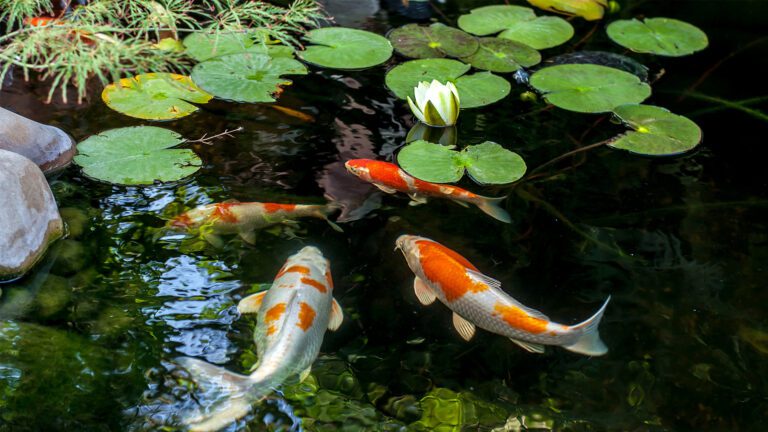
There are three essential items you need for a pond. Obviously, you must have a basin to hold water. Be sure to give your fish plenty of space. They will be happier and healthier, and if you give them enough space, you can watch them grow. I have seen ponds with large koi practically rolling over each other. A water clarification solution had to be added daily, and the fish still didn’t survive.
You need a pump to circulate the water and create surface movement which allows oxygen to enter the water so your fish can breathe. The pump also prevents stagnation which allows mosquitoes to breed and bacteria to grow. People often see my pond and say, “but doesn’t that attract mosquitoes?” Nope, mosquitoes only like stagnant water. A pump also distributes even temperatures and oxygen within your pond allowing your fish to feel comfortable in the pond’s entirety.
A pump’s strength is measured in gallons per hour (GPH). You want to circulate the entirety of your pond water every two hours. A 500 gallon pond would need a 250 GPH pump. If you have a waterfall or other water features that require elevation of the water flow, you will need extra power. I always try to err on the side of extra power. There are ways to diffuse the water pressure and when you first build your pond, that is the highest water pressure you will have. It always slows as your piping collects tiny sediment build up. However, if you go with too much power, your waterfall could turn into a water pistol.
A prefilter is the third essential. Even if your pond collects minimal amounts of debris from the nature around it, your fish create waste which must be filtered from the water. Would you want to swim in your own poo? However safe you think your pond is from debris, I guarantee you are underestimating.
Other Additions
There are many products and apparatuses you can add to a pond. I have found a few to be almost essential. Sunlight will find its way into your pond which will encourage the growth of algae. If this is not controlled, your pond water will turn into green sludge. You can clean it by hand, but that can be labor intensive. Purchase a UV light made for ponds. It connects to your piping outside of the pond, in between the pump and wherever the water is disbursed. The UV light kills the algae as the water runs by it. You may still get a little algae, but this will cut it down significantly. Be sure the UV light is protected from the sun. I have had UV lights only last months from partial exposure to the sun. My current UV light is almost 7 years old because it is well protected.
A canopy with bug netting will cut down on the sunlight and debris entering your pond, making pond maintenance much less of a chore. It will also protect your fish from predators. Fish have a lot of predators in our area; birds, racoons, cats, owls, and even snakes. I have had many a fish disappear. Herons will come all the way from our rivers and gulf to sneak into your yard and poach your fish. The canopy keeps them for seeing your fish in the first place and the bug netting makes it difficult for them to enter your pond. For larger ponds, an appropriately sized canopy may be difficult to obtain. But if possible, I highly suggest one.
Lights are a must. During the day, the glare of sunlight cuts down on the visibility of your fish. Your pond and fish are much more visible at night if you have lights. I have spent countless hours staring at my fish at night. It’s a great place to sit down with the guitar or share a beverage with someone. There is something therapeutic about watching fish. I’m not sure what the science is behind that, I just know the therapy is there.
Fish Care
If you have a healthy pond, fish care is easy. You don’t even have to feed them. They can survive off of algae growth and bugs. And with this type of feeding, there is much less waste and it is easier to keep your pond clean. If you are trying to grow your fish, you may need to give them additional food. Don’t try to bulk them up with the store bought dry pellets. Those are great when you want to play with your fish. Once your fish are comfortable with you, they will eat them right out of your hand. But those pellets are essentially junk food. If you want healthy growth, get brine shrimp or meal worms. We have a bearded dragon (pet lizard) at our house and my wife breads mealworms for it. The dragon cannot keep up with the mealworm production so now we feed them to our fish. I know most of you don’t live in a small zoo like I do, but I’m sure you can find some healthy feeding options online.
Keep pesticides away from your pond. I killed the first fish I bought with pesticides. I knew pesticides were dangerous, so I just didn’t spray close to the pond. A heavy rain hit and toads ran through my yard to the pond. The toads carried the pesticides with them and into the pond. Within a few days my fish were dead.
Don’t worry about water temperature. Even if the top of your pond freezes, the fish can survive underneath the ice. The only thing to be careful about is not feeding your fish if the water temp is under 50 degrees. I just go by the air temp to err on the safe side. Fish become very docile in cold water and their metabolism drops. Any food consumed will rot in their stomach.
Be sure to add underwater features. Fish like things to swim around and features collect algae for fish snacks. Fish also love places to hide, not just from predators, but because sometimes the other fish can be real jerks.
Like I said before, creating a pond can be as easy or complex as you would like, so start simple. It can become very challenging when dealing with complex water features, but to me, that is the fun part. It is also a wonderful creative outlet. There are endless possibilities and designs. A pond offers visual and auditory pleasures to your yard. That constant sound of trickling water is so peaceful. Once the fall leaves are done falling, it is the perfect time of year for pond building. The weather is cooling off, the bugs are going away, and winds are mild meaning less debris in your new pond. Good luck!
Any content, resident submissions, guest columns, advertisements, and advertorials are not necessarily endorsed by or represent the views of Best Version Media LLC (BVM) or any municipality, homeowners associations, businesses, or organizations that this publication serves. BVM is not responsible for the reliability, suitability, or timeliness of any content submitted, inclusive of materials generated or composed through artificial intelligence (AI). All content submitted is done so at the sole discretion of the submitting party.