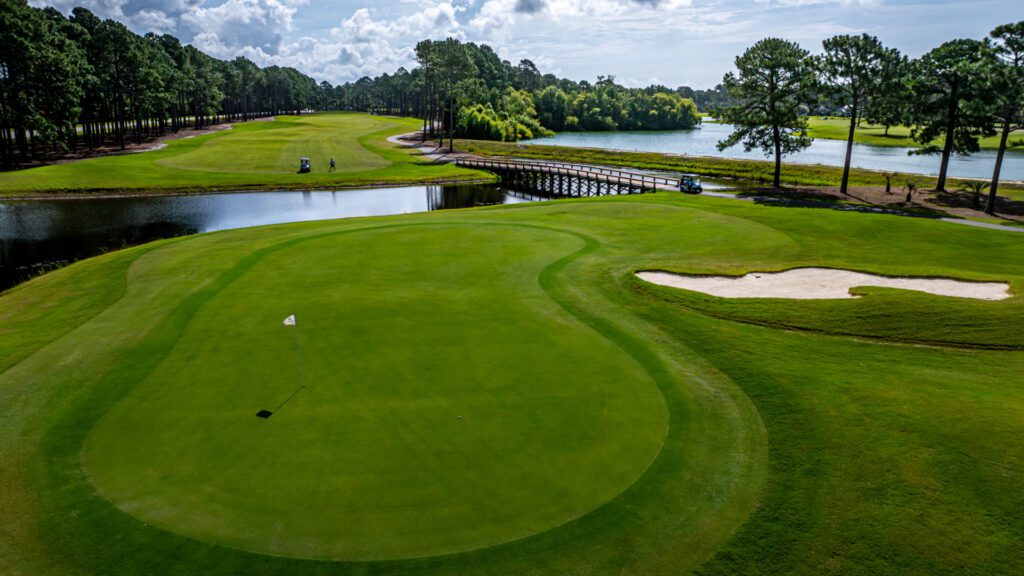
Designing a golf course along the Carolina coast is both an art and a science. Here, nature isn’t just the backdrop— it’s a living, breathing design partner. From tidal marshes and classic Lowcountry terrain to native pines and sandy soil, every element plays a role in how a course is imagined, shaped, and enjoyed.
It’s no wonder that Myrtle Beach—officially trademarked as The Golf Capital of the World™—boasts one of the most diverse collections of golf course designs anywhere. Across the Grand Strand, dozens of legendary architects have left their mark, each putting a unique spin on coastal golf.
In Shallotte, North Carolina, Rivers Edge Golf Club is a perfect example of that artistry. Designed by the legendary Arnold Palmer, the course winds along the Shallotte River, blending coastal elevation changes with sweeping marsh views into seamless strategy. Palmer’s signature was creating “risk-reward” holes, and Rivers Edge is a perfect showcase with many holes requiring long carries over the marsh. The most iconic hole, nicknamed “Arnie’s Revenge,” is hole No. 9 and requires golfers to decide whether to take on a daring carry over the marsh to a narrow green or play it safe and aim for the sloping second fairway beyond.
A short drive south in Sunset Beach, Sea Trail Golf Resort is writing its own new chapter in coastal design. The resort’s three distinct layouts were each crafted by a different architect, and in the last two years, two of the courses have gone through major restoration projects. The Willard Byrd course, refreshed in 2024, features new TifEagle Bermuda greens, cart paths, and bunkers with the Better Billy Bunker system. These enhancements honor Byrd’s strategic approach while advancing modern playability and improved conditions.
The Dan Maples Course at Sea Trail reopened on October 1, 2025, following its own major restoration project, which also included brand-new TifEagle Bermuda greens, improved drainage, and a reimagined course layout. The new design blends the classic Maple’s charm with a new look, comparable to a “Pinehurst look” with natural sandy areas with ornamental grasses framing the fairway, and the removal of all cart paths. While the course continues to grow in and mature, golfers are already enjoying the renewed challenge and character of this coastal gem. It’s a striking example of how a thoughtful restoration can honor a designer’s original intent while adapting to the natural landscape and agronomic conditions of the area.
What makes coastal golf course design so captivating is its harmony with nature. Designers can’t fight the terrain— they must embrace it. Every tree, tide, and grain of sand shapes how a round unfolds. The best courses don’t just exist on the coast— they belong here. And along the Myrtle Beach Golf Trail, that harmony between design and environment is on display at every turn.
Any content, resident submissions, guest columns, advertisements, and advertorials are not necessarily endorsed by or represent the views of Best Version Media LLC (BVM) or any municipality, homeowners associations, businesses, or organizations that this publication serves. BVM is not responsible for the reliability, suitability, or timeliness of any content submitted, inclusive of materials generated or composed through artificial intelligence (AI). All content submitted is done so at the sole discretion of the submitting party.