In the battle for a diner’s attention, biology dictates that photos defeat text every time. Here is the science behind why visual menus sell 30% more.
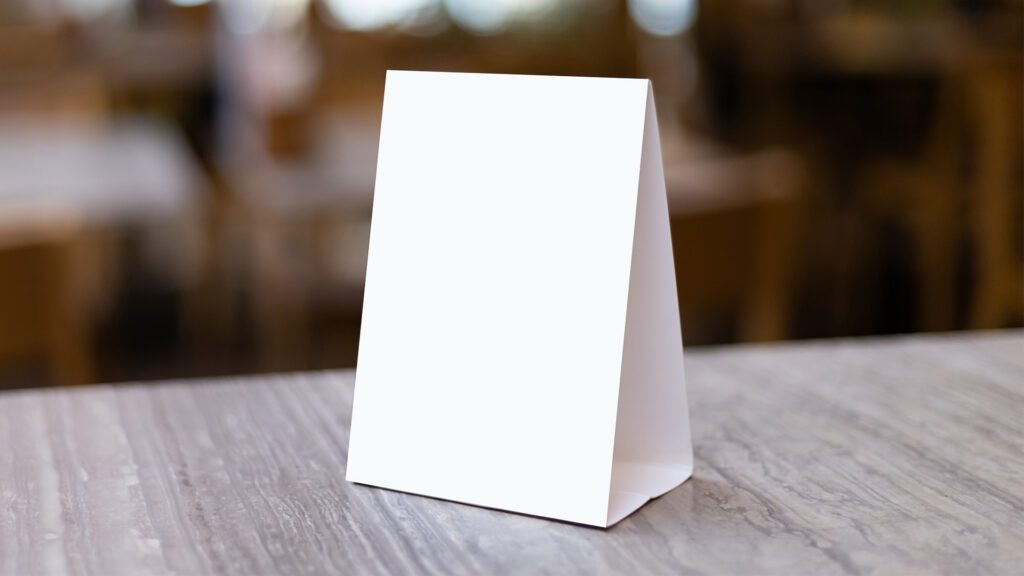
Imagine a couple sitting down at a booth in your restaurant. They are deep in conversation, catching up after a long week. Between them sits a greeting card table tent. One side features a dense paragraph describing your new seasonal cocktail—the ingredients, the history of the spirit, and the flavor notes. The other side features nothing but a high-resolution, glossy image of that same cocktail, glistening with condensation and garnished with a fresh sprig of mint.
Which side stops the conversation?
In the high-distraction environment of a dining room, text is passive, but images are aggressive. While many restaurateurs view menus simply as informational lists, the most profitable operators view them as marketing real estate. When it comes to table tents—which serve primarily to drive impulse add-ons like appetizers, drinks, and desserts—the data is overwhelmingly clear. A text-based description asks the customer to do work; a photo creates a reflex. In the battle for the diner’s attention, the photo doesn’t just win; it dominates.
The Biology of Desire: Why We “Eat With Our Eyes”
To understand why photos outsell text, we have to look beyond marketing and look at biology. Scientists refer to this phenomenon as “Visual Hunger.”
When a customer reads the words “chocolate lava cake,” their brain has to process the symbols, convert them into language, and then simulate a mental image of the cake based on past experiences. It is a multi-step cognitive process. However, when that same customer sees a photo of a molten chocolate center oozing onto a plate, the reaction is primal and instantaneous.
Research indicates that viewing images of desirable food stimulates the brain’s release of ghrelin, a peptide hormone that increases appetite and prepares the body for food intake. This is a biological survival mechanism; for most of human history, if you saw food, you needed to be ready to eat it immediately.
Furthermore, the human brain processes images 60,000 times faster than text. In a restaurant setting, where attention spans are short and sensory input is high, a table tent has milliseconds to make an impression. A paragraph of text is a speed bump; a photo is a highway. By using photography, you are bypassing the customer’s logical brain and appealing directly to their physiology. You aren’t just suggesting they order the dessert; you are physically making them hungry for it.
Reducing Risk: The Visual Contract
Beyond biology, there is the issue of trust. We live in an era of skepticism, where every menu item claims to be “world-famous,” “succulent,” or “cooked to perfection.” To the modern diner, these adjectives are subjective fluff. Text-based descriptions ask the customer to take a gamble; they must hope that the kitchen’s definition of a “generous portion” matches their own.
This uncertainty creates a psychological barrier known as “menu anxiety”—the subtle fear of ordering something disappointing and wasting money or calories on a lackluster meal.
A table tent featuring a high-quality photo acts as a risk-reduction tool. It serves as “visual proof,” offering a transparent contract between the kitchen and the guest. When a customer sees the sear on the steak, the garnish on the cocktail, or the size of the appetizer, the perceived risk of the purchase plummets. This is the “What You See Is What You Get” (WYSIWYG) effect.
This is particularly vital for table tents, which often highlight Limited Time Offers (LTOs) or high-margin specials. Since these are items the customer has likely never ordered before, their hesitation is naturally higher. Data from food hospitality studies suggests that removing this ambiguity through photography can increase conversion rates by up to 25%. By removing the mystery, you remove the objection.
The Table Tent as an Impulse Engine
While the main menu is designed for planned decisions (choosing a main course), the table tent has a different job entirely: it is an engine for impulse buys. Its purpose is to disrupt the dining experience and tempt the customer into buying something they didn’t know they wanted.
This is where the battle between text and photography is decided. Impulse buying is almost exclusively an emotional reaction, not a logical one.
When a customer reads a text description of a dessert after a full meal, their logical brain takes over. They calculate the price, they assess their fullness level, and they consider the caloric intake. Logic usually says “no.” However, a compelling photo bypasses the logical brain and speaks directly to the emotional brain. It shifts the internal monologue from “Do I need this?” to “I want that.”
Industry data supports this shift: studies have shown that placing a “hero shot” of a high-margin item acts as a spotlight. This is often called the “Highlight Effect”—an item with a photo is ordered nearly three times as often as adjacent items with text-only descriptions. By relying on text for your add-ons, you are asking the customer to logically justify an indulgence. By using a photo, you are seducing them into it.
Conclusion: A Picture is Worth 30% More Revenue
The verdict is clear: in the specific context of restaurant table tents, photography is not just an aesthetic choice; it is a financial strategy. Text serves to inform, but photos serve to sell.
While text-based menus have a place—often in ultra-fine dining where mystery is part of the allure—the table tent is a piece of direct marketing real estate. Its job is to grab attention in a distracted environment, trigger a biological hunger response, and reduce the friction of “menu anxiety.”
For restaurant operators, the takeaway is actionable and immediate. Audit your tables. If your tents are filled with paragraphs of adjectives, you are likely leaving money on the table. Swap the copy for a single, professional, high-resolution image. Do not clutter the design; choose one “hero” item that has a high profit margin and give it the spotlight.
A picture may be worth a thousand words, but in the restaurant business, it is worth significantly more than that. It’s worth a 30% increase in sales, a higher check average, and a customer who leaves satisfied, having eaten with their eyes before they ever took a bite.
Any content, resident submissions, guest columns, advertisements, and advertorials are not necessarily endorsed by or represent the views of Best Version Media LLC (BVM) or any municipality, homeowners associations, businesses, or organizations that this publication serves. BVM is not responsible for the reliability, suitability, or timeliness of any content submitted, inclusive of materials generated or composed through artificial intelligence (AI). All content submitted is done so at the sole discretion of the submitting party.