How Equestrians Shape Motion Through Vision and Balance
Use your entire body — from your soles up — to create a smooth, frisbee-like ride!
Earlier in this series, we explored the body’s seven suspension points. I strongly encourage you to revisit that article, as it provides essential groundwork for understanding and applying the principles reinforced here.
The purpose of this article is to reaffirm the mission of horizontal motion.
The objective of nearly all transportation on Earth is horizontal motion. Even when our destination appears vertical — up a hill or down a slope — it is still approached from a horizontal perspective. That distinction is critical.
Whether riding uphill, downhill, or on level ground, the mission does not change. Along with the horse’s graceful horizontal travel comes a surplus of vertical motion. It is the rider’s responsibility to manage, redirect, and sculpt that motion into a functional horizontal plane. When traveling on an incline or decline, that angle simply becomes our new “horizontal.” The task remains the same: maintain efficiency and balance with “intent” as we move toward the destination.
This is where critical thinking becomes essential.
Critical thinking, however, is not always the focus of the average equestrian. Most riders are primarily concerned with finishing the course, completing the race, or simply getting through the ride. Yet herein lies the secret to achieving those goals with true success, or what we might call “Victory.”
Victory can take many forms: a safe arrival, a healthy horse, a confident rider, a deeper partnership—or standing atop the podium at a Grand Prix. Regardless of the outcome, every one of these achievements depends on the same underlying physics and the same thoughtful approach to motion.
So let us refocus on the true goal.
Transforming the horse’s vertical motion into a smooth, frisbee-like glide above the rider’s shoulders gives both horse and rider profound advantages in efficiency, balance, and longevity. Does the horse consciously think this way? Of course not. Do most riders? Not nearly enough.
While nearly all equestrians strive to improve, very few devote sufficient attention to the ergonomics of what they are actually trying to accomplish.
The first step in evaluating your progress is vision.
Begin this exercise before you mount your horse. As you walk through your environment, observe how your own vertical movement affects what you see. Notice how distant objects shift in relation to closer ones as your body rises and falls. When you are elevated, your line of sight may pass over a nearby object; as you lower, that same object may partially block what lies beyond.
Become acutely aware of this visual phenomenon. Simply allow your perception to register the changes naturally and without effort.
Note: This is an ideal practice to engage in while walking to the stable, as it helps establish the mindset as a natural instinct before beginning groundwork with your horse. It also brings you into a calm, meditative state that will carry through your groundwork and riding.
Once you truly understand this visually — without intervention of the will — you are prepared to apply the same awareness to your riding. This is where real transformation begins.
Which brings us to the half seat.
The half seat is a powerful tool for achieving true horizontal motion. In a correct half seat, the rider has access to the full complement of the body’s suspension points discussed earlier. Each point must remain active and coordinated; none can afford to become passive. When these suspension points work in harmony, vertical motion is absorbed, redistributed, and redirected rather than amplified.
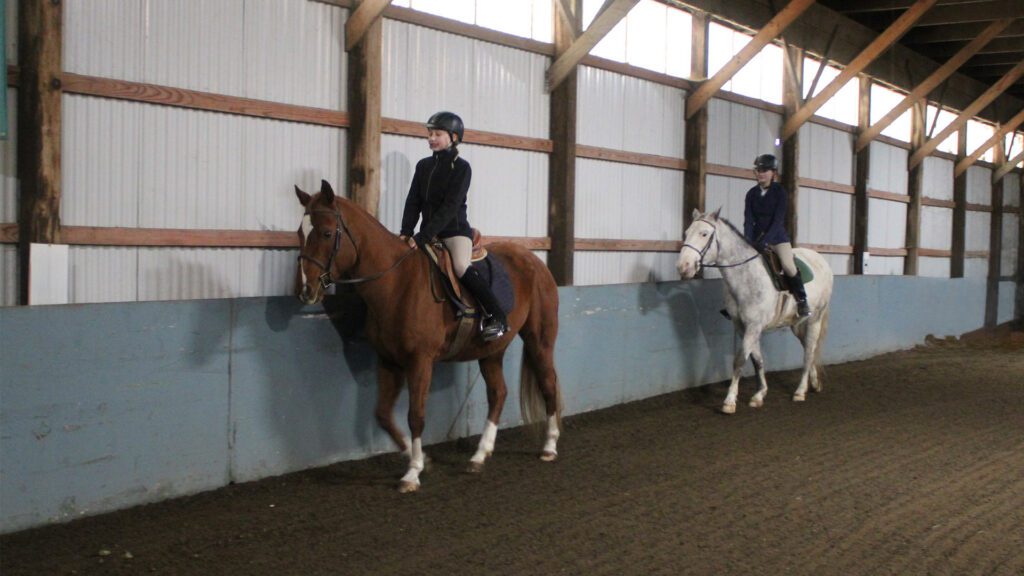
The trot is the ideal gait with which to begin developing this skill. It produces the greatest amount of redundant vertical motion available for conversion, making it an ideal laboratory for learning true motion management from the half seat. At the trot, the rider can fully engage the body’s available systems and refine their coordination with precision.
Complete the process progressively. Begin at the walk, engaging primarily from the core upward to establish fluid horizontal motion. Return to the trot, now employing your full physical facility. Finally, apply the same principles to the canter, where a smooth, silky half seat brings the entire exercise to fruition.
And always remember:
Ride with intent — it will carry you toward your true destination.
For inquiries, call: 716-667-7669 or visit: www.orchardparkequestrian.com.