I often get asked about wildlife issues, including animal sightings on properties. I would like to take this opportunity to clarify and help with guidelines on Nuisance Animals. I’m not a Nuisance Wildlife Control Operator (NWCO) in the State of New York, but I do have knowledge of the behavior and am familiar with NYS regulations for the common animals we see in our backyards on an intermittent or daily basis.
New York State Department of Environmental Conservation (NYSDEC) defines “Nuisance” or “Damaging” Animals as the following:
Nuisance Wildlife– A wild animal that may cause property damage, is perceived as a threat to human health or safety or is persistent and perceived as an annoyance. Examples include a skunk or fox living under the porch or shed. If an animal is not causing any concern, for example, it is simply passing by, is observed only once or twice and does not cause any harm, then it should not be considered a nuisance.
Damaging Wildlife– A wild animal that damages property, for example, digs up your yard, eats your landscape plants or vegetable garden, kills or threatens your livestock or pets, fouls your lawn, eats the fish in your pond, damages your home, etc.
RELOCATING NUISANCE ANIMALS
The other issue is relocating a nuisance animal after it has been caught in a live trap. NYSDEC rule states:
It is illegal for you to move or relocate an animal off your property. You cannot live-trap an animal and release it in a park, on State land, or anywhere other than on the property where it was captured. If you need a wild animal removed from your property, contact a Nuisance Wildlife Control Operator (NWCO). Relocating an animal can create problems for neighbors, spread diseases like rabies or Lyme disease, and cause unnecessary stress to the animal. This task must be handled by a licensed professional.
I bring this up because I was told on several occasions that Norway Rats were being caught in live traps and released. Rats are transporters of pathogens and parasites, and they host ectoparasites such as mites, fleas, lice, and ticks. When you move these rodents, you are also moving the ectoparasites with them. I have been contracted to solve rat issues for homeowners in numerous area towns, and there has been an uptick in rat activity. If you are experiencing rat activity on your property, it is important to address the situation promptly and systematically before it spreads to other properties. Rat control does not require a Nuisance Wildlife Control Operator to solve the issue; it falls under General Pest Control Licensing.
DEALING WITH TERMITES
“Unseen Pests” are found in the ground, and I am referring to termites. As we get closer to the spring warm up, termites become the “unseen pest” of the season.
For many years, the conventional method of treating termites was to apply a curtain application of a pesticide in the soil along the perimeter of your foundation for the whole house. This is a very expensive solution, costing $2,500 to $5,000 and yearly inspection fees.
The good news is that termite treatments have come a long way. Termite monitoring and termite baiting have become the norm.
Termite bait stations do not attract termites to your home but rather intercept them as they complete their natural foraging behavior and before they find your home. Once termites have entered the station, we would install the active ingredient Trelona® from BASF in a compressed termite bait solution to eliminate the termites. This process of colony elimination ensures your home is protected now and in the future.
How are stations installed? Termite bait stations are strategically installed around the perimeter of your home, typically in landscape beds adjacent to the home. Installation requires digging 2.5- to 3-inch-diameter, one-foot-deep cavities into the ground. These cavities are placed approximately 10–20 feet apart. Once the cavities are created, the stations are placed in them. Inspection and station maintenance are required, and service frequency is determined by the type of landscape along the house’s perimeter.
Termite bait stations can be used as a monitoring system or a remediation system on the perimeter of the house. Home inspections consist of looking for termite mud tubes, damaged wood members, or other conducive conditions that could lead to termite activity and making recommendations on how to remove the conducive conditions.
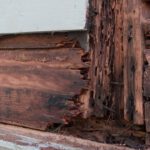
As shown in this photo, termite damage was found after a swarm of termite-winged reproductives showed up on a spring day.
Our homes are our biggest investment, and given the high costs of building materials and labor needed to repair damaged buildings, it is far less expensive in the long run to inspect and maintain what we have rather than replace it. I’m always available for questions via email at pestguardpro@gmail.com.
Any content, resident submissions, guest columns, advertisements, and advertorials are not necessarily endorsed by or represent the views of Best Version Media LLC (BVM) or any municipality, homeowners associations, businesses, or organizations that this publication serves. BVM is not responsible for the reliability, suitability, or timeliness of any content submitted, inclusive of materials generated or composed through artificial intelligence (AI). All content submitted is done so at the sole discretion of the submitting party.