“The Galápagos Islands are probably the most famous wildlife-watching destination in the world. And no wonder − it’s impossible to exaggerate the sheer spectacle of the place that provided inspiration for Charles Darwin’s ground-breaking theory of natural selection.” –Mark Carwardine, British Zoologist
Some places are beautiful. Others are memorable. And then there are places like the Galápagos Islands—places that quietly, profoundly change you.
I’ve been twice, and I’m going back again—this time with my husband, our children, and our grandchildren to celebrate a milestone birthday. Of all the places in the world we could go, this is the one that felt right. Not because it’s flashy or luxurious, but because it offers something far more meaningful.
Located about 600 miles off the coast of Ecuador, the Galápagos are remote, raw, and wildly beautiful. Volcanic landscapes meet turquoise water, and every island feels a little different from the last. But what truly sets this place apart is the wildlife—and the way you experience it.
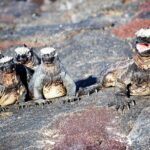
Animals here simply don’t fear humans. With no natural predators, they’ve never had to. That means you’re not observing from afar—you’re part of the moment. You can stand beside marine iguanas warming themselves on black lava rock, watch blue-footed booby perform their endearingly awkward mating dance, or snorkel alongside playful sea lion pups. On one trip, my husband spent nearly 30 minutes swimming with a sea lion that just…stayed. Darting, circling, coming back again. It wasn’t us seeking out the wildlife—it was the wildlife inviting us in.
The timing of your visit shapes what you’ll see and feel. The warm, wet season (December through May) brings calmer seas and clearer water, which makes snorkeling especially incredible. This is when sea lions are at their most playful in the water, and you’ll often find them eager to interact. It’s also a time of courtship—those blue-footed boobies showing off, and other species actively nesting and raising young.
In the cooler, dry season (June through November), things shift. The water is richer in nutrients, which draws in more marine life—bigger fish, more activity below the surface. On land and in the air, it’s a dynamic time for birdlife, with waved albatrosses and other seabirds in full breeding cycles. You’ll notice more dramatic behavior—feeding, nesting, competing. It feels a bit more wild, a bit more intense.
Days in the Galápagos Islands fall into a natural rhythm that’s both active and deeply immersive. Mornings might begin with a guided hike across lava fields or along coastal trails, where every step reveals something unexpected—iguanas blending into the dark volcanic rock and nesting birds just feet away. By midday, you’re slipping into the water for a snorkel, often surrounded by curious sea lions or schools of vibrant fish. Afternoons can bring kayaking along quiet shorelines or zodiac rides that get you eye-level with the wildlife. In between, expert naturalists share stories, science, and insights that bring everything into context—turning what you’re seeing into something you truly understand. It’s a perfect balance of movement, discovery, and those quiet moments where you just stop and take it all in.
Of course, the islands are forever linked to Charles Darwin, whose observations here helped shape the theory of natural selection. But this isn’t something you just learn about—it’s something you see unfold in real time. The Galápagos truly are a living, breathing classroom of evolution.
For me, though, the impact of this place goes far beyond science. There’s something deeply humbling about being in an environment so untouched, so delicately balanced. It made me slow down. Pay attention. Think about my role in all of it. I came home more aware—of what I consume, how I travel, and how small choices matter. It didn’t feel like a dramatic shift in the moment, but over time, I realized it had changed how I see the world and my place in it.
That’s why bringing my family back feels so important. This trip is a gift—but not in the traditional sense. It’s not about the destination or the cost. It’s about sharing something meaningful together. Watching my grandchildren experience this kind of wonder, seeing my children connect with it in their own way—that’s the kind of richness you can’t put a price on. It’s a shared memory that becomes part of who you are as a family.
I’ve traveled with Lindblad Expeditions in partnership with National Geographic, and it is, without question, a superior way to experience the islands. The depth of knowledge, the access, the guides—it elevates everything. That said, there are many ways to experience the Galápagos, and as a travel advisor, I love helping people find the right fit—whether that’s a luxury expedition, a smaller vessel, or a more budget-conscious option. The magic of the islands isn’t limited to one style of travel—it’s available to anyone willing to go.
And once you do, it stays with you.
“It is not the strongest or the most intelligent who will survive, but those who best manage change.” — Charles Darwin
Any content, resident submissions, guest columns, advertisements, and advertorials are not necessarily endorsed by or represent the views of Best Version Media LLC (BVM) or any municipality, homeowners associations, businesses, or organizations that this publication serves. BVM is not responsible for the reliability, suitability, or timeliness of any content submitted, inclusive of materials generated or composed through artificial intelligence (AI). All content submitted is done so at the sole discretion of the submitting party.