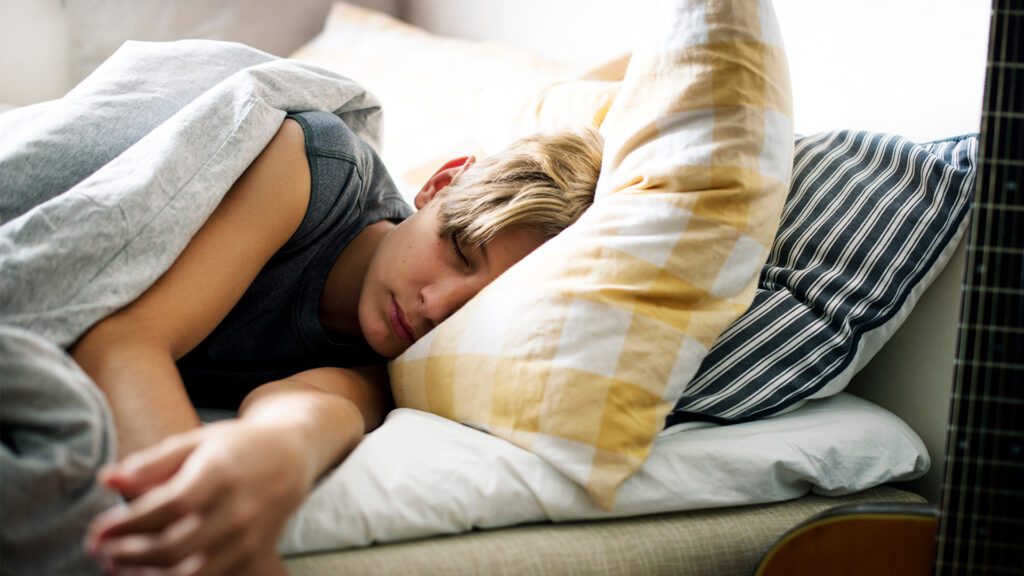
“What’s an appropriate bedtime for my 6th Grade child?” This question came to me at a 5th and 6th Grade parent coffee at my school a few years ago, and it took me by surprise. While I had expected questions about the curriculum, the interscholastic sports program, or instrumental music, bedtime was not a frequent topic at this type of meeting. I almost always advise parents not to simply accept the oft-repeated adolescent complaints (“But NOO-body else has to…” or “But EVV-erybody…) and encourage them to check in with other parents. On this one, I suspected there were so many variables that clear answer might be elusive.
As it turns out, there is helpful guidance when it comes to students and their sleep patterns. Here is a summary worth sharing:
- Toddlers (age 1–2) need 11–14 hours of sleep in every 24-hour period, including naps.
- Pre-school children (ages 3–5) need 10–13 hours (again, including naps). Daily naps typically phase out by about age 5.
- Children ages 5–12 need 9–12 hours per night in order to operate at peak performance.
- Teenagers (possibly our most sleep-deprived population) need between 8 and 10 hours of sleep per night.
According to the CDC, somewhere between 77% and 86% of teenagers get insufficient sleep on school nights. The resulting sleep deprivation can have broad effects on a student’s ability to be successful in the classroom and in athletics and arts activities. On the academic side, lack of sufficient sleep can affect attention, abstract thinking, creative problem-solving, mental sharpness, and memory. On the more physical side, sleep deprivation can affect motor function, delay auditory and visual reaction time, and even diminish cardiovascular performance and endurance. Thus, failing to get enough sleep can diminish all aspects of a student’s experience in school, in activities, and behind the wheel.
Teenage sleep deprivation is complicated and compounded by the fact that adolescents’ circadian rhythms (body clocks) truly change during these years. Teens’ biological “night” actually begins and ends later than it does for their parents. Just visit any college dorm at midnight and you’ll see the natural (perhaps nocturnal) habitat of the late adolescent in full flower!
Still, there are a few basic patterns that will help you help your child to be a better sleeper (and by extension, a better student, athlete, musician, and even conversationalist!):
- Bedrooms should be cool and dark
- Bedrooms should be free from computers and TVs
- Late-night cell phone use, texting, and social media scrolling can keep teenagers up for hours, so limiting them by whatever means are at your disposal is a wise choice
- Avoid caffeine beginning in the late afternoon (yes, even chocolate counts)
- Strive to have a consistent bedtime, wake up time, and routine. (good luck!)
- Give your children 30–60 minutes of down time before going to bed (no TV or computer)
- Separate work areas and sleep areas; avoid using the bed as a study space.
Though the challenges for parents in today’s world of instantaneous worldwide connectivity are very real, creating strong sleep habits will pay dividends for your family.
We often think of success as an A-to-Z journey — but for teens, it often begins somewhere closer to Z.
Mark Heller is Head of School at Academy at the Lakes, a PreK3 – 12th grade independent school in Land O’Lakes. Learn more about Academy at the Lakes by visiting www.academyatthelakes.org.
Any content, resident submissions, guest columns, advertisements, and advertorials are not necessarily endorsed by or represent the views of Best Version Media LLC (BVM) or any municipality, homeowners associations, businesses, or organizations that this publication serves. BVM is not responsible for the reliability, suitability, or timeliness of any content submitted, inclusive of materials generated or composed through artificial intelligence (AI). All content submitted is done so at the sole discretion of the submitting party.