When most people look at a tree, they notice the leaves, the shade, or the overall shape. What often goes unnoticed is something that plays a much bigger role in the long-term health and safety of the tree: its branch structure.
Branch structure refers to how limbs grow and attach to the trunk and to each other. A well-structured tree distributes weight evenly, grows predictably, and is much more likely to withstand wind, snow, and ice. Poor structure, on the other hand, creates weak attachment points that can eventually fail under the tree’s own weight.
Many of the tree failures we respond to aren’t caused solely by storms. In many cases, the real issue began years earlier as the tree developed poor structural form. One of the most common problems is something called co-dominant stems. This happens when two large stems grow from the same point and compete to become the main trunk. Instead of one central leader, the tree ends up with two heavy stems pushing against each other. Often bark becomes trapped between them, preventing the wood from forming a strong connection.
As the tree grows larger, the pressure at that junction increases. Eventually, the tree reaches a point where the structure can’t support the weight anymore and one of the stems splits away.
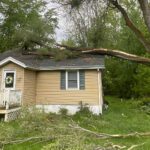
Several of the photos shown here are examples of that type of failure. Large limbs or leaders have broken out of otherwise healthy trees, sometimes landing on homes or nearby structures. These breaks often seem sudden, but the structural weakness usually existed long before the failure occurred.
The good news is that many structural problems can be prevented early in a tree’s life. Structural pruning on young trees helps guide proper growth by encouraging one dominant trunk and well-spaced branches. Removing or reducing competing stems while they are still small allows the tree to develop stronger attachments as it matures. Even mature trees can sometimes benefit from structural pruning. While major structural defects can’t always be completely corrected, careful reduction of certain limbs can help redistribute weight and reduce the likelihood of breakage.
Trees are long-term investments in a landscape. With proper structure, they can provide shade, beauty, and value for generations. But like any structure, they rely on a strong framework to hold everything together.
Taking the time to evaluate and maintain branch structure today can help prevent major problems tomorrow – and keep your trees standing strong for years to come.
Any content, resident submissions, guest columns, advertisements, and advertorials are not necessarily endorsed by or represent the views of Best Version Media LLC (BVM) or any municipality, homeowners associations, businesses, or organizations that this publication serves. BVM is not responsible for the reliability, suitability, or timeliness of any content submitted, inclusive of materials generated or composed through artificial intelligence (AI). All content submitted is done so at the sole discretion of the submitting party.