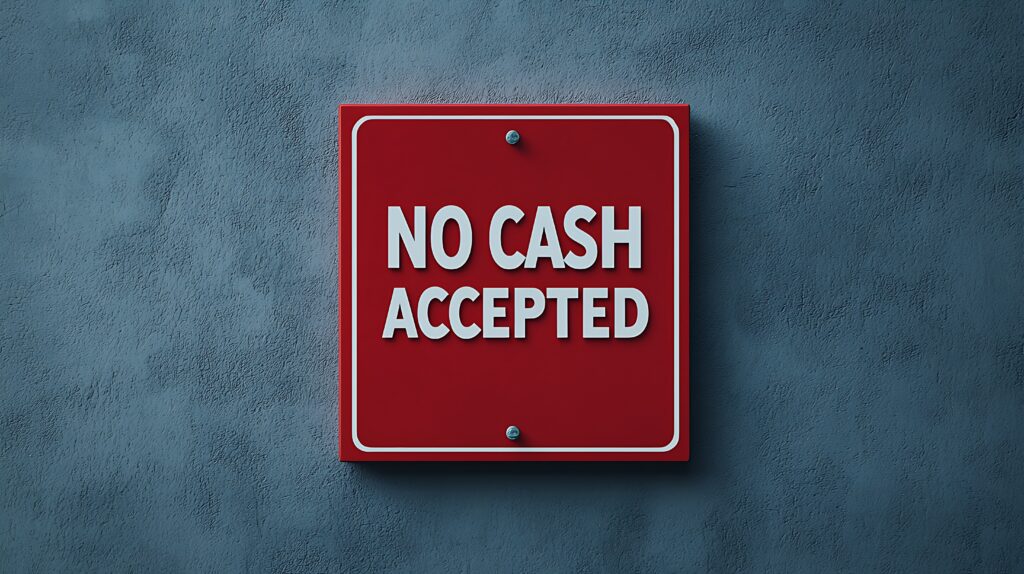
I was at a gas station recently when a simple sign caught my attention: “No Cash Accepted.” The message lingered with me longer than I expected.
In my practice, for years now, we have had many clients ask – often from a place of genuine concern – “What is the trend toward digitizing currency?” Most people immediately think of cryptocurrency or government-issued digital money. But the truth is more subtle and closer to home: Our Canadian currency has already been evolving into a digital space, and today we are seeing that shift unfold in everyday life.
Legal Tender Does Not Mean Mandatory Acceptance
Contrary to popular belief, businesses in Canada are not legally required to accept cash for everyday purchases. While Canadian bank notes and coins are legal tender, that status applies primarily to the payment of debts – not to routine retail transactions.
The Bank of Canada states this clearly:
“There is no law that requires anyone to accept cash as a form of payment.” (Source)
In simple terms, when you buy something in a store, café, or gas station, you are entering into a private transaction. As long as a business clearly posts its payment policy in advance, it may choose how it accepts payment – including card-only or digital-only options.
What the Cashless Trend Ultimately Signals
The growing refusal of cash does not mean that cash will disappear tomorrow. Instead, it signals a structural shift in how value moves through the economy.
Physical money is losing its central role not because governments have banned it, but because digital systems are faster, cheaper, and increasingly built into everyday life.
There are also practical safety considerations. If cash is lost or stolen, it is gone for good. Digital payments, on the other hand, often come with protections:
- Lost or stolen cards can be cancelled
- Unauthorized charges can often be reversed
- Transactions create records that can be reviewed or questioned
In many ways, this has changed how people think about financial security.
We’re Already Using Digital Money – Often Without Realizing It
One important truth is that most of us already rely on digital payments, even if we don’t think of them as “digital currency.” Examples include:
- Debit cards at grocery stores
- Automatic bill payments
- Online banking to check balances or deposit cheques
- Interac eTransfers to family members or service providers
These systems reduce the need to carry cash, visit bank branches, or handle exact change – and they quietly shape how money flows through the economy.
Convenience Is Reshaping Consumer Expectations
Digital payments have fundamentally rewired how people think about money. Speed, ease of use, and seamless integration into daily routines increasingly outweigh the familiarity of physical cash.
Mobile wallets, tap-to-pay cards, and app-based payments enable transactions in seconds – often without opening a wallet or interacting with a cashier.
For younger consumers in particular, digital payments are not just an option; they are the default. The U.S. Federal Reserve has found that adults aged 18-24 now use mobile devices for nearly half of all their payments, while cash increasingly serves as a backup rather than a primary method. (Source)
These habits, formed early, are shaping how businesses design their payment systems—and influencing which payment methods remain viable.
A Frictionless Future – With Tradeoffs
The momentum toward a digital currency future is not ideological; it is practical. Consumers choose convenience. Businesses choose safety and efficiency. Governments follow usage patterns to maintain relevance and stability.
At the same time, the features that make digital money attractive – speed, traceability, and automation – also raise important questions about privacy, accessibility, and resilience during system outages.
As cash acceptance continues to shrink, ensuring that convenience and safety do not come at the expense of choice will be one of the defining challenges of the next phase of monetary evolution.
Any content, resident submissions, guest columns, advertisements, and advertorials are not necessarily endorsed by or represent the views of Best Version Media LLC (BVM) or any municipality, homeowners associations, businesses, or organizations that this publication serves. BVM is not responsible for the reliability, suitability, or timeliness of any content submitted, inclusive of materials generated or composed through artificial intelligence (AI). All content submitted is done so at the sole discretion of the submitting party.