As America prepares to celebrate its 250th anniversary, travelers are looking beyond famous landmarks and searching for journeys that tell the story of our nation. Few experiences capture that spirit quite like a road trip along Florida’s historic Dixie Highway—the route that helped transform the Sunshine State into one of America’s most beloved travel destinations.
Long before GPS, interstate exits, and high-speed highways, adventurous motorists traveled on a patchwork of brick and gravel roads known as the Dixie Highway. Constructed between 1915 and 1929, it became one of the country’s first major road networks, connecting the industrial cities of the Northeast with the warm climate, beaches, and growing communities of the South.
For many Americans, the Dixie Highway represented freedom, discovery, and the promise of adventure. Families packed their cars, left the cold winters behind, and headed south toward Florida’s sunshine. Along the route, roadside motels, citrus stands, diners, and attractions sprang up to welcome travelers. Much of what we now think of as “Old Florida” owes its existence to the tourism boom created by this pioneering roadway.
Although the original highway system was largely replaced after the Federal Highway Act of 1956 ushered in the Interstate era, traces of the Dixie Highway remain throughout Florida. For today’s traveler, following the old route offers a fascinating blend of history, culture, and scenic exploration.
The journey can begin right in the heart of Orlando. From Orange Blossom Trail, travelers head south through Kissimmee and continue along US-17 through Central Florida’s agricultural communities, passing through places like Bartow and Fort Meade before reaching Punta Gorda on Florida’s Gulf Coast. From there, the route follows the famed Tamiami Trail through Naples and onward to Miami, where travelers can reconnect with portions of the original roadway along West Dixie Highway.
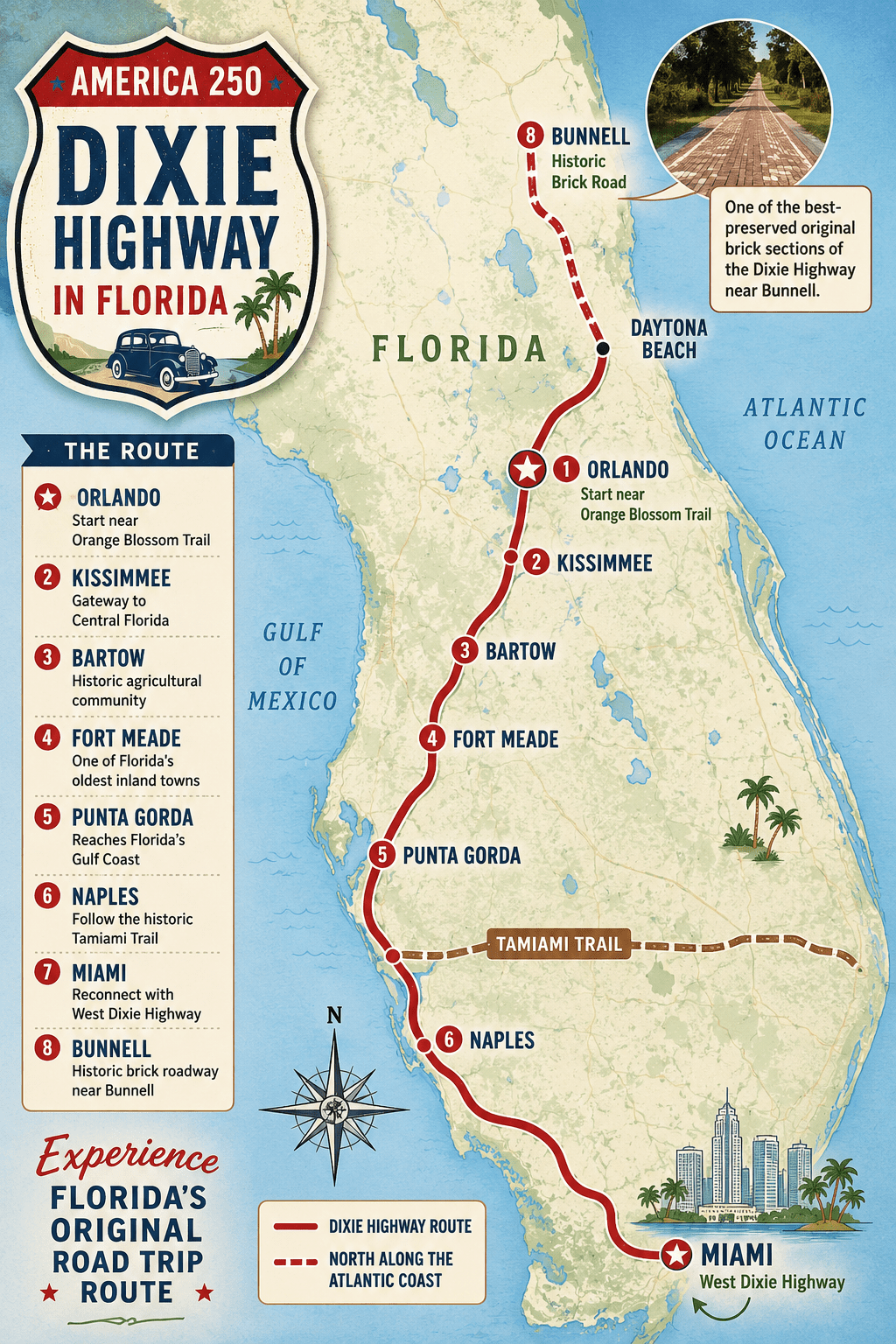
As the journey continues north along Florida’s Atlantic Coast, historic sections of the route weave through charming communities, coastal landscapes, and some of the state’s oldest settlements.
For active and curious travelers, this isn’t simply a drive—it’s an opportunity to experience Florida at a slower pace. Along the way, visitors can explore historic downtown districts, discover local museums, paddle scenic waterways, hike nature preserves, and sample regional cuisine that reflects generations of cultural influences.
One of the most rewarding stops lies near Bunnell, where a surviving section of the original brick roadway still exists. Standing on those century-old bricks offers a tangible connection to the travelers who helped shape modern Florida and the American road trip tradition.
As we celebrate 250 years, journeys like the Dixie Highway remind us that the story of our nation is also found in the roads that connected communities, inspired exploration, and encouraged generations of Americans to venture beyond the horizon. For travelers seeking a road trip rich in history and authentic Florida experiences, retracing the Dixie Highway offers a unique opportunity to drive through the past while discovering the Sunshine State in a whole new way.
Any content, resident submissions, guest columns, advertisements, and advertorials are not necessarily endorsed by or represent the views of Best Version Media LLC (BVM) or any municipality, homeowners associations, businesses, or organizations that this publication serves. BVM is not responsible for the reliability, suitability, or timeliness of any content submitted, inclusive of materials generated or composed through artificial intelligence (AI). All content submitted is done so at the sole discretion of the submitting party.