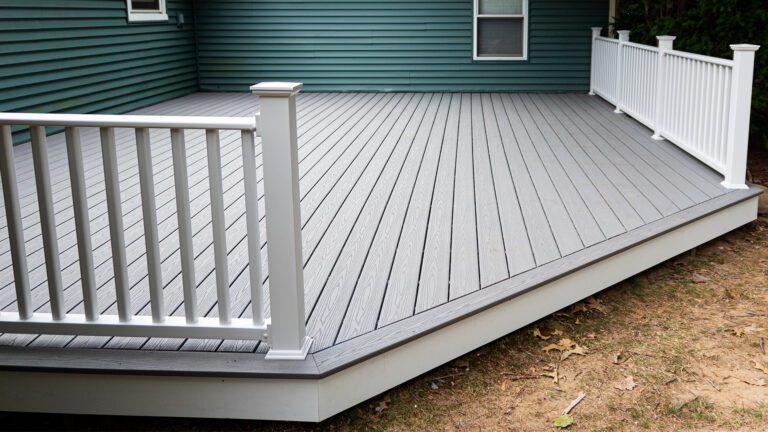
Why the picture frame matters
Walk around a newer neighborhood and you’ll notice many beautiful composite decks. Unfortunately, many of them contain the same shortcut that can shorten the life of the deck’s framing. It’s called running the fascia “tall.”
In this installation method, the fascia board is installed flush with the top of the decking. It creates a clean appearance on day one and saves installation time, but it also creates a narrow shelf where leaves, dirt, pine needles, and moisture become trapped against the rim joist.
Over time, that debris stays wet, keeping constant moisture against one of the most important structural members of the deck. Even today’s pressure-treated lumber isn’t immune to long-term moisture exposure. Eventually, the rim joist can begin to deteriorate long before the decking itself needs replacement.
A better approach is a properly built picture-frame border that slightly overhangs the fascia. That small overhang allows rainwater and debris to fall past the fascia instead of collecting on top of it. The result is better drainage, easier cleaning, and significantly less opportunity for moisture to remain trapped against the framing.
Most composite decking manufacturers illustrate or recommend this style of installation because it promotes proper drainage and accommodates normal expansion and contraction of the decking. It also creates a cleaner, more intentional finished appearance.
Why, then, do so many decks still use the flush fascia method?
The answer is simple: it’s faster. It requires fewer layout considerations and less finish work, helping reduce labor costs. In a competitive market, shortcuts like this can lower the initial price of a project—but often at the expense of long-term durability.
At D2B Decks, we believe homeowners deserve to understand these details before making an investment that should last for decades. Small construction decisions that are invisible on move-in day often become the difference between a deck that still performs well 25 years later and one that requires expensive structural repairs much sooner.
When comparing deck proposals, don’t just ask what decking brand is being used. Ask how the deck is being detailed to manage water. Those answers may matter far more than the color of the boards.
*Deck Details That Matter* is a recurring home improvement series by D2B Decks (formerly D2B Services). While our roots are in full-service remodeling, we’ve chosen to specialize in designing and building decks throughout the Twin Cities because we believe outdoor living deserves the same level of craftsmanship as the home itself.
Any content, resident submissions, guest columns, advertisements, and advertorials are not necessarily endorsed by or represent the views of Best Version Media LLC (BVM) or any municipality, homeowners associations, businesses, or organizations that this publication serves. BVM is not responsible for the reliability, suitability, or timeliness of any content submitted, inclusive of materials generated or composed through artificial intelligence (AI). All content submitted is done so at the sole discretion of the submitting party.