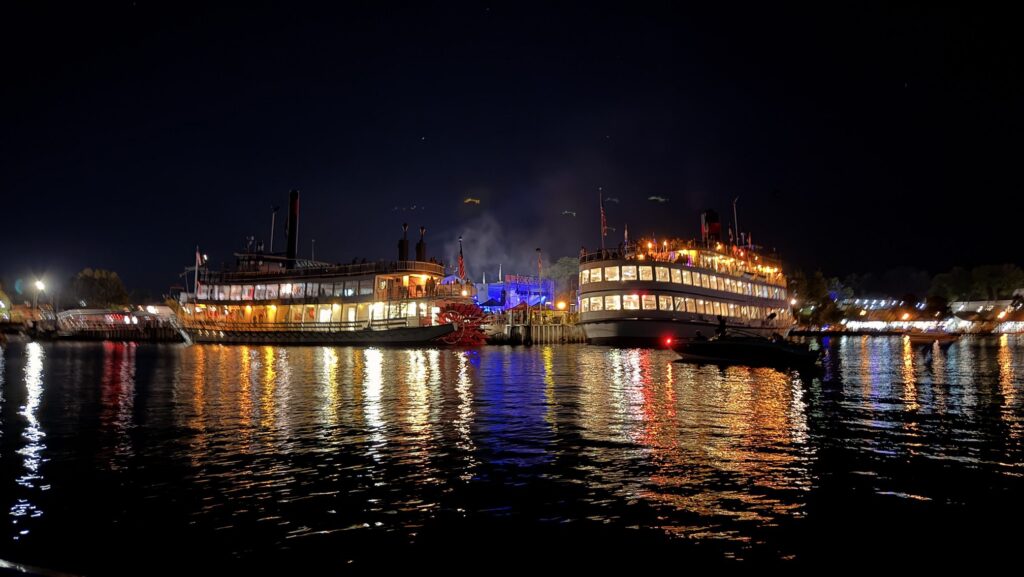
One of the most enjoyable parts of boating on Lake George is spending a beautiful evening on the water. Whether you’re cruising to and from dinner or simply taking in the stars, the sounds, and the islands, there are plenty of ways to enjoy the beauty of the lake after dark.
Much of the Adirondack Park, including parts of Lake George, rates a Class 2 or 3 on the Bortle scale, a measure of just how dark the night sky truly is. That makes our lake one of the best places on the planet to turn your eyes toward the stars.
Still, nighttime navigation is intimidating to many boaters. Caution is healthy, but with the right training and preparation, enjoying the lake after hours doesn’t have to be out of reach. Here are some tips and tricks for boating after dark.
Step 1: Know the Rules
The first step is understanding nighttime regulations, which differ from daytime rules. The maximum speed at night is 25 mph, down significantly from the daytime limit of 45 mph. Your vessel must also be equipped with proper lighting, which includes red and green navigation lights as well as a stern light, and those lights must meet minimum standards for brightness and visibility. That means they can’t be blocked by flags, radar domes, or anything else that would keep other boaters from seeing your navigational markers.
Just as important, avoid turning on additional lighting that could wash out your navigation lights, including docking lights, spotlights, and underwater lights. You might think you’re making your vessel more visible, but you’re actually making it harder for others to judge your boat’s speed, heading, and distance.
Step 2: Keep Your Head on a Swivel and Enlist Your Crew
Even the most trained eyes can miss other boaters at night, which is one of the reasons the speed limit drops so dramatically. Ask your crew to keep watch over your blind spots, but don’t let them replace your own diligence. It’s just as important that you monitor behind you and to the sides to make sure other vessels aren’t closing in. Think of it like defensive driving on the road: being proactive about avoiding accidents keeps everyone safer on the water.
And just because the law requires lighting on all vessels doesn’t mean everyone follows the rules. Assume you’re looking for unlit boats at all times, and you’ll be far more likely to spot them if they’re out there.
Step 3: Start Small
Begin by boating only in areas you’re familiar with. During the day, pick out landmarks you know might be visible at night, and remember where they are. Many vessels have GPS, and it’s certainly a helpful tool. But in the event of a system malfunction or failure, knowing your surroundings is what will get you home.
Even on a dark night, a trained eye can pick out landmass in the foreground as it passes across lit and even unlit land behind it. Learning to read a dark horizon this way is an important skill for identifying islands, peninsulas, and other landmasses, and starting in familiar waters is the best way to build it. As the skill develops, more of the lake will open up to you.
Keep in mind, too, that most buoys on the lake are reflective and become visible in your navigation lights once you’re within about 50 feet. When you suspect you’re approaching a hazardous area or a no-wake zone, bring your boat down to idle speed well in advance so you have time to adjust your heading as you close in.
Step 4: Give Yourself Time and Do What’s Comfortable
One of the best ways to keep your entire crew safe is to give yourself plenty of time. If you’re ever unsure of where you are, the best thing you can do is bring your vessel down to idle speed. There’s no reason to be in a hurry out there at night. Idle speeds are often safest because you can more easily identify other vessels, and you have more time to react before entering areas you shouldn’t. If your guests understand the timeframe before you head out, you won’t feel pressured to rush back to your dock.
Step 5: Make Sure Your Safety Gear Is Up to Snuff
All boats are required to carry fire extinguishers, signal flares, and other safety equipment. Check that none of it is past its expiration date, so it’s ready if you ever need it. Bring a VHF radio along with your cell phone so you have a backup form of communication at the ready, and test the radio the day of your trip by calling for a “radio check” on Channel 16 to confirm you get a reply.
With the right preparation and a little patience, boating after dark can become one of the most rewarding parts of your season on Lake George. Take it slow, know your waters, and enjoy the view.
Any content, resident submissions, guest columns, advertisements, and advertorials are not necessarily endorsed by or represent the views of Best Version Media LLC (BVM) or any municipality, homeowners associations, businesses, or organizations that this publication serves. BVM is not responsible for the reliability, suitability, or timeliness of any content submitted, inclusive of materials generated or composed through artificial intelligence (AI). All content submitted is done so at the sole discretion of the submitting party.