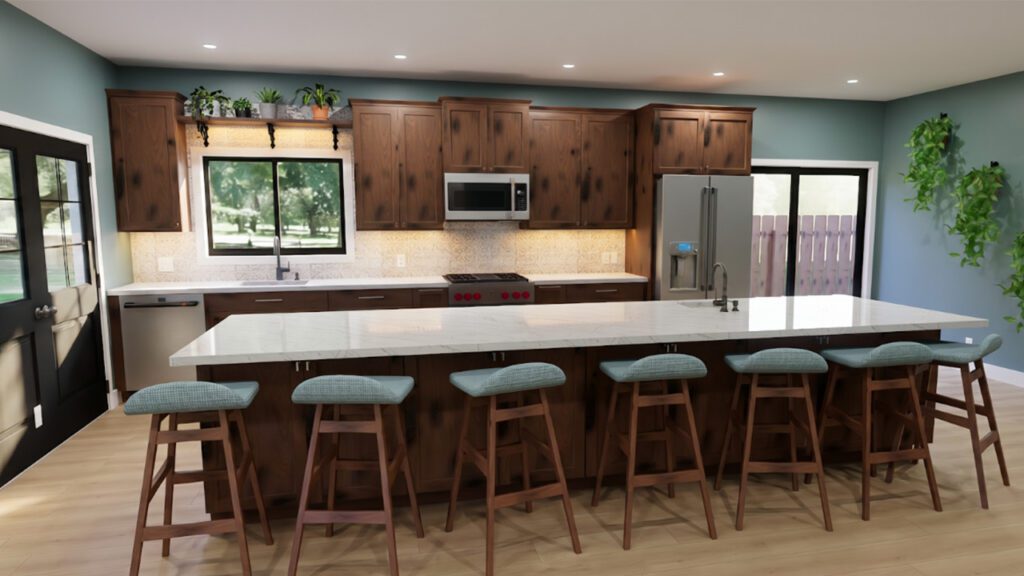
Most of the renovation regrets I see don’t come from bad taste. They come from trying to picture a finished room with a paint chip, a tile sample, and a 2D floor plan that’s hard to read at true scale.
Homeowners fall in love with a countertop in a showroom, a cabinet color in a photo, or a layout on a page, then feel blindsided when the finished space doesn’t match what they had in their head. And by the time it’s obvious you want to make a change, materials are ordered, framing is underway, or the trades have already started.
That’s the gap a 3D rendering is built to close.
A rendering is a realistic digital preview of your space, built from your real floor plan and your real material choices, not a generic inspiration photo. Instead of guessing how cabinets, counters, flooring, and lighting will look together, you can see them together, at true scale, in your own room.
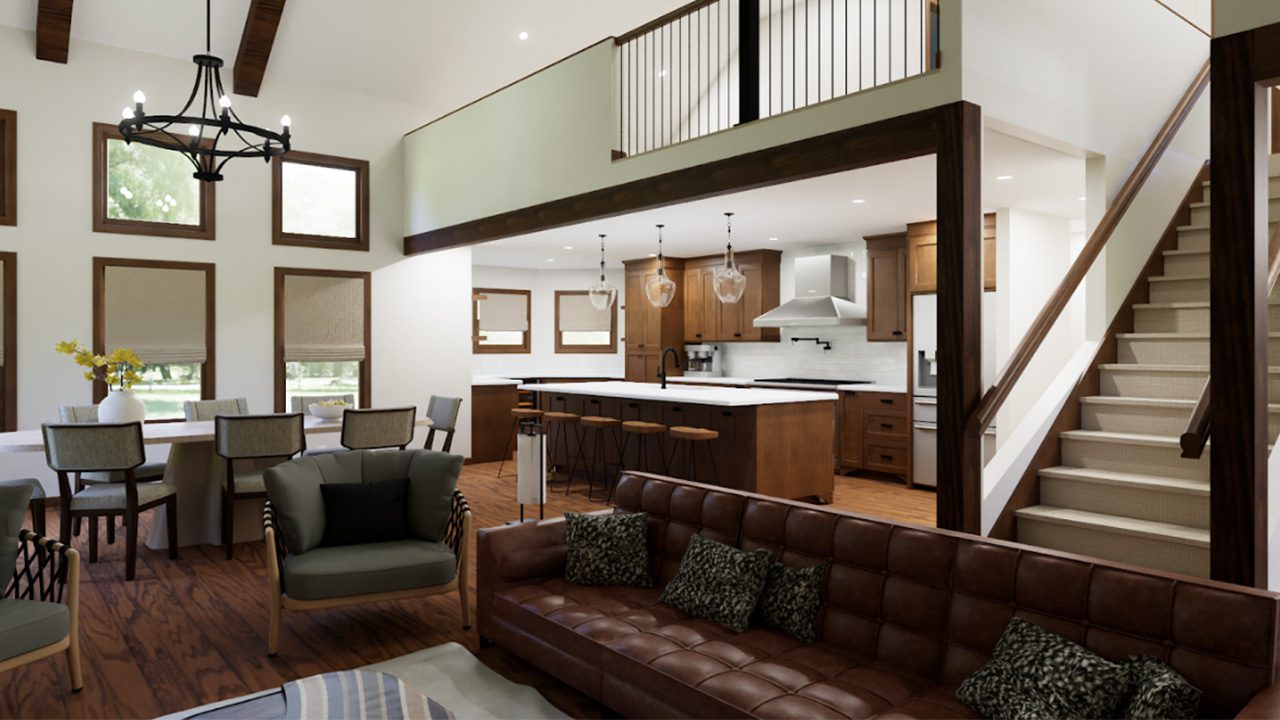
Renderings also help with the part most people forget to plan for: actually, living in the space. Take a dining room. On paper, the table fits. In a rendering, you might catch that once the chairs are pulled out there’s barely room to walk behind them, or that the buffet you love leaves no clear path to the kitchen. How many people can really sit down comfortably? Does the sofa block a walkway? Is there a wall that can hold a media console, or a spot where a Christmas tree can go in December without taking over the room? When you can see the room at true scale, you’re not just choosing finishes. You’re planning how the home will work day to day.
This is also where small, “safe” decisions show their real impact. I worked through a kitchen recently where the homeowners had their heart set on a deep navy island. It’s a beautiful color, and in the showroom it looked perfect. But once we dropped it into the rendering—next to their actual cabinets, under their actual lighting, in a room that didn’t get much natural light—the navy read almost black and made the whole space feel smaller. Seeing that, they moved to a softer color they ended up loving even more. In a rendering, that’s a five-minute change. After the island is built and installed, it’s a very different conversation.
The same goes for a bold tile that overwhelms a narrow kitchen, or a window placed where it quietly kills a good design. A rendering surfaces those things while they’re still easy to change—before anything’s ordered or built.
And the value goes past looks. Every change made after materials are ordered or framing is complete costs something in dollars, time, or both. Catching a scale problem, a color clash, or a layout issue in a rendering keeps it from turning into a change order later. That matters even more when the “guess” is a five-figure kitchen or a whole-house remodel.

This is just as true for new construction. New builds involve dozens of interconnected selections, often locked in months before you can walk through the space. A rendering helps close that gap, so the choices you’re committing to on paper match the life you’re picturing.
At Elevate Consulting Group, renderings are never a stand-alone “pretty picture.” They’re paired with a real floor plan, a clear set of selections, and hands-on coordination with your contractor—so the visual is backed by a plan that’s been checked for function, budget, and buildability.
If you’re planning a renovation or a new build, ask one question before you sign off: Can I see this rendered first?
It’s a simple step that can save you from expensive, stressful corrections later—and help you move forward with confidence.
Jessica Steele is the Founder and Lead Consultant of Elevate Consulting Group, providing 3D renderings, design coordination, and project consulting for homeowners across West Michigan. Reach her at 269-443-1101, jessica@elevateconsultingmi.com, or www.elevateconsultingmi.com.
Any content, resident submissions, guest columns, advertisements, and advertorials are not necessarily endorsed by or represent the views of Best Version Media LLC (BVM) or any municipality, homeowners associations, businesses, or organizations that this publication serves. BVM is not responsible for the reliability, suitability, or timeliness of any content submitted, inclusive of materials generated or composed through artificial intelligence (AI). All content submitted is done so at the sole discretion of the submitting party.