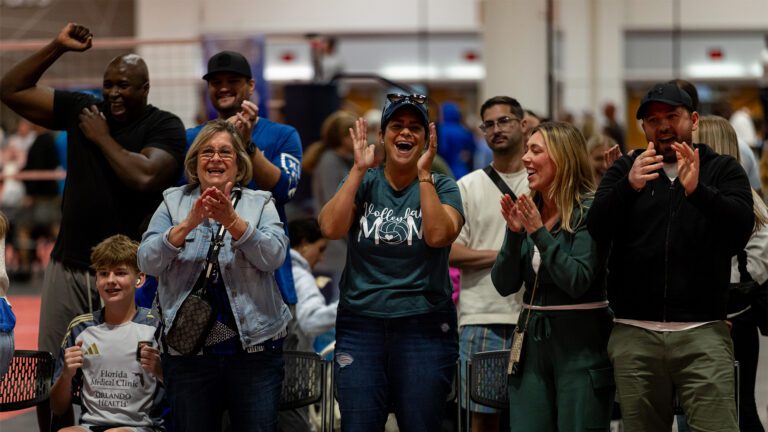
Walk into almost any youth sporting event and you’ll see the same thing: kids competing, coaches coaching, officials trying to manage the game—and parents watching every moment from the sidelines. Parents are an essential part of youth sports. They drive to practices, pay registration fees, buy equipment, rearrange family schedules, travel on weekends, and provide encouragement after both great games and difficult ones. Without their commitment, youth sports simply would not exist in the way they do today. But with that investment can also come pressure.
Having spent much of my life around sports—as a player, coach, parent and now working every day in a youth sports environment—I’ve seen how powerful a parent’s influence can be. And sometimes the most important thing we can do for a young athlete is also one of the hardest: Give them the space to own their experience.
The Game Looks Different From the Sideline
Every parent wants their child to succeed. We want them to make the team, get playing time, perform well, and be recognized for their effort. Those feelings are natural. Problems can begin when a child’s performance starts to feel as important to the parent as it does to the child. Suddenly, every missed shot matters. Every coaching decision gets analyzed. Playing time becomes a source of frustration. The official’s call becomes personal. And the ride home turns into a breakdown of everything that happened during the game. Meanwhile, the young athlete may simply be thinking, Did I have fun? Did I play hard? When do we play again? Sometimes adults make youth sports more complicated than kids do.
Let the Coach Coach—and Let Practice Be Practice
One of the healthiest relationships in youth sports is the one between an athlete and a coach. Young athletes need to learn how to listen to instruction, accept criticism, ask questions, and advocate for themselves. Those skills become much harder to develop when a parent constantly steps in to solve problems. That doesn’t mean parents shouldn’t ask questions or raise legitimate concerns. They absolutely should, particularly when something involves a child’s safety, well-being or treatment. But there’s also tremendous value in allowing a young athlete to approach a coach and say, “What do I need to do to get better?” or “What can I work on to earn more playing time?” That’s not just developing an athlete. That’s developing a young person who is learning to communicate and take responsibility. Another area where we have seen youth sports change is practice.
Today, it is common for parents to watch nearly every minute of every practice. There is nothing inherently wrong with watching your child practice. Parents enjoy seeing their kids participate, and their support is important. But watching can become counterproductive when every drill, coaching decision and mistake is being evaluated from the sideline. A player misses a shot and hears a parent tell them what they did wrong. A coach gives an instruction and a parent offers a different one. A child comes off the court for water and immediately receives feedback about what just happened. Even when the intention is good, imagine being a young athlete trying to process instructions from a coach while also looking toward the sideline for approval—or worrying about what a parent is going to say afterward. Practice needs to be a place where kids are allowed to make mistakes. That’s what practice is for. They should be able to try something new, fail at it, receive coaching, try again and improve without feeling like every repetition is being graded by someone in the stands. Parents can watch. Parents can encourage. Parents can certainly celebrate progress. But during practice, sometimes the best support is simply allowing the coach to coach and the athlete to learn. And when practice ends, every session doesn’t need a post-practice evaluation on the ride home. Sometimes, “How was practice?” is enough.
Be Their Safe Place
Kids already know when they played poorly. They know when they missed the shot, made the turnover or didn’t play as much as they hoped. Most don’t need a detailed analysis before they’ve even left the parking lot. Sometimes the best post-game conversation is simply: “I loved watching you play.” There will be opportunities to talk about effort, attitude and improvement. But immediately after competition, a parent doesn’t always need to become another coach. Kids need someone in their corner regardless of what happened on the scoreboard. Home should be the place where their value isn’t determined by points scored, games won or minutes played.
How We Behave Matters Too
Children watch us. They notice how adults react to officials. They hear what we say about coaches. They see how we treat opposing teams and other parents. And they notice our behavior during practice, too. A parent may believe a quiet comment from the bleachers is harmless, but young athletes hear more than we sometimes realize. Instructions shouted across the court, frustrated body language after a mistake or constant reactions to a coach’s decisions can put a child in an uncomfortable position. Who are they supposed to listen to—the coach or the parent? We can’t ask young athletes to demonstrate sportsmanship, composure and respect while the adults surrounding them demonstrate something different.
The sideline is teaching lessons whether we realize it or not.
Success Looks Different for Every Child
One of the biggest changes in youth sports is how early the conversation about the “next level” can begin. Travel teams, rankings, showcases, social media highlights, college scholarships and professional aspirations can make families feel as though every game—and sometimes every practice—is part of a child’s athletic résumé. But the overwhelming majority of young athletes will not become professional athletes—and that’s perfectly fine. Sports can still give them something incredibly valuable. They can develop confidence. Learn discipline. Build friendships. Become healthier. Discover leadership. Learn how to handle disappointment. Understand teamwork. And create memories they’ll carry for the rest of their lives. Those aren’t consolation prizes. Those are some of the greatest outcomes youth sports can provide.
Creating the Right Environment at Wiregrass Ranch
At Wiregrass Ranch Sports Campus, we have the privilege of seeing thousands of young athletes and families come through our doors. We want our campus to be a place where athletes can compete at a high level, but we also want it to be an environment where kids can learn, grow and enjoy sports. That requires everyone—coaches, officials, staff members and parents—to play a role. We want parents to cheer. We want packed sidelines and enthusiastic families. We want kids to feel that excitement when they make a great play and hear their family celebrating. But we also want the experience to remain theirs. There is a difference between supporting the journey and controlling the journey.
Sometimes the greatest contribution a parent can make is simply being present, encouraging effort, respecting the people involved and allowing their child to experience the ups and downs that come with competition. That includes giving them something that can be increasingly difficult to find in youth sports: room to learn without feeling like they are constantly being evaluated.
Years from now, most kids won’t remember the score of a Saturday morning game. They probably won’t remember every basket they made, every drill they completed or every mistake they committed. But they will remember how sports made them feel. And they’ll remember who was standing on the sideline cheering them on.
Let’s make sure that’s a memory worth keeping.
813.939.5902 | info@playwiregrass.com | www.playwiregrass.com
Any content, resident submissions, guest columns, advertisements, and advertorials are not necessarily endorsed by or represent the views of Best Version Media LLC (BVM) or any municipality, homeowners associations, businesses, or organizations that this publication serves. BVM is not responsible for the reliability, suitability, or timeliness of any content submitted, inclusive of materials generated or composed through artificial intelligence (AI). All content submitted is done so at the sole discretion of the submitting party.