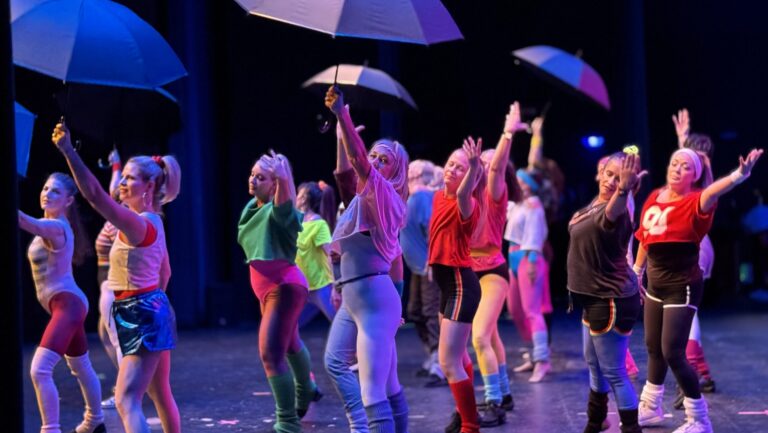
Why do so many adults who dance have that extra sparkle in their eyes and bounce in their step? Have you ever seen a vivacious, silver-haired human out in the world and found out they are, or were, a dancer and thought, “ahhh, that explains it.” Dancers are just…ALIVE.
In the last two decades, researchers at Harvard, Columbia, and the National Institutes of Health have published articles with titles like “Dance and the Brain,” and ”Dancing Combines the Essence for Successful Aging.” Neuroscientists are demonstrating what many of us, including the fifty-two dancers at Joy in Motion between the ages of 50 and 75 already know–dance is a total mind-body-social-emotional elixir!
Dance is an investment in your LIFEspan.
- Use It or Lose It – Muscle and Bone
Dancing puts your whole body weight on one leg at a time and involves small hops, jumps, or pivots moving from one direction to another. This impact loads your tissues and triggers your body to build denser bones and stronger muscles. Dancing on sprung studio floors especially keeps it low-impact enough to reduce injuries while also toning the smaller joint-stabilizing muscles in the legs.
- Fall Prevention and Vestibular Training
When you practice weight shifts and directional changes while dancing, you are also increasing your chances of being able to catch your balance should you start to stumble in your everyday life. Dancing also gives your brain practice interpreting input from your vestibular-cochlear nerve. When you practice hearing music while rotating your head and changing levels from high to low while dancing, you train your brain to process multiple inputs without getting dizzy in everyday situations.
- Short-Term Memory Practice and Dementia Risk-Reduction
Remaining physically active is already an across-the-board lifespan benefit, but remembering choreography in a dance class–especially under the gentle pressure of keeping up with the music–is a mental workout unparalleled by other leisure activities like walking, tennis, golf, cycling, and swimming, said one Harvard study. A 2003 New England Journal of Medicine article reported people who danced in their 70s showed a 76% lower risk of developing dementia within the five years of the study compared to the people who didn’t dance.
Dance is an investment in your JOYspan.
- Happy Hormones
There are also hormonal benefits to dance that go deeper than what you would get during a gathering with friends. Science is showing us that hearts begin beating together with other dancers, and breathing can also begin to sync, leading to physiological co-regulation that feeds our mammalian selves, releasing both oxytocin and endorphins–the JOY hormones!
- Social Network & Quality of Life
Humans that dance with heartbeats and breaths synchronized register a profound sense of interconnectedness. Dance acts as a “biological handshake” of safety and can rapidly build trust and empathy, even among complete strangers. Making new friends as an adult can be hard, but dance can be an accelerated bridge to a social network, which research shows is more important to your quality of life as you age than other factors such as cholesterol levels, IQ, genetics, or social class.
Any content, resident submissions, guest columns, advertisements, and advertorials are not necessarily endorsed by or represent the views of Best Version Media LLC (BVM) or any municipality, homeowners associations, businesses, or organizations that this publication serves. BVM is not responsible for the reliability, suitability, or timeliness of any content submitted, inclusive of materials generated or composed through artificial intelligence (AI). All content submitted is done so at the sole discretion of the submitting party.