A Cure for Your Pipes
Are you experiencing sewer issues but dread the idea of excavating, cutting concrete, or destroying your beautiful landscaping? Well, fear not! CIPP Lining, or Cure-in-Place Pipe Lining, might just be the perfect solution for you.
What is CIPP Lining?
CIPP Lining has been around for nearly five decades, and it offers a fantastic way to repair existing, damaged pipes without the need for excavation. This method is particularly beneficial when the defective piping lies beneath a patio, porch, section of basement floor, or in commercial buildings such as hospitals or gymnasiums. Imagine avoiding the mess, noise, and significant repair costs associated with traditional pipe repair methods!
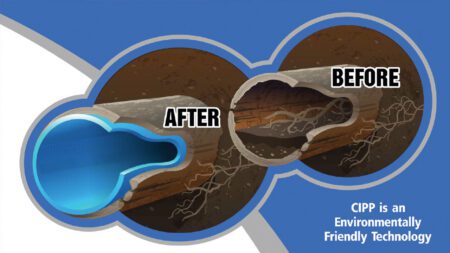
Beyond minimizing disruption and avoiding costly excavation, CIPP Lining helps restore the integrity of pipes affected by leaks, corrosion, and root intrusion. It’s a long-lasting solution that can extend the life of your piping system for up to 50 years or more. Plus, it’s versatile enough to repair various pipe sizes and materials, including clay, cast iron, and concrete, as well as sewer, water, and gas lines.
The CIPP Lining Process
Now, let’s talk about the lining process. It all begins with a thorough inspection and cleaning of your existing pipes by our skilled technicians. Using a camera and high-pressure jetter, they assess the lengths, depths, and condition of your pipes, as well as the number of reinstatements needed. Ideally, the work is done through a manhole or cleanout in the line.
The first step of the process is called the wet-out stage, where a textile liner is impregnated with a resin mixture composed of an epoxy base and a pre-determined hardener. Next, the liner is inverted into the problematic pipe using air pressure, with the resin now on the outside against the existing pipe wall. After inversion, a calibration tube is inserted inside the liner using hot water, steam, or ultraviolet (UV) light to activate the resin and cause it to harden. This creates a smooth, corrosion-resistant new pipe wall.
Finally, if necessary, a robotic cutting device is used to cut any reinstatements for branch line connections off the mainline. A camera inspection is then performed to ensure the liner is installed smoothly, all reinstatements are cut, and the line is open and flowing properly.
So, whether you need to reline piping at your residence, commercial building, or municipal infrastructure, CIPP Lining may be just what you’re looking for. Give Litteken Plumbing Co., Inc. a call at 618-224-2249, and they’ll be happy to assist you.