Advanced Technology in Physical Therapy: BioMechanic Physical Therapy
Why do athletes recover so quickly, and how are the same tools now available to you? Have you ever wondered why professional athletes recover from injuries so quickly? Well, of course, they have access to ultra-expensive, elite technology. Now, most of those same technologies are available in advanced physical therapy clinics.
Just like therapists differ in personality and style, they also differ in treatment approaches. Some rely primarily on exercise, some focus on hands-on techniques, and some, like me, blend manual therapy with the most effective modern technology available. During my 30+ years of hands-on practice, I’ve seen fads come and go, but the newest wave of technology is genuinely impressive. Some older technologies remain excellent, but newer tools have elevated what’s possible in healing. Let’s have a look.
Real LASER Therapy: Beyond Red Light
Many people are familiar with simple red-light therapy, from infrared saunas to wearable beanies, to those used by massage therapists. Those typically use basic red light, a class III laser. Technology has gone far beyond that. Class IV lasers deliver a lot of “wow.” They emit more energy at a faster rate and use multiple wavelengths, which cuts healing time in half for both bone and soft tissue. It does this by altering the healing cascade, pain reduction and tissue regeneration.
These lasers are powerful enough to heal nerves, something only a few devices can do. Class IV lasers are hard to find due to the expense of the equipment (we have only two in Virginia Beach), but treatments are not as pricey as you might think, typically about $60 per visit. Comparable to “a lunch out,” not hundreds of dollars. Because of the cost, only clinics that truly invest in high technology have them. A common brand of these lasers is called an MLS laser and can be combined with Shockwave for even more impressive results. Eighty percent of people feel 80% better after one treatment.
Shockwave Therapy: A Game Changer for Chronic Problems
Shockwave is quickly becoming known as a device that “treats almost everything,” especially stubborn, chronic issues that haven’t responded to traditional care. It is commonly used to help people avoid surgery, including those facing joint replacements or back surgery. Research shows Shockwave becomes even more effective when paired with an MLS laser.
Shockwave works by sending high-energy acoustic waves into the tissue. The rapid increase and decrease in pressure is a little uncomfortable, but impressively stimulates healing, breaks down scar tissue, improves blood flow and reduces pain. It even helps regenerate tissue. (As a bonus: it can also help with cellulite and wrinkles.) Immediate effects of shockwave include increased blood flow, pain reduction/numbing and improved mobility in stiff areas. Long-term effects (3–5 visits) include tissue regeneration, breakdown and “cleanup” of scar tissue, improvement in oxygenation, bone growth and nerve healing. Shockwave is more like “a dinner out,” often running $150/visit.
Automated Ultrasound Therapy: Massaging with Sound Waves
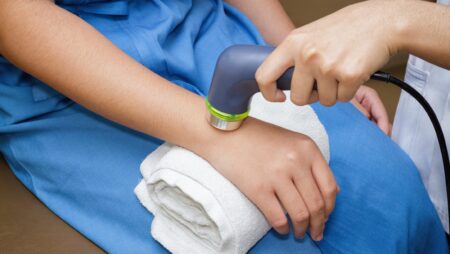
You may have had an ultrasound in physical therapy. It used to be used for heating, but its actual valuable effects are speeding the remodeling of injured and scarred tissue and impressively moving fluid. It can flush away an old bruise in a day, meaning lots of toxins get pushed out of the area. Blood in the form of a bruise can be damaging to tissues, so this is a great ingredient for getting better faster. This is another tech that is hard to find, but if you do, the cost is paid for by your insurance, so no extra charge. Free lunch?
Iontophoresis: Steroids Without Needles
Using a small, battery-driven machine, Iontophoresis is a technology that uses electrical current to deliver corticosteroid (the same medication used in joint injections) directly to injured tissue. This method painlessly delivers it locally, not into your bloodstream, making it a great option for tendonitis, bursitis, arthritis, plantar fasciitis and rotator cuff. It noticeably reduces pain and inflammation in 1–4 treatments. This one will run you about $20 extra per visit. Starbucks?
Vibration Plates: Small Effort, Big Neuromuscular Payoff
Vibration platforms are increasingly popular in physical therapy. Rapid oscillations trigger small involuntary muscle contractions, which increase muscle activation by 40% more than performing an exercise on the floor. This makes even simple movements on the platform much more effective. It improves balance and stability for your whole body or an isolated joint, such as your shoulder.
This can also be useful for older adults, people struggling with balance issues, or those with neuropathy. It boosts local circulation and lymphatic flow, helping reduce stiffness and swelling.
And just one more thing: It supports bone health, so it is a valuable therapy for those with osteoporosis or osteopenia. Cool factoid, astronauts use vibration training to maintain bone density. This one counts as exercise, so the cost is covered by insurance.
Compression Sleeves with Ice and Air: A New Team
Although compression and ice have been used forever in physical therapy, technology has added a new twist by teaming the two. You may have seen this at tournaments or fairs. These inflatable systems combine cold therapy with pressure to reduce swelling and improve recovery after a game, injury or surgery. This is another one covered by insurance.
And How About You?
So compare what you have had in the past to a professional sports player’s PT. It would include heat and electricity, ice and compression, exercise with vibration or electrical assistance, sound and light, lasers and shockwave. Individually, these tools cut healing time by more than half. Combined — that’s when you see the athlete back in no time. Just take note. Physical therapy has evolved. Look for a clinic near you that keeps up by investing in the latest technology, and you too can heal as fast as your favorite player.