Resetting the Rhythm: How Vibroacoustic Therapy Calms the Stress Response and Restores Balance
In a world that’s always “on,” rest has become a lost art. Chronic stress, anxiety, and fatigue are so common that most people can’t remember what true calm feels like. Our nervous systems stay overstimulated, our muscles tense long after the stressor is gone, and sleep often feels shallow and restless.
But what if the key to restoring balance isn’t through willpower or medication, but through vibration — sound frequencies that literally tune the body back to calm?
That’s the science behind vibroacoustic therapy (VAT), a sound-based relaxation technique that uses low-frequency vibrations and harmonic music to influence the body and nervous system. It’s not new — NASA and European medical researchers have studied it for decades — but it’s gaining new attention as one of the most effective ways to help the body move from “fight or flight” into deep parasympathetic recovery.
The Science of Sound and Stress
Every system in the body operates through vibration and frequency. From your heartbeat to your brainwaves, your body is in constant motion. When stress hits, that rhythm shifts — heart rate and cortisol rise, muscles tighten, and the brain moves into high alert.
Prolonged activation of the sympathetic nervous system — the body’s stress response — can lead to inflammation, fatigue, insomnia, digestive issues, and hormonal imbalance. The body was never designed to live in “go mode” all the time — and this is where vibroacoustic therapy helps restore balance.
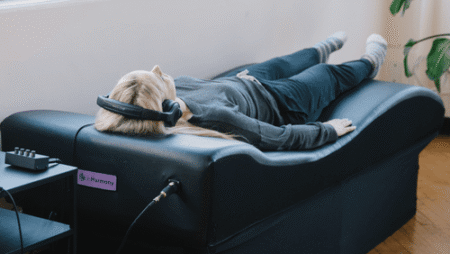
During a session, the client reclines on a specialized sound bed that delivers low-frequency sound waves through the body while calming music plays through headphones. These frequencies — typically 30 to 1,000 hertz (Hz) — penetrate deeply into muscles, tissues, and even cells, promoting both physical and neurological relaxation.
The vibrations stimulate the vagus nerve, a key pathway of the parasympathetic nervous system that influences heart rate, digestion, and emotional regulation. When activated, the vagus nerve signals the body that it’s safe to relax, slowing the heart rate, deepening breathing, and lowering stress hormones.
A Full-Body Reset
Beyond its calming effect, vibroacoustic therapy has measurable benefits. Research and user reports show it can:
- Reduce stress and anxiety by lowering cortisol and promoting alpha and theta brainwave activity associated with calm and clarity.
- Ease muscle tension and pain by improving circulation and triggering endorphin release.
- Support attention and focus in individuals with ADHD or ADD, as rhythmic sound frequencies help synchronize neural pathways and stabilize sensory processing.
- Improve sleep and mood balance, especially in those with PTSD, anxiety, or a nervous system that stays “stuck in high gear.” (What experts call high sympathetic tone — meaning the body’s stress response stays switched on, even at rest.)
- Enhance recovery and cognitive performance by improving nervous system coherence and brain-body communication.
For most people, the experience feels like a deep meditation — without the struggle of trying to quiet the mind. The rhythmic vibration naturally guides the nervous system into alignment.
Safe, Gentle, and Suitable for All Ages
One of the most remarkable aspects of vibroacoustic therapy is its safety and adaptability. Because it’s noninvasive, drug-free, and customizable, it’s suitable for all ages — from children who struggle with focus or anxiety to older adults managing pain, stiffness, or sleep disturbances.
For children and teens, the combination of vibration and sound can calm sensory overload, enhance concentration, and improve self-regulation — making it especially helpful for those with ADHD, autism spectrum disorders, or generalized anxiety. Adults often report improved mood, focus, and emotional stability, while seniors find relief from muscle tension and better sleep — all without side effects.
The Parasympathetic Advantage
The parasympathetic nervous system is the body’s natural healing mode — where digestion, repair, and detoxification occur. Yet most people spend their days in sympathetic dominance, constantly responding to stress signals from work, screens, caffeine, and daily life.
When this balance is restored through vibroacoustic therapy, the body can finally do what it was designed to do: heal.
Vibroacoustic therapy doesn’t just help you feel relaxed — it helps retrain your body to stay relaxed. Over time, consistent sessions can “reprogram” the nervous system to recognize calm as the default state instead of chaos.
Think of it like tuning an instrument that’s been slightly off pitch for years. With each session, your body remembers its natural rhythm. You may notice better sleep, lower anxiety, sharper focus, and a grounded sense of peace that carries into daily life.
Stress may be unavoidable, but how your body responds to it can change. Vibroacoustic therapy offers a natural, noninvasive path to restore balance — one vibration at a time. By calming the nervous system, activating healing pathways, and synchronizing the body’s internal rhythm, it helps you not just cope with stress, but recalibrate from it.
If you’d like to experience this advanced technology for yourself, vibroacoustic therapy is available locally at The Wellness Institute in Enterprise, Alabama.