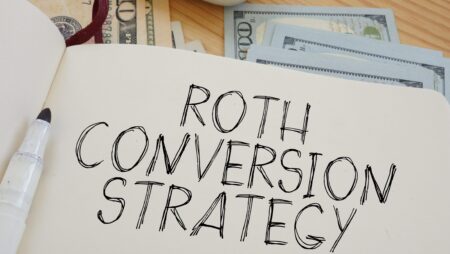
Roth Conversion Retirement Plans: To Convert or Not to Convert
Deciding whether to convert a retirement plan into a Roth IRA isn’t as straightforward as it seems. While Roth conversions can offer tax-free income in retirement, they may not be suitable for everyone and can lead to unintended consequences. Below, we outline the pros and cons of Roth conversions in key areas.
Taxes
Arguments For:
- The main reason for a Roth conversion is to generate tax-free income. If an individual has funded a Roth IRA for at least five years and has a qualifying event (such as reaching age 59 ½), then all assets within the Roth IRA are tax free.
- If you anticipate being in a higher tax bracket in the years to come, you may lock in a lower tax rate now by converting.
- Future tax rates are uncertain, but history shows they often rise. A Roth conversion lets you lock in today’s rate.
Arguments Against:
- Conversions are taxed at your ordinary income rate, potentially pushing you into a higher tax bracket.
- Roth conversions may require quarterly tax payments to the IRS.
- If you’re in a higher tax bracket now and expect to be in a lower bracket in the future, doing a Roth conversion now could lead to paying more taxes.
There is a price of admission that must be paid on all conversions. While having the ability to withdraw tax-free funds is extremely beneficial in retirement, you should ask yourself: Do I have the funds available to pay the tax bill? If not, it may make sense to spread the conversions out over multiple years, or it may not be suitable at all.
Required Minimum Distributions (RMDs)
Arguments For:
- Roth IRAs have no RMDs, which means no taxable mandatory distributions.
- Distributions from most employer plans, IRAs, and Social Security are taxable, so tax diversification in retirement can be especially important when distributions are required. Having a tax-free account to withdraw from may help you stay within a certain tax bracket.
Arguments Against:
- A charitably inclined individual may be able to do a qualified charitable distribution (QCD) from a traditional or inherited IRA and avoid taxation.
- An individual must be at least age 70½ and file a standard deduction tax return to do a QCD. The maximum QCD amount is $108,000 for 2025, and it generally can only be done from traditional or inherited IRAs.
If you plan to give that amount to a charity as a QCD, it may not make sense to do a conversion. QCDs are nontaxable, so there is no financial benefit in converting to a Roth only to later donate the funds. However, if your goal is to reduce or eliminate RMDs, a Roth conversion may help lower your future tax bill.
Age
Arguments For:
- Younger individuals have more time for their investments to potentially grow and compound tax-free earnings.
Arguments Against:
- Older individuals have less time to accrue tax-free earnings.
- A person under age 59½ who withholds taxes from their IRA will have a 10% penalty on the tax withholding portion.
Young investors have time on their side. The longer assets remain in a Roth IRA, the longer the time horizon for potentially compounding tax-free growth.
Estate Planning
Arguments For:
- Leave tax-free income to your beneficiaries.
- Conversions may help certain beneficiaries stay in a lower tax bracket, especially when beneficiaries need to deplete an inherited IRA within 10 years.
Arguments Against:
- The IRA owner is on the hook to pay taxes on the conversion still.
- Roth conversions may increase Social Security taxation and higher Medicare premiums for certain individuals.
Roth conversions can be a useful estate planning tool if you want to leave tax-free income to your beneficiaries. Since estate planning often involves older individuals, I can work alongside your legal and tax advisors to help you understand how a Roth conversion might impact your Medicare premiums or Social Security benefits.
General
Arguments For:
- Business owners with net operating losses can utilize Roth conversions in a potentially tax-free manner.
- Unlike Roth contributions, Roth conversions do not require earned income or have income limits.
- Stocks generally can be converted to a Roth IRA in kind.
Arguments Against:
- Roth conversions are permanent and cannot be reversed.
Each individual’s financial situation is unique. Contact Stifel’s New York Bryant Park office at (212) 847-6501, and we can help you understand how a Roth conversion may impact your specific retirement goals.
Decisions to roll over or transfer retirement plan or IRA assets should be made with careful consideration of the advantages and disadvantages, including investment options and services, fees and expenses, withdrawal options, required minimum distributions, tax treatment, and your unique financial needs and retirement planning. Neither Stifel nor Stifel Financial Advisors provide recommendations with respect to your decision to move assets out of an employer-sponsored retirement plan. Once you inform your Stifel Financial Advisor that you have chosen to roll your retirement assets to an IRA with Stifel, your individual investment needs can be addressed. You should consult with your tax advisor regarding your particular situation as it pertains to tax matters.
Stifel does not provide legal or tax advice. You should consult with your legal or tax advisor regarding your particular situation.