The DeShong Building: A 90-Year Legacy of Motion, Metal, and Main Street Grit
Home of South Main Iron – Est. 2018
Tucked just one block south of the Paris, Texas town square stands a building that has witnessed nearly every chapter of American transportation history. From wagon yards and black-and-white movies to gleaming Chevys and today’s roaring motorcycles, the DeShong Building has always been about one thing: movement.
But its story doesn’t begin with bricks and showroom lights. It begins in the raw frontier days of the Republic of Texas.
From Land Grants to Wagon Ruts (1838–1910)
The land beneath the DeShong Building was first granted on March 2, 1838—the very day Texas celebrated its second year of independence. A headright was awarded to Larkin Rattan, part of the young republic’s effort to populate its vast, untamed landscape. Just a year later, George W. Wright, the founder of Paris, Texas, acquired 1,000 acres and donated 50 acres to form the city’s center.
Over the next several decades, the property would pass through many hands, including Henry D. Woodsworth, one of the city’s first educators and a notary. By the late 1800s, the plot had taken on a humble but industrious life. It hosted everything from a bedspring factory to a Chinese laundry. But by far its most colorful identity was as a wagon yard—where travelers stopped to rest their teams and trade goods. Horses, hitching posts, and the grit of hard travel defined this space.
Lights, Camera, Fire: The Theater Years (1908–1916)
The dawn of the 20th century brought a new type of horsepower: projection reels. In 1908, the Lyric Theatre opened on the northeast corner of the lot, soon transforming into the Majestic, then the Jewel, and finally the Grand. These weren’t just movie houses—they were cornerstones of entertainment in a town that was evolving fast.
Tragically, in 1916, a devastating fire swept through downtown Paris. The Grand Theatre, along with much of South Main Street, was lost. The projector bulbs dimmed for good, and the land sat quiet for nearly two decades—its ashes waiting for rebirth.
Lamar Chevrolet and the DeShong Brothers (1934–1960)
That rebirth came in 1934, when brothers Jess and Lloyd DeShong poured concrete and vision into a bold, modern structure: a two-story, 28,000-square-foot brick automotive dealership known as Lamar Chevrolet.
This was no ordinary car lot. It featured expansive showrooms, state-of-the-art service bays, a second-story parking garage, and an attached Sinclair gas station. Innovative for its time, the station even offered indoor fueling—a rarity then and now.
Because the land sloped steeply between Main Street and SW 1st, the DeShongs installed concrete ramps to allow vehicles to travel between levels. That decision made the building home to Paris’ only multi-level parking garage, a mechanical marvel in the 1930s.
Lamar Chevrolet wasn’t just about Chevys. Over the next 26 years, they sold Cadillacs, opened Lamar Appliance Co., and even started DeShong Aviation Sales, a regional airplane dealership serving 51 counties. With a hangar at Legion Field, they quite literally helped Northeast Texas take flight.
During World War II, when new car manufacturing halted, the DeShong team pivoted—focusing on used car service and trade-ins. By the time they sold the business in 1960, they’d moved 1,976 new vehicles and over 4,000 used ones through the building.
New Names, Same Drive (1960–1986)
The torch passed in 1960, but the DeShong Building never lost momentum. It became home to Burtrum-Woolston Chevrolet, and later Burtrum Chevrolet City, which operated until relocating in 1968.
That same year, Bill Booth Motors—a Chrysler-Plymouth dealership—moved in just a week later, continuing the building’s legacy as a center of auto culture for another 16 years. The gas station, too, evolved, swapping signs from Sinclair to Mobil, then Phillips 66.
By 1986, after five decades and more than a few oil changes, the DeShong Building saw its final days as a new car dealership. But its story was far from over.
From Millwork to Modernization (1987–2009)
In the decades that followed, the DeShong Building shifted from chrome bumpers to custom woodwork. Under owners like H&W Investments and the Harper Six Family Limited Partnership, it served as a factory space for store fixtures and millwork.
Pieces built here went to national chains like Blockbuster Video and J.C. Penney, as well as Texas courthouses, where craftsmen restored historic doors, trims, and moldings. The old ramps and concrete floors that once held Chevys now supported sawdust and skilled hands.
Though quieter than the revving engines of decades past, the building remained a place of purpose and production.
A Thunderous Revival: South Main Iron (2018–Present)
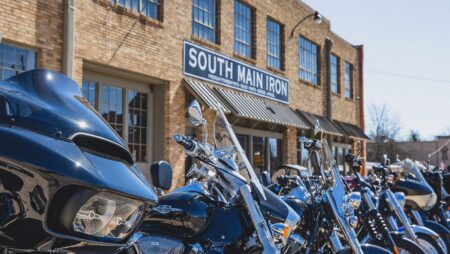
In April 2018, the hum of machinery turned to the roar of engines as South Main Iron opened its doors inside the DeShong Building. A new chapter had arrived—and it was two-wheeled, fast, and full of fire.
Specializing in motorcycles, UTVs, and ATVs, South Main Iron brought the space full circle: back to the business of transportation. But not just selling machines—building a lifestyle around them.
Since moving in, the South Main Iron team has restored and reimagined the space. They installed massive bay doors on SW 1st Street, restored storefront windows, added matching yellow pine doors to the annex, and crafted stylish, functional office spaces within the historic frame. The showroom, once filled with sedans and carburetors, now gleams with Used Harley-Davidsons, Hi
The service department? It’s alive with the clatter of tools and the kind of friendly conversation that can only come from a team of locals who live and breathe the ride.
Where Past and Present Ride Together
Today, South Main Iron isn’t just a dealership—it’s a community hub, a heritage site, and a testament to reinvention. On any given day, you might see a test ride roaring past the Plaza, or hear stories swapped beneath vintage neon signs.
The building itself stands as both a monument and a machine—still in motion after all these years.
Final Thoughts
The DeShong Building is more than walls and ramps. It’s a living story of Paris, Texas—of its people, its grit, and its ongoing evolution. From wagons to windshields to wide-open throttle, this building has seen it all.
And thanks to South Main Iron, the ride is far from over.
Special Thanks
We gratefully acknowledge Marvin Gorley, whose research and historical narrative made this article possible. His work preserves the stories behind the bricks and ensures that the DeShong legacy—and the people who shaped it—continue to inspire future generations.