A Contractor’s Perspective: Pavers vs. Poured Concrete
After two decades of landscape construction in the North Okanagan, I’ve witnessed countless homeowners face a critical decision: paving stones or poured concrete? While concrete may appear less expensive initially, the long-term reality tells a different story.
Vernon’s dramatic freeze-thaw cycles are unforgiving to poured concrete. Our temperature swings from -20°C winters to +35°C summers create the perfect conditions for concrete cracking. Within three to five years, most concrete patios develop unsightly cracks that cannot be invisibly repaired. Once a concrete slab cracks, your options are limited to living with it, applying temporary patches that never quite match, or complete removal and replacement—an expensive proposition.
Paving stones, by contrast, are designed to move with ground fluctuations. Their individual units and sand-filled joints absorb the expansion and contraction that destroys concrete. When installed with proper base preparation—crucial in our clay soils—they remain stable and beautiful for decades.
The practical advantages extend beyond durability. Need to access underground utilities? With pavers, we simply lift the necessary stones, complete the work, and replace them—no jackhammering, no obvious repair patches. Try that with concrete, and you’re left with a permanent scar across your patio.
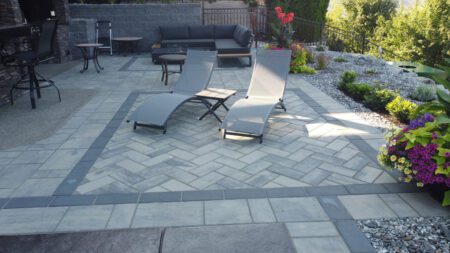
Design flexibility is another significant advantage. Leading manufacturers like Barkman, Belgard, and Techo-Bloc have revolutionized outdoor living spaces with innovative products that go far beyond basic rectangular pavers. From tumbled stones that replicate centuries-old European courtyards to sleek contemporary slabs with clean lines, the design possibilities are remarkable.
These premium paving systems offer countless patterns, colors, and textures that can complement any architectural style. You can mix colors to create custom borders, incorporate contrasting bands for visual interest, or use different sizes to establish distinct zones within your outdoor space.
They curve gracefully around garden beds, accommodate slopes with terraced solutions, and adapt to future landscape changes without looking patched or compromised. Concrete’s design limitations are stark by comparison: it’s flat, typically gray or stamped with patterns that wear unevenly, and completely permanent.
The investment difference isn’t as dramatic as many assume. When you factor in concrete’s shorter lifespan and inevitable repair costs, quality paving stones often prove more economical over a 20-year timeline.
More importantly, they maintain their appearance and function throughout that period, while concrete steadily deteriorates. Should a paver become stained or damaged years down the road, replacing individual stones is straightforward and invisible—try matching new concrete to weathered material.
For Vernon homeowners planning outdoor living spaces, the choice becomes clear: paving stones deliver lasting beauty, practical flexibility, and proven performance in our challenging climate. It’s not just about initial cost—it’s about making a wise long-term investment in your property.