Robertson Jewelers: What’s New?
In every era of fine jewelry, the industry delights in declaring something “new.” New cuts, new settings, new aesthetics, new movements. Yet for those of us who have spent decades at the bench, in buying rooms, and across the counter from discerning clients, the pattern is unmistakable: what is celebrated as innovation is almost always reinvention.
Jewelry, unlike fashion, does not progress by erasing its past. It advances by returning to it—carefully, selectively, and with better tools.
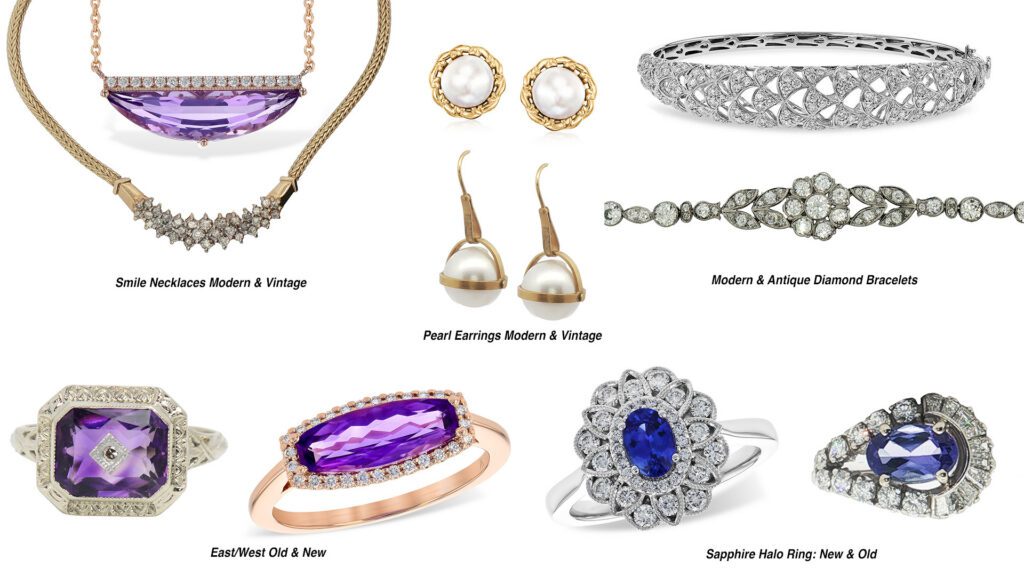
Walk through any contemporary high-end showcase and the lineage is clear. Elongated solitaires set east–west, low-profile mountings, softened geometry, substantial gold chains, and restrained pavé work all trace their origins to designs that predate modern marketing cycles by generations. The difference is not the idea itself, but how confidently and precisely it is executed today.
Art Deco remains the most frequently borrowed language in modern design, and with good reason. Its emphasis on symmetry, proportion, and architectural clarity translates effortlessly into contemporary taste. What today’s client perceives as modern elegance is often a Deco principle rendered cleaner—without milgrain, without engraving, without the visual density required when tools were limited. Modern manufacturing allows us to revisit these designs with a lightness and exactitude early jewelers could only aspire to.
Edwardian influence follows closely behind. The slender platinum profiles, delicate diamond tracery, and ethereal presence of early 20th-century jewelry are reappearing under the banner of “minimalism.” But true Edwardian design was never minimal; it was intricate, intentional, and engineered for grace. Today’s versions simplify the look while preserving the proportion, creating pieces that feel airy yet substantial—an old sensibility, refined for modern wear.
Even the enduring solitaire engagement ring, often framed as timeless simplicity, is itself a historical artifact. Its popularity rose alongside advances in diamond cutting and platinum metallurgy over a century ago. What we sell today as clean and contemporary is, in truth, a continuation of a design language perfected long before any of us were here.
The same can be said for halos and clusters. Once dismissed as overdone, they have quietly returned—thinner, lower, and more disciplined. Modern halo rings often resemble their 19th-century predecessors more closely than the oversized styles that dominated the early 2000s. When balanced properly, they feel archival rather than trendy, grounded in history rather than marketing.
Gold, too, has completed its predictable arc. Heavy chains, bold links, and sculptural gold earrings are framed as bold statements, yet they draw directly from Victorian, Renaissance, and mid-century references. What has changed is restraint. Today’s gold designs rely less on ornament and more on weight, surface, and proportion. Polished against brushed finishes, softened edges replacing sharp ones, mixed tones blending rather than contrasting—these are refinements, not revolutions.
Color follows a similar pattern. Sapphires, emeralds, rubies, spinels, and garnets were never absent from fine jewelry; they simply fell out of favor during decades obsessed with diamond uniformity. Their current resurgence is not discovery, but rediscovery. Clients today are drawn to depth of color, individuality, and narrative—values long embedded in antique and estate jewelry.
Technology, often credited with driving modern design, has not altered aesthetics nearly as much as it has eliminated compromise. CAD modeling, precision casting, and advanced setting techniques allow jewelers to return to historic proportions with greater consistency. Designs that once required heroic labor and inevitable imperfections can now be executed with repeatable accuracy—without losing the hand-finished character that defines fine work.
Lab-grown diamonds fit neatly into this same cycle. They have not introduced new visual language. Instead, they have reopened doors to old ones. Large, matched layouts, dramatic rivière necklaces, expansive earrings, and bold cocktail rings—designs once reserved for royalty or rare clientele—are again commercially viable. The designs are familiar; the accessibility is new.
What all of this underscore is a fundamental truth of fine jewelry: novelty is rarely the goal. Longevity is. The pieces that endure long enough to be called “new” again are the ones that were right from the beginning. They respected proportion, honored materials, and understood the wearer.
As established jewelers, our responsibility is not to chase trends or invent aesthetics that cannot age gracefully. It is to recognize which historical designs still resonate, to edit them with discipline, and to execute them with integrity. Jewelry does not need to shout to feel relevant. It needs to be made well, designed thoughtfully, and rooted in ideas that have already proven they can last.
In the end, the most successful new designs are not those that break from the past—but those that remember it.
For over fifty years I have enjoyed presenting both the newest and oldest designs to my clients who then decide what direction to go to tickle their fancy. Our showroom is stocked with styles from the most modern designs to those that were popular centuries ago. So please stop today and we’ll take an incredible journey through time together!