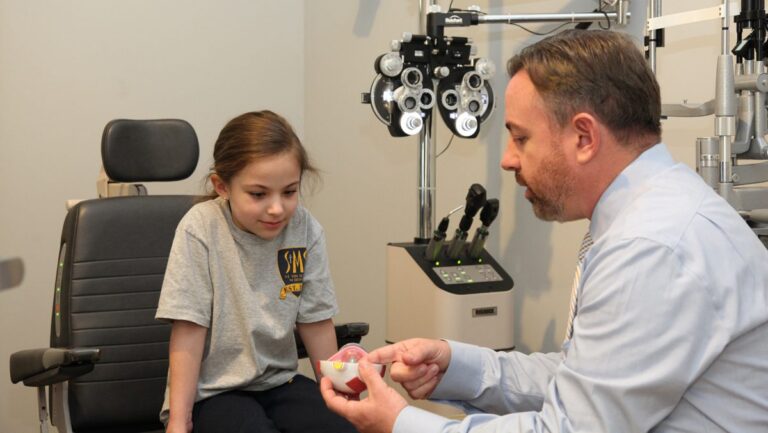
As an optometrist, the most frequently asked question I get from parents is, “What is a good age for a first eye exam?” Most parents are surprised to hear that 6 months old is the youngest patient that I see. And that I recommend an eye exam even if the child has no specific vision complaints.
The American Optometric Association (AOA) recommends eye exams at 6-12 months old, preschool age (3-4 years old), before starting elementary school (5-6 years old), and examinations every year after. Although vision screenings at the Pediatrician or school may be done, this does not replace a comprehensive eye examination, and many ocular conditions can be missed. At comprehensive pediatric examinations, we monitor for more than just vision but also look at refractive error, binocular vision, accommodation, and ocular health. All of these factors play a role in children meeting developmental milestones and helping them succeed in school.
The major components of a pediatric eye examination include:
Refractive Error
When children are old enough, we can measure their vision subjectively using eye charts with letters, numbers, or shapes. We can use machines such as an auto-refractor or spot screener to get an estimation of the prescription. We mainly rely on retinoscopy. By using a special handheld light, we can neutralize the reflexes of the eye with lenses to determine what the power of the eye is. This can be done without any response from the child.
Once we know the powers of the eye, we determine if the child needs glasses. We are looking for hyperopia, or farsightedness, which can cause eye strain or difficulty reading. Myopia, or nearsightedness, means that the child cannot see things far away. This can lead to difficulty seeing the board while at school. Astigmatism can cause blurry vision at all distances as the eye is shaped more like a football. If one of these things are uncorrected, it can lead to amblyopia or a lazy eye, in which the eye does not see the 20/20 line on the vision chart.
Binocular Vision
Binocular vision is how the eyes work together. We look to make sure the eyes are aligned properly and are pointing at the same thing. If one eye points out, this is called an exotropia. If one eye points in, this is called an esotropia. Both of these can cause double vision, headaches, or difficulty reading.
Accommodation
Accommodation is the focusing system of the eye. When your child is reading, their eyes must accommodate to see things up close. Some children have a focusing system that is weak. This can cause blurred vision up close, headaches, or eye strain. Some children have a focusing system that is too strong which can cause blurred vision far away, headaches, or eye strain.
Ocular Health
We also look at the front and back of the eye during an eye examination. The anterior segment refers to the front of the eye. Here we can monitor many things, some of the most common seen in children are eye allergies, dry eyes, and cataracts.
When looking at the posterior segment, or back of the eye, we are monitoring the retina. We do this by using eye drops or pictures to see inside the eye. Here we can see blood vessels which reflect our systemic health. We also see the optic nerve which connects the eye to the brain. Conditions seen that can be seen in children include glaucoma (damage to the optic nerve), retinoblastoma (tumor), or congenital defects.
Children use their eyes all day long. Whether it be in school, soccer practice, or watching a movie with the family, it is important to make sure that they can do all of these things with clear and comfortable vision. Even if the child has no vision complaints, it is important to monitor all aspects of their eyes to make sure that their eyes stay healthy and develop properly.
Talk to your optometrist about scheduling your child for a comprehensive pediatric eye examination!
Any content, resident submissions, guest columns, advertisements, and advertorials are not necessarily endorsed by or represent the views of Best Version Media LLC (BVM) or any municipality, homeowners associations, businesses, or organizations that this publication serves. BVM is not responsible for the reliability, suitability, or timeliness of any content submitted, inclusive of materials generated or composed through artificial intelligence (AI). All content submitted is done so at the sole discretion of the submitting party.