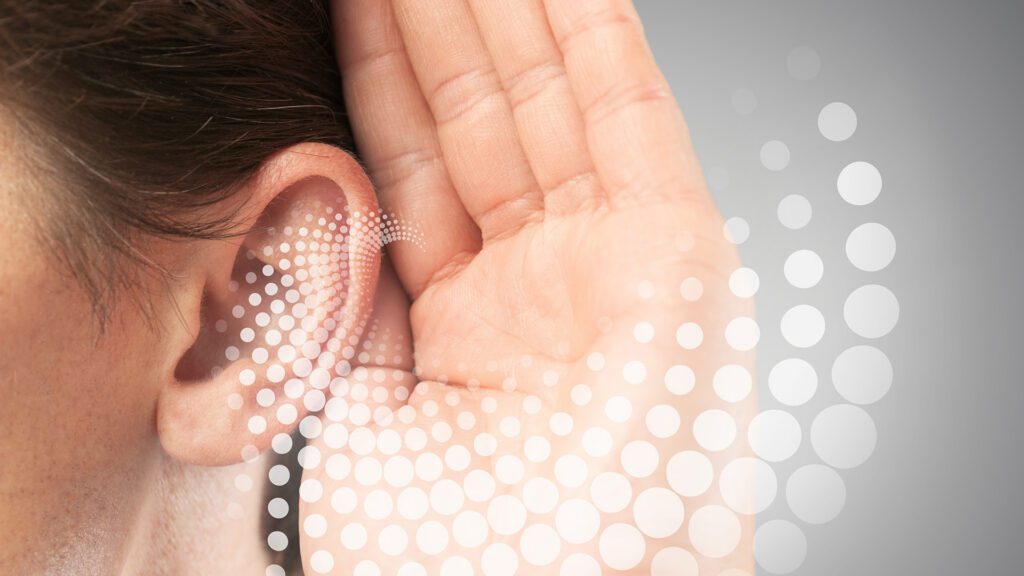
Our ears don’t just hear sounds, they make sounds too.
It’s not widely known that our ears not only hear sounds, they actually make sounds. Otoacoustic emissions (OAE) are very faint sounds produced by the inner ear, aka the cochlea, in response to other sounds. OAE were predicted back in 1948 and confirmed 30 years later.
Inside our cochlea is a structure called the Organ of Corti, an amazing creation of evolution. This is where the ‘magic’ of our hearing occurs. While I’m not going to get crazy technical, it’s important to understand the basics of what’s happening.
Soundwaves come into our ear and hit our eardrum, causing it to vibrate. Energy in air has now been converted into mechanical energy. Our three tiny middle ear bones, attached to the ear drum and each other, are now vibrating. The last bone is sealed into a ‘window’ into the cochlea. Its piston-like vibrations create a fluid wave that travels up the cochlea, converting mechanical energy into fluid energy. That fluid wave disturbs a membrane, which is the floor of the Organ of Corti and which supports the two different types of nerve cells, known as ‘hair cells’ because of the hair-like tips (known as stereocilia) at the end of the cells. The two types, known as inner (IHC) and outer hair cells (OHC), have distinct roles in how we hear. The IHC are the ones that actually send the neural signals to our brain to be processed, with the fluid energy now finally converted into electrical energy.
The OHC role is supportive, to ‘fine tune’ our hearing and work as an internal biological amplifier. They are what give the healthy ear its fine frequency/pitch discrimination and significantly increase the amplitude or volume of the neural signals. They do this by actively stretching and shrinking in response to incoming sounds. It is the movement of these cells that produces OAE, which in turn is an indicator of the health of the inner ear. The presence of OAE simply indicates normal/near normal OHC function, which is strongly correlated with “normal” subjective hearing thresholds.
It’s important to remember this is a single test, evaluating a small (though important) part of the auditory system, within a comprehensive test battery. It only provides one piece of the puzzle. The presence of OAE does not rule out problems in other areas of the auditory system, just those associated with OHC function.
OAE testing is quick (~1 minute), painless, non-invasive, repeatable, and objective. Because of this, it’s been a boon for universal newborn hearing screening programs. OAE are sensitive to changes in the cochlea caused by ototoxic drugs (certain chemotherapy agents, IV antibiotics, etc) or loud noise exposure, which makes OAE testing ideal for monitoring for subtle changes that basic subjective audiometry (‘press the button if you hear the sound’) misses.
Because OHC damage is associated with tinnitus, OAE testing is part of our tinnitus sufferer test protocol, as it may indicate cochlear dysfunction that doesn’t show up on the basic test. It’s also included in our professional musician/hearing conservation testing and treatment protocol, allowing us to track OHC health over time.
Hearing is a sense, by its very nature subjective. There are no objective tests that tell us how people subjectively perceive sound. So the field of Audiology has developed many different tests, some subjective and some objective, that assess specific parts of the auditory system in order to get the fullest picture of a person’s hearing health. Unfortunately, most hearing healthcare providers/practices rely solely on the basic subjective audiometry results. No speech-in-noise testing, no probe microphone measures when programming hearing aids, no consistent and proactive follow up, no best practices. That’s not what comprehensive audiology looks like. OAE testing isn’t necessary for everyone. However, when indicated, its inclusion (and the inclusion of many other tests and/or procedures) is what comprehensive care looks like.
Please continue to show that you love your community by supporting our local businesses and remembering the humanity of those around you.
Any content, resident submissions, guest columns, advertisements, and advertorials are not necessarily endorsed by or represent the views of Best Version Media LLC (BVM) or any municipality, homeowners associations, businesses, or organizations that this publication serves. BVM is not responsible for the reliability, suitability, or timeliness of any content submitted, inclusive of materials generated or composed through artificial intelligence (AI). All content submitted is done so at the sole discretion of the submitting party.