
Earlier this summer, my family capped off a busy Baptism and Father’s Day with dinner at an Augusta Road favorite, Corona’s. Amidst the queso chaos and two T-Rex dinosaurs dining with us, our 3 ½-year-old son, Robert, spotted “a coin” under the booth! The deal was simple: finish his quesadilla, then collect his treasure amongst the fallen chips.
It turned out to be a copper penny (technically 97.5% zinc and 2.5% copper after mid-1982, but who’s counting). It also proved to be a perfect teaching moment.
“What can I do with my coin, Daddy?” he asked.
I told him he had three choices: save it, spend it, or give it away.
- Save = drop it in his piggy bank.
- Spend = buy a lollipop, though Corona’s had already handed him a Dum-Dum.
- Give = share it with his baby sister, Leigh.
Since Leigh had been baptized that morning and was already swimming in gifts, the logical choice was the piggy bank (with a little parental encouragement). That penny became more than pocket change. It was Robert’s first lesson in handling money with intention.
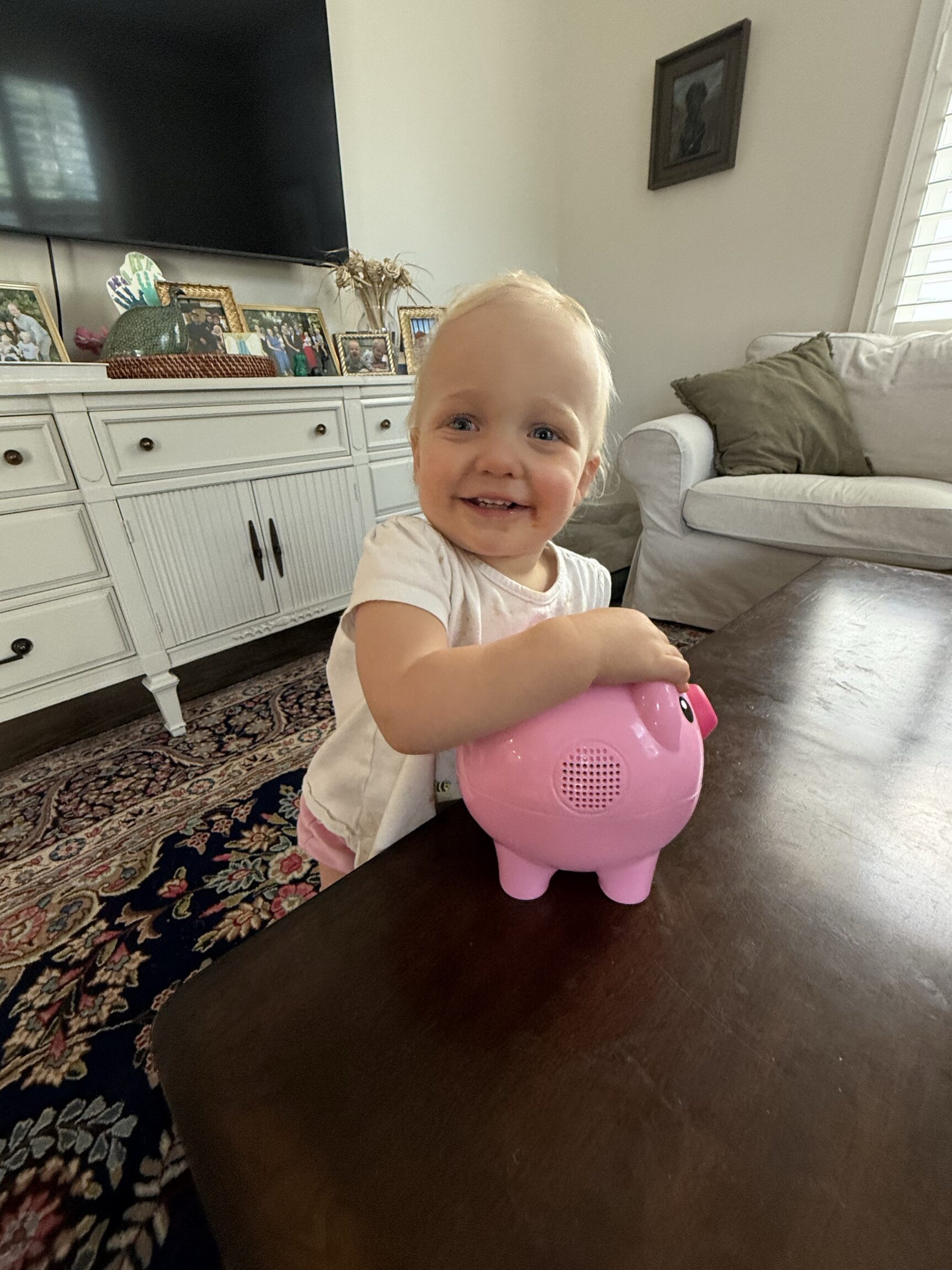
(Submitted by Robert DiBenedetto)
Why Start So Young?
Parents, grandparents, and mentors work hard to raise capable, confident children. Yet financial skills often get left out of that effort, sometimes because money feels uncomfortable to discuss, sometimes because we feel uncertain on our own footing. The result is that many kids reach adulthood without basic money habits.
A common question I get is, “When should I start teaching my child about money?” My answer: as early as you teach kindness and sharing. Leigh, at 1 ½, already has a hand-me-down Fisher-Price piggy bank she enjoys stuffing with plastic tokens. She is learning to count and to save before she can spell either word.
Three Habits, Not a Hierarchy
Save, spend, and give are not competing choices. They are three habits that work together, and each one deserves its own attention. A few practical starting points for younger children:
- Use three jars or piggy banks, labeled save, spend, and give. At this age, visuals are everything.
- Tie small allowances or gift money to small decisions. Let them choose where each dollar goes and resist the urge to override.
- Narrate the “why.” When you give to a favorite cause or save for a family trip, say it out loud. Kids absorb more than we realize.
The goal at this age is not financial literacy. It is laying a foundation of values around money that we can build on for years to come. My wife, Hannah, and I often compare it to training a well-behaved dog like our black lab, Boozie. The Wildrose Kennels equation for success is a foundational gundog training philosophy designed to build a rock-solid, predictable habit. It is calculated as: Repetition + Consistency – Boredom × Variable Conditions = Predictable Habit.
In the next article, I will explore how these early habits evolve into budgeting, earning, and the difference between needs and wants during the tween and teen years.
Disclaimer: This article may not be copied, reproduced, or distributed without HB Wealth’s prior written consent. The information is provided for informational purposes only and should not be considered a recommendation to purchase or sell any financial instrument, product or service sponsored by HB Wealth or its affiliates or agents. The information does not represent legal, tax, accounting, or investment advice; recipients should consult their respective advisors regarding such matters. Investors are advised to consult with their investment professional about their specific financial needs and goals before making any investment decision.
Any content, resident submissions, guest columns, advertisements, and advertorials are not necessarily endorsed by or represent the views of Best Version Media LLC (BVM) or any municipality, homeowners associations, businesses, or organizations that this publication serves. BVM is not responsible for the reliability, suitability, or timeliness of any content submitted, inclusive of materials generated or composed through artificial intelligence (AI). All content submitted is done so at the sole discretion of the submitting party.