
Over the past several years, airway orthodontics has become one of the hottest topics in dentistry and orthodontics. Parents are hearing about mouth breathing, tongue ties, palatal expansion, sleep apnea, and facial growth everywhere – from Instagram and TikTok to podcasts and Facebook groups. The challenge is that social media often presents complex medical issues in simple, absolute terms.
As an orthodontist, the topic of airway and expansion comes up almost daily in my office, and I love that parents are asking thoughtful questions about their children’s health. Sleep-disordered breathing is an important medical condition that deserves attention, but with so much conflicting information online, it can be difficult to separate emerging science and evidence-based medicine and dentistry from marketing, opinion, and pure money-making products and services.
Because of all the recent interest (and controversy) over the topic, the American Association of Orthodontists (AAO) published a white paper on orthodontics and sleep-disordered breathing, which reviewed hundreds of scientific studies to provide updated guidance. Given the recent attention and publication, I thought it would be helpful to provide guidance from experts in the field of orthodontics and a summary of that white paper for parents seeking answers for themselves or their children to these important questions.
Airway Matters. Evidence Matters Too.
The AAO encourages every orthodontist to routinely screen patients for risk factors such as chronic mouth breathing, snoring, enlarged tonsils, obesity, disrupted sleep, and developmental concerns. When these signs are present, referral to a physician for diagnosis is strongly recommended. The paper repeatedly emphasizes that sleep-disordered breathing is a medical diagnosis. Orthodontists play an important role in recognizing risk, but physicians remain responsible for making the diagnosis before airway-directed treatment begins.
What About Expansion?
Palatal expansion has become one of the most talked-about orthodontic procedures online. Expansion remains the ideal treatment for children between the ages of 8 and 10 who have a narrow upper jaw and crossbite. In other words, the top teeth don’t fit over the bottom teeth like a lid fitting over a box. Expansion is most effective between the ages of 8 and 10 due to growth and development and fusion of the palatal suture. It is an excellent treatment plan when it is needed and for the right patient.
What About Expansion and Airway?
Orthodontists undergo additional training after dental school to specialize in tooth movement and skeletal jaw discrepancies. We are trained to treat the teeth and jaws (sometimes in conjunction with oral surgeons and other dental specialists). Yes, airway is certainly impacted by tooth and jaw position, but teeth and jaws aren’t the only contributing factors. Soft tissue, muscle tone, neurologic control, weight, and anatomy also contribute. This is why it is so important to involve physicians, pediatricians, ENT specialists, and sleep medicine specialists in the discussion and not just jump to expansion as the “cure all”.
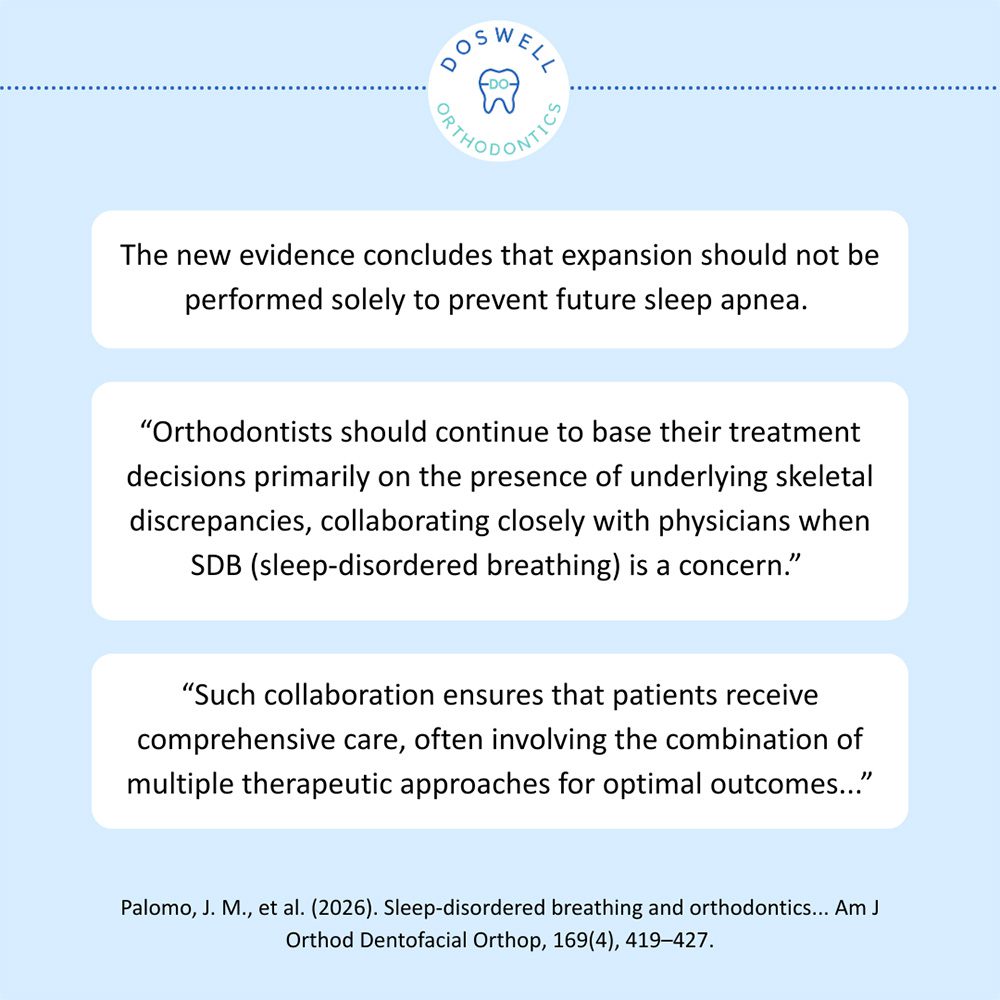
The new evidence concludes that expansion should not be performed solely to prevent future sleep apnea. Instead, it is most appropriate when a child has both a confirmed diagnosis of sleep-disordered breathing and a legitimate orthodontic indication (e.g. crossbite) as part of an interdisciplinary treatment plan. It is also important to note that having a crossbite does not mean you have or will have sleep-disordered breathing, and having sleep-disordered breathing does not mean you have a crossbite and need an expander.
One Finding That May Surprise Parents
One of the most reassuring findings in the paper is that not every child who snores or mouth breathes is destined to develop sleep apnea. While some children do require treatment, research shows that many children with mild sleep-disordered breathing improve naturally as they grow. This reinforces the importance of individualized evaluation rather than one-size-fits-all recommendations.
The Take-Home Message
The strongest recommendation throughout the paper is collaboration. Orthodontists, pediatricians, ENT specialists, sleep medicine specialists, and families each play an important role. As a parent, if your child snores regularly, breathes primarily through the mouth, seems excessively tired during the day, has behavioral concerns, or struggles with sleep, those concerns deserve evaluation. Sometimes treatment is needed, sometimes an expander is needed, and sometimes watching and waiting and allowing growth to happen, is needed. Without the proper evaluation and diagnosis, the proper treatment cannot be rendered.
The goal is to provide the right treatment, for the right child, at the right time, based on the best available evidence. In today’s world, information is more accessible than ever, but not all information carries the same level of evidence.
My goal as an orthodontist is to listen carefully to every family’s concerns, stay current with the latest research, recommend treatment based on foundational principles of growth and development, orthodontics, biology, and work closely with other specialists and doctors to provide the best collaborative care to patients.
Any content, resident submissions, guest columns, advertisements, and advertorials are not necessarily endorsed by or represent the views of Best Version Media LLC (BVM) or any municipality, homeowners associations, businesses, or organizations that this publication serves. BVM is not responsible for the reliability, suitability, or timeliness of any content submitted, inclusive of materials generated or composed through artificial intelligence (AI). All content submitted is done so at the sole discretion of the submitting party.