Names have been changed to protect privacy
Anthony’s parents knew that something was wrong with his vision. He could read the 20/20 line on the eye chart. But they knew that vision is more than seeing 20/20. They thought his visual skills needed for reading, such as tracking, might be inadequate.
When Anthony came for a binocular vision exam, my assessments showed that his parents were correct. Anthony had trouble with the following visual skills: tracking, focusing, and teaming. These difficulties caused a lot of trouble in school.
Fortunately for Anthony, visual skills can be taught. Children who have speech delays benefit from speech therapy. Children who struggle with their fine motor skills can make significant progress in occupational therapy. In the same way, children with poor visual skills benefit from vision therapy.
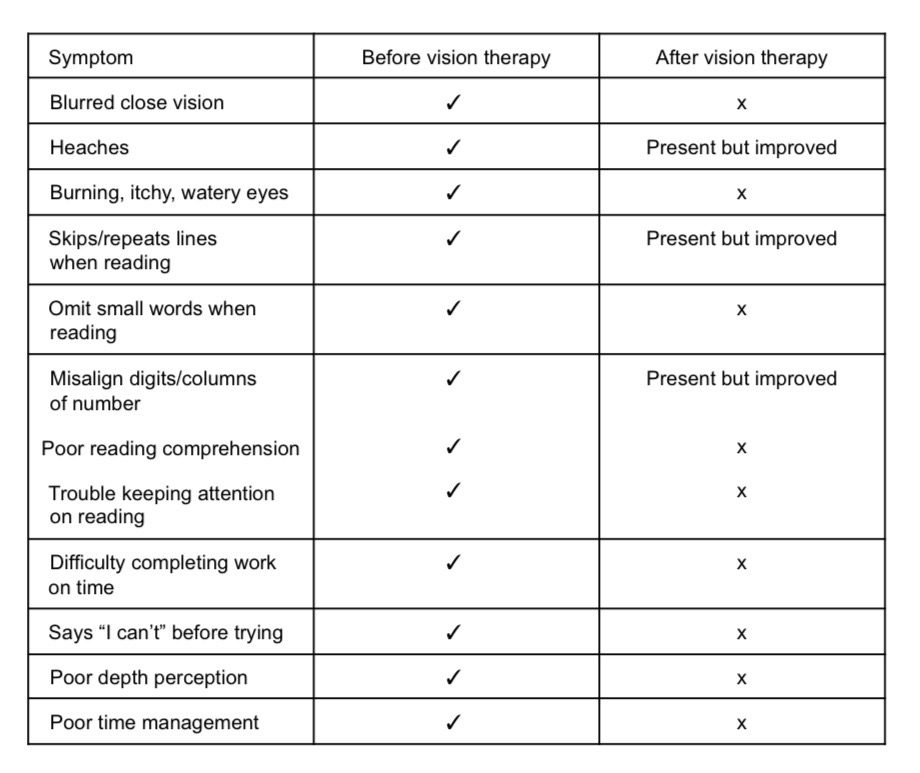
The table below shows the improvements Anthony made in vision therapy. All the symptoms listed in the left column were present before vision therapy. Imagine how difficult schoolwork must have been for him! After vision therapy, most of his symptoms had disappeared. The few that remained were significantly improved.
Many children who struggle in school suffer from an undiagnosed vision problem. In fact, 1 out of every 4 school-aged children has a vision problem that affects their ability to learn. However, children don’t know that their symptoms aren’t normal. They usually assume that everyone else has the same problems that they do, so they rarely complain. This often leads to poor self esteem; children see their peers excel in school while they struggle.
If you are a parent, aunt, uncle, grandparent, or teacher, sit down with the child in your life and ask them if they experience any of the symptoms in the following list:
- Avoids reading or near work
- Loses place while reading
- Uses finger or marker to keep place
- Skips words or lines
- Re-reads the same line
- Slow reading
- Poor reading comprehension
- Omits or substitutes words
- Difficulty copying from board or paper
- Short attention span for near tasks
- Headaches with near work
- Eyes hurt
- Eyes feel tired
- Burning or stinging eyes
- Watery eyes
- Blurred vision at near
- Blurred vision at distance
- Words move, jump, swim, or float
- Double vision
- Sees better with one eye closed
- Tilts head or closes one eye to read
- Poor depth perception
- Clumsy or bumps into things
- Motion sickness
- Dizziness or nausea with visual tasks
If your child answers “yes” to any of these questions, schedule a binocular vision exam for them.
By uncovering their vision problems and finding treatment, you may change the course of your child’s life.
Any content, resident submissions, guest columns, advertisements, and advertorials are not necessarily endorsed by or represent the views of Best Version Media LLC (BVM) or any municipality, homeowners associations, businesses, or organizations that this publication serves. BVM is not responsible for the reliability, suitability, or timeliness of any content submitted, inclusive of materials generated or composed through artificial intelligence (AI). All content submitted is done so at the sole discretion of the submitting party.