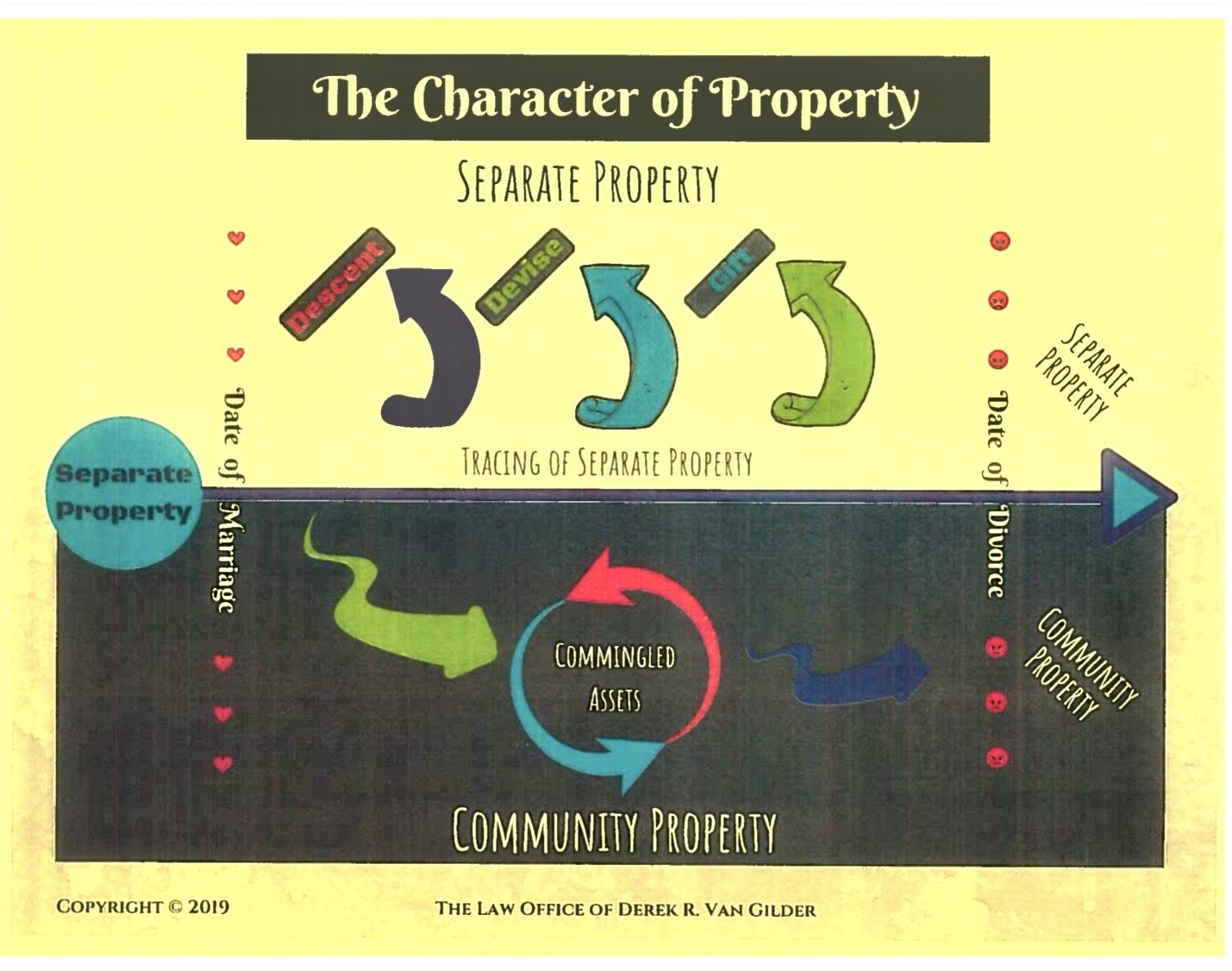
Whenever a couple decides to separate and get a divorce, one of the concerns involves the determination of the character of real and personal property in a divorce. Property is classified as either separate or community property. Please look at the chart below as to such characterization.
(Submitted by Derek R. Van Gilder)
First, the definition of community property is anything that comes into the marriage is considered community property with a few exceptions. From the time a couple get married, everything, including income, salaries, and purchases of any property is considered community property. The exceptions include anything that comes in by gift, devise or decent.
Examples of a gift is just that. Aunt Sally gives the husband or wife a gift of $10,000. That is separate property. If Aunt Sally dies and gives either spouse $10,000 in her Will, that is considered separate property of the person receiving such money. Finally, if Aunt Sally dies and the husband or wife is a relative that receives $10,000, from her estate that amount is considered separate property.
Also, any property that one party owns prior to the marriage is also considered separate property. If one spouse had purchased a home prior to the marriage, that home would be separate property just like any other property-real or personal- that is owned prior to a marriage.
There are two other principles that govern the characterization of property in a marriage. The first is the tracing principle. If you can trace the origin of a particular piece of property as to its source, then that property continues to have that character. The house purchased prior to a marriage continues to be separate property as long as one can trace the title and origin.
The second principle is commingling. If one person has separate property and commingles it with community property, then the separate property loses it character of separate property. So, the separate property money that Aunt Sally has given is put into a community account, that separate property money can then be considered community property.
There are some other nuances that have to be considered so one should consult an attorney whenever there is an issue with the identification or characterization of property.