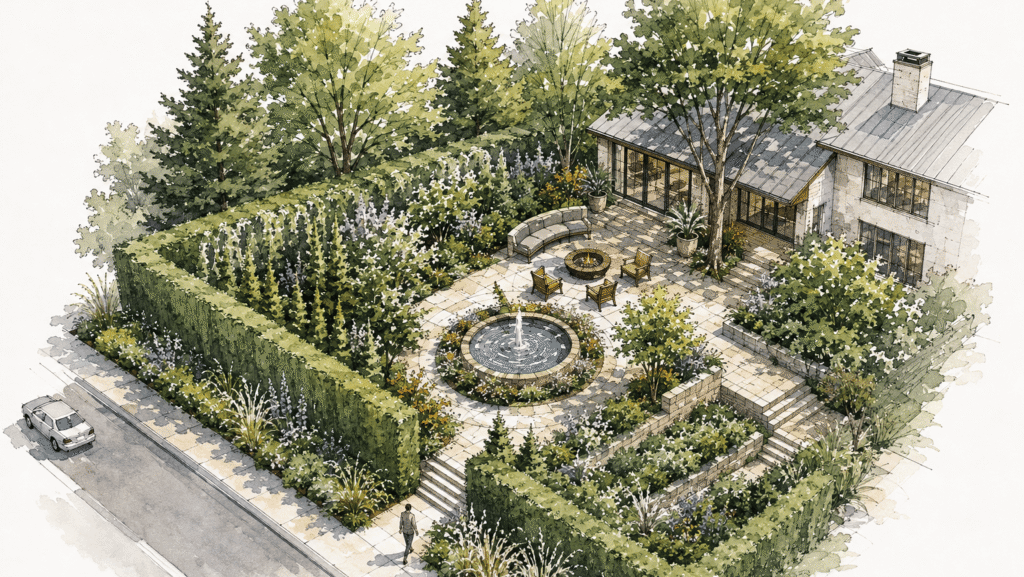
The instinct, when a property feels exposed, is to build a wall. Walls solve one problem and announce several others. They communicate defensiveness. They draw attention to exactly what the owner is trying to protect. They do nothing for elevated sightlines, nothing for sound, and along this coastline, they rarely solve the actual problem—which is not that the boundary is undefined, but that the experience of the interior space feels observed.
The properties that achieve genuine seclusion—where you stop registering the outside world entirely, where a conversation on the terrace feels private even though the property line is forty feet away—do it through landscape. The mechanism is considerably more deliberate than it appears from the result.
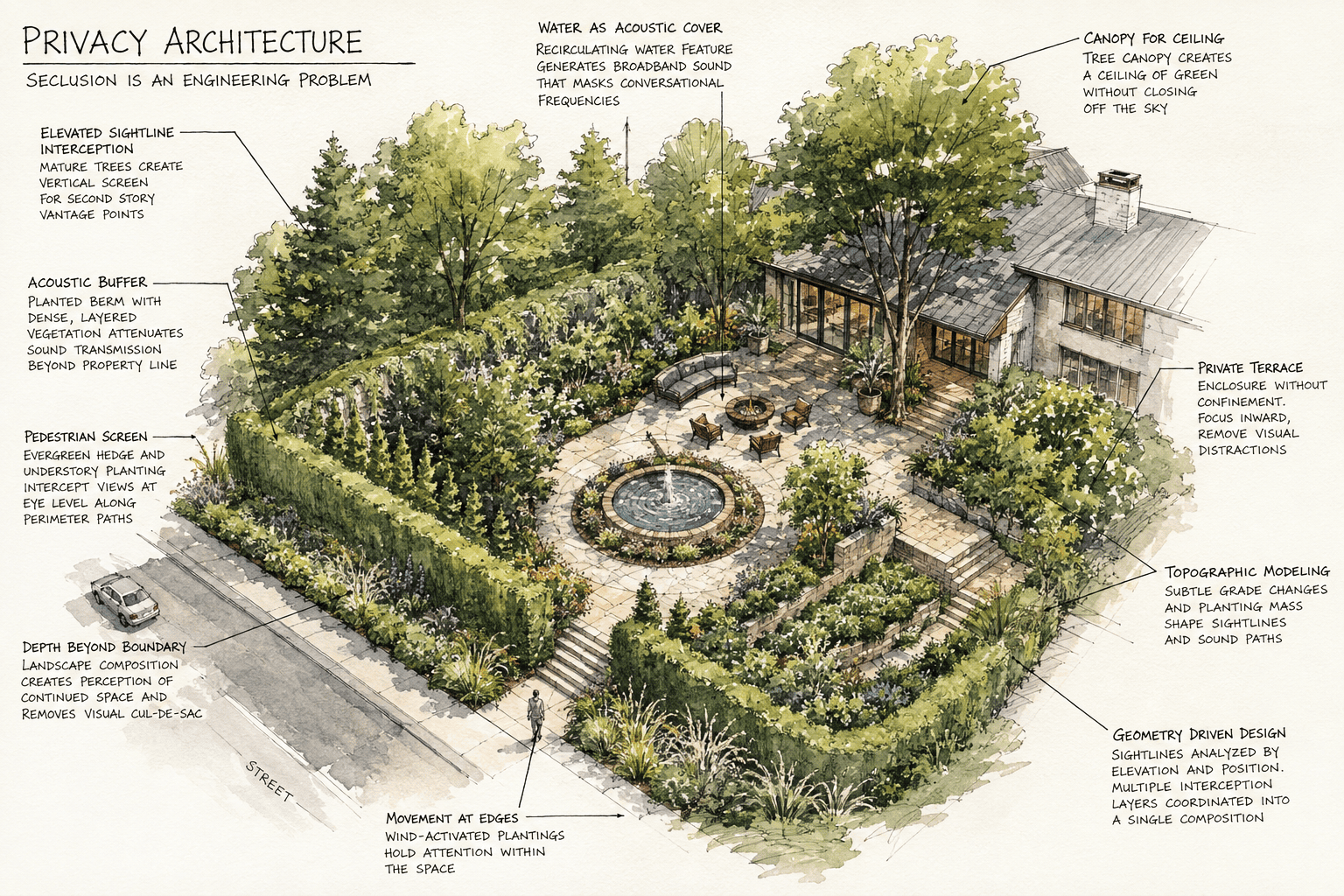
Effective privacy design begins with geometry. Where is the viewer and at what elevation, moving or stationary? A car on the road, a pedestrian on the path and a neighbor on a second-floor terrace each require different interception geometry—different plant heights, different canopy densities, different horizontal positions relative to the area being screened. A mature hedgerow that solves the road sightline may do nothing for the elevated angle from an adjacent property’s guest room. A planted berm addressing pedestrian movement along the perimeter creates no acoustic benefit whatsoever. These are separate problems requiring separate solutions, coordinated into a single coherent composition that reads as landscape rather than security measure.
Submitted photo
Sound is engineered independently from sight in a serious privacy system. Water features here are not primarily decorative—they generate broadband acoustic coverage that masks conversational frequency specifically. The placement, volume and acoustic signature of a recirculating feature is calibrated to the geometry of the space it serves and the sound environment it must override. Planted berms with appropriate soil density and vertical mass attenuate transmitted sound differently than a fence of equivalent height. The combination of topographic intervention planted mass and moving water can create environments where normal conversation stays private within a surprisingly constrained perimeter.
The psychological dimension is where most privacy design ultimately falls short. A landscape that creates genuine seclusion—where the nervous system stops registering exposure and relaxes into the space—does specific things. It provides enclosure without confinement, using canopy to create a ceiling without closing off the sky. It creates the perception of depth beyond the boundary, so the eye reads the space as extending further than it actually does. It uses movement at the edges—the animation of planted material in coastal wind—to hold attention within the space rather than drawing it outward.
This is engineering with biological materials. It requires survey data, sightline modeling, and a designer who understands that privacy is an experiential outcome, not a product category you specify from a menu.
Any content, resident submissions, guest columns, advertisements, and advertorials are not necessarily endorsed by or represent the views of Best Version Media LLC (BVM) or any municipality, homeowners associations, businesses, or organizations that this publication serves. BVM is not responsible for the reliability, suitability, or timeliness of any content submitted, inclusive of materials generated or composed through artificial intelligence (AI). All content submitted is done so at the sole discretion of the submitting party.