One of the most important parts of managing a residential building project is managing the contractor/homeowner relationship. We are going to explore this relationship over the next few articles. Let’s start with You (the homeowner) and how you can manage your side of this relationship.
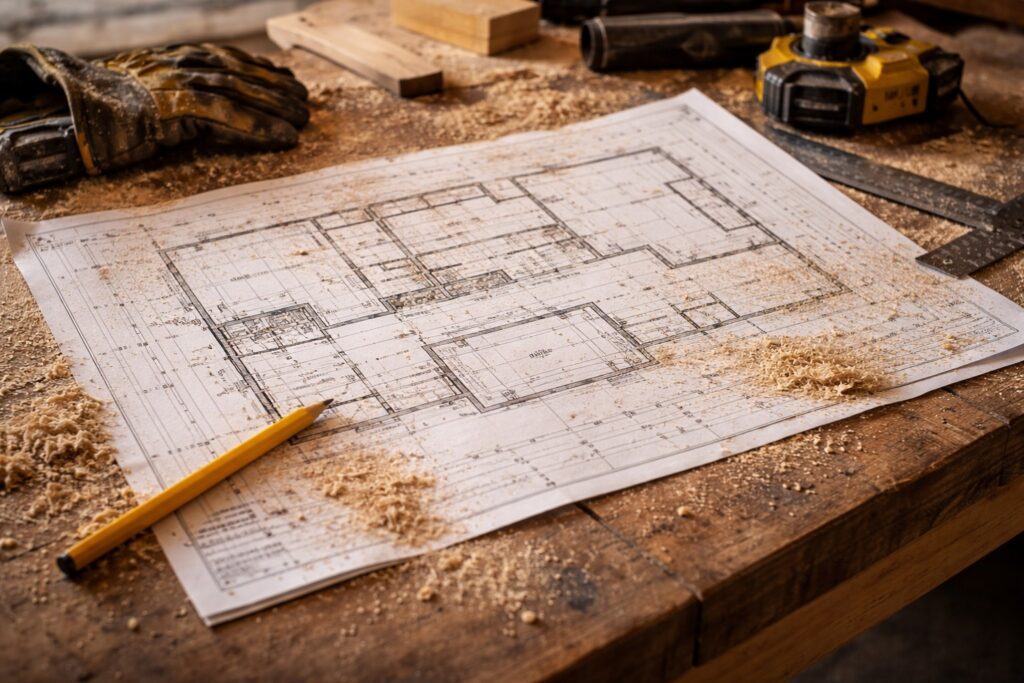
- Have a plan — It’s okay if you don’t have an architect or blueprints/drawings before you start looking for a builder, but it will save you thousands of dollars to have your new or remodel space worked out thoroughly on paper or computer before anyone starts working on your house. Your contractor should be able to refer you to an architect or draftsperson or create plans in-house that are ready for the permitting process. Your plans are your best foot forward to a positive relationship with your contractor. Try to make as many decisions as you can up front before the crew comes to your house.
- Choose wisely — In our area, there are basically three types of contractors: 1-3-man band, small companies like mine with 4-10 employees (and/or subcontractor labor), and the big guys with 15-50 trades people or more. Unless you have a small project, the smaller the outfit, the longer it will probably take to finish your project. But the smaller to middle sized contractor may be able to deliver higher quality and more personal attention to you. Although some of the biggest builders in our area also attract and retain some of the best carpenters, drywallers, and painters who do top-tier work, smaller contractors will probably be onsite more and even in the tools for small to medium companies. With bigger companies, you probably won’t have the owner working alongside the crew. Whatever size, you want an owner or project manager dedicated to finishing your project. Please find a licensed builder with proper insurance. Every year we seem to get projects where we have had to come in after other unlicensed workers have botched things up or ghosted the homeowner, leaving them with an unfinished project. A licensed builder is more obligated to complete projects, fulfill contracts, pass inspections, and hold your money in trust to pay for the costs of your project.
- Ask for a task-linked payment schedule — I haven’t always done this, but it’s good to have a draw schedule based on the completion of project milestones (demo, framing, insulating, drywall, paint, etc.) For smaller projects, it may be as simple as half up front and the rest upon completion, but you may have 5-10 milestones on a larger project and it’s difficult to match progress with exact payments. We try to get itemized invoices out to our clients every two weeks so client and contractor can compare costs to estimates.
- Monitor invoices carefully — Keep track of workers time on the job and let the contractor know if you see discrepancies in time tracking. Some companies use “time card” apps that only allow a worker to clock in when geolocation shows they are onsite and automatically clocks out when the worker leaves. With bigger projects across lots of invoices, you want to make sure that time or materials haven’t been double billed or unbilled. You can’t do much to control the “burn rate” of your payments once a project is underway other than scaling back the scope of work or choosing less expensive materials towards the end of the project.
- Read the fine print — Is your agreement a fixed bid price or a Time & Materials (T&M) agreement, or some hybrid? Fixed bids will likely be jacked up to make sure the contractor can make money despite unforeseen hiccups in the project. T&M projects can fall in your favor if the work goes smoothly and it takes less time than estimated, but cost overruns are common. We do a lot of remodeling of old homes where we often have to repair rot or fix original construction to bring it up to code. So, lately, we’ve been doing T&M agreements plus markups with a “Not to Exceed” 25% over the estimate clause.
- Pay on time — Most contractors have already paid their people and paid for materials or need to pay their building center accounts by the time you get the invoice. If you have a question about a $500 charge on a $20,500 invoice, pay the $20,000 and work out the issue with the contractor later instead of slamming the brakes on the project funding.
- Regular communication — Make it a habit to check in with your contractor at least once a week and ask for regular photo and text updates if you are not living onsite. It can be very stressful to live in a house while it’s being remodeled, so try to build a rapport with your builder beyond just picking paint colors and bathroom fixtures. It may feel like the contractor and crew have moved into your house, but they will be finished one day and you can enjoy your new space for years to come.
Any content, resident submissions, guest columns, advertisements, and advertorials are not necessarily endorsed by or represent the views of Best Version Media LLC (BVM) or any municipality, homeowners associations, businesses, or organizations that this publication serves. BVM is not responsible for the reliability, suitability, or timeliness of any content submitted, inclusive of materials generated or composed through artificial intelligence (AI). All content submitted is done so at the sole discretion of the submitting party.