How our local affiliate is redrafting the blueprint on affordable housing and why it matters to our entire community
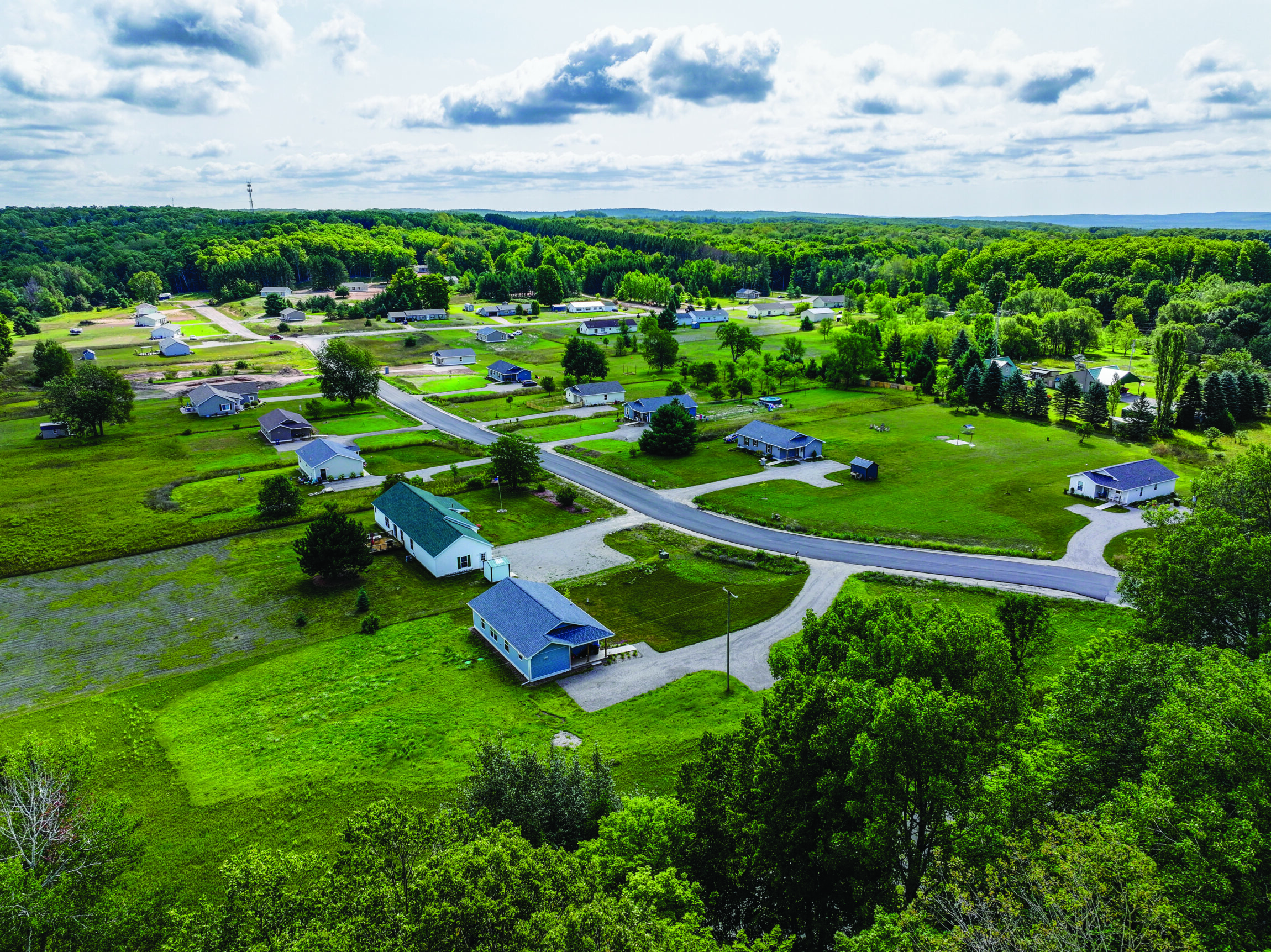
The early morning scene is familiar to anyone who has volunteered with Northwest Michigan Habitat for Humanity over the past three decades: a small crew gathered around a home under construction, volunteers in matching t-shirts and holding hammers, ready to raise a wall. It’s the steady work of building one family’s dream, one board and one nail at a time. But drive past our new Meadowlands development in Alanson, and you’ll see something fundamentally different. Where a single home once took 12- 18 months to complete, we now build more than 10 homes per year. In just four years, 38 families became neighbors in this thriving community. Where volunteers once spent hundreds of hours framing walls, precision-engineered modules now arrive from climate-controlled factories, assembled with exacting quality control. Where families once moved into scattered single-lot homes across the region, they now build community together from day one.
This isn’t your father’s Habitat. And that’s exactly the point. For decades, Habitat for Humanity’s model has been simple and effective: gather volunteers, build a home, change a family’s life. Our affiliate has built more than 60 homes this way, and each one represents stability and security for generations.
But we recognized a troubling reality: the workforce housing crisis was growing faster than we could address it. The people who make our resort community function—teachers, nurses, first responders—were being priced out of homeownership entirely. We realized we needed to fundamentally change our approach to home building.
Submitted photo
The evolution to modular neighborhood development represents a dramatic shift in our methods, but the heart of Habitat’s mission remains the same. The transformation is dramatic: what once took longer than five years—building 10 homes—now happens in one. Families achieve housing security years sooner, and children gain stability when it matters most for their development. Donor dollars stretch further when building a consolidated neighborhood development, while factory precision delivers superior quality and eliminates weather delays and exposure damage.
Perhaps most importantly, we’re creating an intentional community near schools, employment, nature trails—the kind of social environment that research shows produces better outcomes for children, stronger financial stability, and higher civic engagement.
While our methods have evolved, Habitat’s core remains the same. Every homeowner still invests 200 hours of sweat equity—work that now extends to building their neighbors’ homes and community from the ground up. Comprehensive financial literacy and homeownership preparation remain central to our program. We serve families making up to 120% of the Area Median Income who demonstrate the ability to secure mortgage approval and the willingness to partner with us during their homeownership journey. The transition hasn’t been without challenges. Bob Turk, Habitat Board President, is candid about the learning curve: “We’ve had to build new partnerships with modular manufacturers, rethink our volunteer engagement program, sweat equity requirements, and secure significantly larger land parcels. But seeing the first modules arrive and watching an entire street of homes take shape in days—we knew we’d made the right decision.”
This model offers unprecedented opportunities to invest in Northwest Michigan Habitat for Humanity’s nationally recognized and proven, scalable solution to our workforce housing crisis. Through corporate partnerships and volunteering, or financial support—you can create a visible, lasting legacy.
As the last families are preparing to move into Meadowlands, we’re already planning the next development. This model’s success proves transformational change is possible.
Bob reflected: “Habitat was founded on a radical idea, that everyone deserves a decent place to live, and that communities working together can make that happen. We haven’t abandoned that idea. We’ve just found a more powerful way to bring it to life. This is still Habitat. It’s just Habitat evolved.” The hammers, t-shirts, and early morning volunteers aren’t gone. They’ve just been joined by factory precision, neighborhood-scale vision, and a commitment to meeting the moment our community is in. This isn’t your father’s Habitat. It’s your community’s Habitat—reimagined for the challenges and opportunities of today.
Any content, resident submissions, guest columns, advertisements, and advertorials are not necessarily endorsed by or represent the views of Best Version Media LLC (BVM) or any municipality, homeowners associations, businesses, or organizations that this publication serves. BVM is not responsible for the reliability, suitability, or timeliness of any content submitted, inclusive of materials generated or composed through artificial intelligence (AI). All content submitted is done so at the sole discretion of the submitting party.