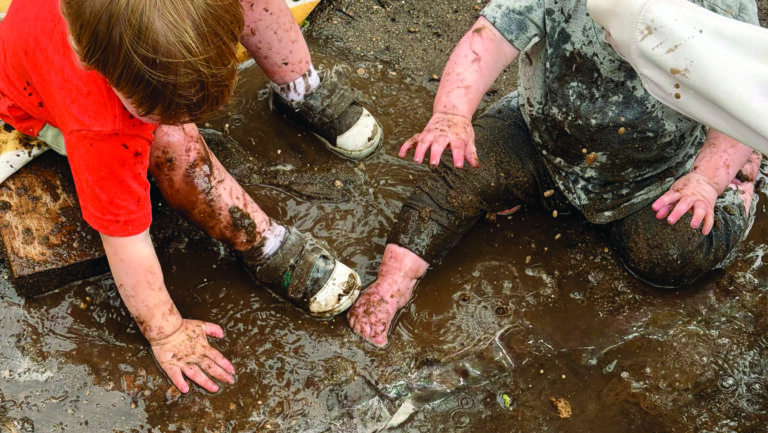
When adults hear the word “learning,” we often picture a teacher leading a lesson, children completing an activity, or a finished product that can be sent home. For young children, however, some of the most meaningful learning looks much simpler: digging in the dirt, building with sticks, pouring water between containers, pretending to run a restaurant, or trying again and again to climb onto a log.
Play is not a break from learning. Play is how young children learn.
When children build a tower, they experiment with balance, size, cause and effect, and early engineering concepts. When they make mud pies with friends, they practice communication, cooperation, sequencing, and flexible thinking. Running, climbing, carrying, and digging strengthen the body while developing coordination, spatial awareness, and confidence. Even disagreements during play offer valuable opportunities to practice expressing needs, considering another person’s perspective, and solving problems.
The deepest learning often happens when adults resist the urge to take over. If a child is struggling to move a heavy branch, immediately moving it for them may solve the problem—but it also ends the investigation. A thoughtful adult might instead ask, “What else could you try?” or “Would another tool help?” This keeps the child in charge of the thinking while still providing support.
Children also benefit from long, uninterrupted periods of play. It takes time to choose an idea, gather materials, create a plan, encounter a problem, adjust that plan, and continue. Frequently moving children from one adult-directed activity to another can interrupt the very concentration and persistence we hope they will develop.
At Over Yonder Nature School, this belief is central to The Rooted Child Project, our educational approach designed around the whole child. It brings together early academics, practical life skills, emotional development, observation, discovery, and meaningful outdoor experiences. Rather than separating learning into isolated subjects, it recognizes that children develop across many areas at once. A garden investigation may include science, language, mathematics, teamwork, responsibility, and wonder—all within one authentic experience.
Teachers support this work by observing closely, preparing inviting environments, asking meaningful questions, and introducing skills when children are developmentally ready. Low teacher-to-child ratios allow educators to know each child well and respond to individual needs rather than expecting every child to learn in the same way or on the same timeline.
Families can encourage this kind of learning at home without purchasing special materials or planning elaborate activities. Offer open-ended items such as cardboard boxes, bowls, fabric, blocks, chalk, water, or natural objects. Allow children to be bored long enough to create their own ideas. Ask questions that invite thinking instead of testing: “What did you notice?” “How did you figure that out?” or “What do you think will happen next?”
Most importantly, look beyond the mess or the absence of a finished product. A child who spends an hour moving rocks, mixing leaves, or building a shelter may be developing far more than we can immediately see. Curiosity, independence, resilience, creativity, and collaboration are not extras in early childhood. They are the foundation for everything that comes next.
Any content, resident submissions, guest columns, advertisements, and advertorials are not necessarily endorsed by or represent the views of Best Version Media LLC (BVM) or any municipality, homeowners associations, businesses, or organizations that this publication serves. BVM is not responsible for the reliability, suitability, or timeliness of any content submitted, inclusive of materials generated or composed through artificial intelligence (AI). All content submitted is done so at the sole discretion of the submitting party.