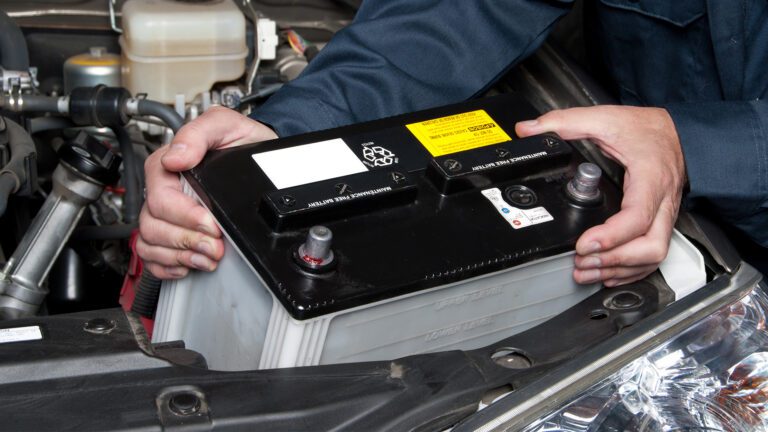
As a battery expert here at Batteries Plus, I often see customers standing in our aisles, staring at the shelf and wondering, “Does it really matter which battery I pick?” The short answer is yes. While both AGM and traditional flooded lead-acid batteries share the same fundamental chemistry, how they are built changes everything about how they perform, how you maintain them, and how long they will last in your car or truck.
Both technologies are lead-based, but their internal design sets them apart.
- Traditional Flooded Lead-Acid Batteries: These are the classic “wet cell” batteries that have been around for over a century. They feature lead plates submerged in a free-flowing liquid electrolyte solution. Because they contain liquid, they must be kept upright to prevent leaks and require room for gases to escape.
- AGM (Absorbent Glass Mat) Batteries: These are a modern evolution. Instead of a pool of liquid, AGM batteries use thin fiberglass mats between the plates that absorb and hold the electrolyte. This makes them sealed, spill-proof, and highly resistant to vibration.
Performance and Reliability
Choosing the right battery depends on your vehicle’s technology and your driving habits.
- The Case for AGM: If you drive a newer vehicle equipped with automatic start-stop technology, advanced safety features, or many high-drain electronic accessories, AGM is often the superior choice. AGM batteries charge significantly faster and have lower internal resistance, allowing them to deliver power more efficiently. They are also better suited for deep cycling, meaning they can handle being discharged and recharged repeatedly without losing capacity as quickly.
- The Case for Flooded: If you are driving a standard vehicle with moderate electrical demands and are looking to save money upfront, a high-quality flooded lead-acid battery is still a proven, reliable workhorse.
Maintenance: The “Set It and Forget It” Factor
One of the biggest advantages of upgrading to an AGM battery is the difference in maintenance requirements.
- AGM: These are essentially maintenance-free. Because they are sealed, you never have to worry about checking fluid levels or adding water.
- Flooded: These require a bit more attention. To get the most life out of a flooded battery, you should periodically check the electrolyte levels and top them off with distilled water if the caps are removable. You also need to keep a close eye on the terminals to prevent corrosion buildup, which is a common issue for wet-cell designs.
A Note on Longevity and Cost
While AGM batteries have a higher upfront cost, many drivers find them to be a better long-term value.
- AGM batteries typically last 4 to 10 years, compared to the 3 to 5-year lifespan common for standard flooded batteries.
- Flooded batteries are the most budget-friendly option at the cash register, but you may find yourself replacing them more frequently.
Pro-Tips for Battery Care
Regardless of which battery you choose, here is how you can ensure it lasts as long as possible:
- Keep Terminals Clean: For all battery types, periodic cleaning of the terminals helps prevent corrosion and ensures a strong connection.
- Use the Right Charger: If you use a battery charger or maintainer, be careful. AGM batteries require precise voltage control to avoid overcharging, which can permanently damage them. Always ensure your charger has an “AGM” setting.
- Monitor Your Driving: If your vehicle has a flooded battery, be more vigilant about checking your electrolyte levels if you drive in high-heat areas, as heat can speed up evaporation.
Still unsure which one fits your specific truck or car? Stop by Batteries Plus in Howell. We can test your current battery’s health and help you decide if an upgrade to AGM is the right move for your vehicle’s electrical demands.
For more information visit: https://www.batteriesplus.com/store-locator/mi/howell/batteries-plus-1241/
Any content, resident submissions, guest columns, advertisements, and advertorials are not necessarily endorsed by or represent the views of Best Version Media LLC (BVM) or any municipality, homeowners associations, businesses, or organizations that this publication serves. BVM is not responsible for the reliability, suitability, or timeliness of any content submitted, inclusive of materials generated or composed through artificial intelligence (AI). All content submitted is done so at the sole discretion of the submitting party.