Living in the Wasatch Back, movement isn’t just something we do, it’s how we live. We ski, golf, hike, bike, ride, train, chase after our kids, and bring our dogs along for every step of the journey. We ask a tremendous amount of our bodies, often without realizing how much we’re compensating until pain sets in or we’re sidelined from what we love.
I see the exact same pattern in animals.
A dog might hesitate before jumping into the truck. A horse might suddenly struggle to bend to the left or pick up a correct lead. Sometimes the signal is obvious; more often, it’s remarkably subtle.
As a sports medicine clinician and chiropractor who treats both people and animals, I’ve learned a fundamental truth over the course of my career: movement tells a story. My job is to listen closely and decipher what that story is telling us.
More Than “Where Does It Hurt?”
When someone walks into my office, I don’t simply adjust the area that hurts and send them on their way. I want to understand why it hurts in the first place.
How are you moving? Where are your restrictions? What is compensating for a hidden weakness? Is an old, forgotten injury altering how your body functions today?
With a foundation in sports rehabilitation, my approach to care is rooted in whole-body movement mechanics. While a spinal adjustment is often a key piece of the puzzle, effective treatment requires a full toolkit. Depending on what your body needs, care may integrate dry needling, cupping, soft-tissue therapy, Class IV laser, shockwave, spinal decompression, or targeted movement rehabilitation.
Tools are never applied arbitrarily; every modality serves a specific purpose, and every care plan must be as unique as the individual standing in front of me.
And sometimes, that patient happens to stand on four legs.
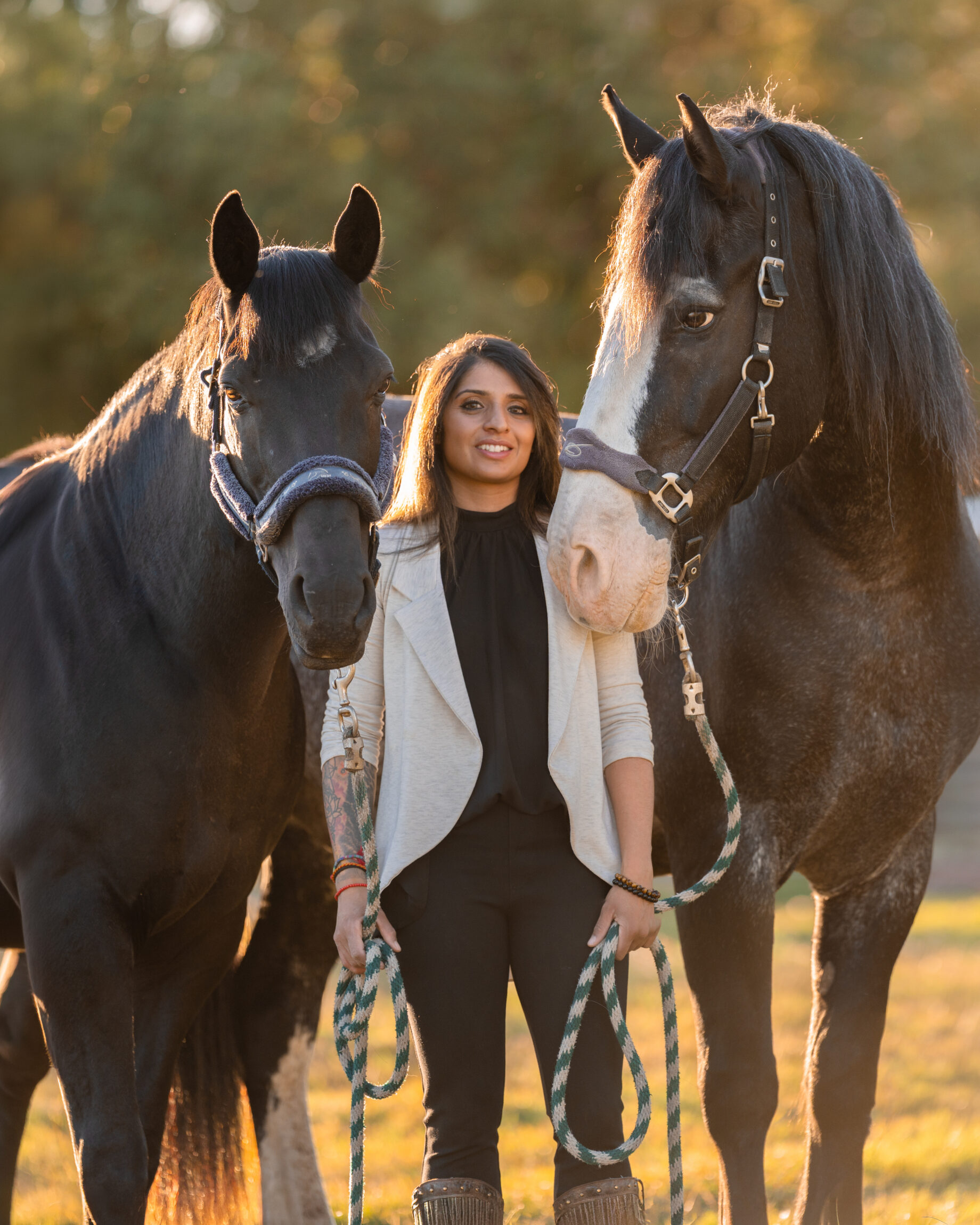
Submitted photo
Different Patients. Same Philosophy.
Treating both humans and animals is easily one of the most rewarding dimensions of my practice.
A golfer needs rotation and mobility through the spine to swing freely. A skier relies on multi-planar stability and coordination. A performance horse requires efficient mechanics to carry weight fluidly under saddle. And a trail dog needs comfortable, resilient joint motion to join you on the trail, or simply leap into the car for the next weekend adventure.
The patient changes, but the clinical philosophy remains identical.
With animals, I evaluate movement patterns, posture, joint mobility, muscle symmetry, and subtle performance changes. Alongside chiropractic adjustments, therapies like Class IV laser, shockwave, and PEMF (Pulsed Electromagnetic Field) therapy allow us to address tissue healing and recovery at a deeper cellular level.
What Should You Look For?
In human patients, indicators worth investigating include persistent neck or back discomfort, tension headaches, sciatica, chronic tightness, reduced range of motion, recurring athletic injuries, or simply a feeling that your body isn’t firing the way it used to.
In dogs, watch for subtle signs like hesitation on stairs, stiffness after resting, changes in gait, reluctance to play, or trouble getting up from their bed.
In horses, keep an eye out for difficulty bending through turns, trouble holding a lead, altered stride length, sensitivity during grooming or saddling, resistance under rider, or an unexplained drop in performance.
One of the most frequent things I hear from an owner or rider is: “I can’t quite explain it, but something just feels off.”
Trust that intuition. That observation is invaluable.
Chiropractic care does not replace primary medical or veterinary diagnostics. I believe strongly in integrative, collaborative care and in recognizing precisely when a condition requires chiropractic care, and when it requires a different medical pathway.
The Goal Is Bigger Than Pain Relief
Whether I’m working with a patient in my Heber or Park City clinic or meeting a horse out at the barn, I always begin with one question: What do you need to get back to doing?
Maybe that means playing 18 holes without your lower back seizing up. Maybe it’s carving turns down the mountain with your family, returning to heavy lifting, hiking local trails with your dog, or competing comfortably in the arena.
There is no assembly-line protocol waiting for you here. The treatment must adapt to the patient, never the other way around.
Throughout my career, I’ve had the privilege of treating everyone from active local families to high-level competitive athletes. Expanding into animal chiropractic gave me a fresh perspective on biomechanics, recovery, and human movement as well.
At the end of the day, whether my patient walks on two legs or four, the core mission never changes: help them move better, recover better, and live fully.
There’s too much life to enjoy here in the Wasatch Back to sit on the sidelines. Let’s keep you moving.
Any content, resident submissions, guest columns, advertisements, and advertorials are not necessarily endorsed by or represent the views of Best Version Media LLC (BVM) or any municipality, homeowners associations, businesses, or organizations that this publication serves. BVM is not responsible for the reliability, suitability, or timeliness of any content submitted, inclusive of materials generated or composed through artificial intelligence (AI). All content submitted is done so at the sole discretion of the submitting party.