Storms can bring strong winds and heavy rain, but some times the storm isn’t the only reason a tree fails. Existing damage, decay or structural problems can make a tree more vulnerable long before bad weather arrives.
While not every damaged tree needs to be removed, knowing what to look for can help homeowners recognize when it may be time for a professional evaluation.
1. DEAD OR HANGING LIMBS
Large dead branches, broken limbs or branches hanging in the canopy can fall without much warning. Pay particular attention to limbs over your home, driveway, vehicles or areas where your family regularly spends time.
2. CRACKS OR SPLITS IN THE TRUNK
Deep cracks or splits in the trunk, or separation where large limbs meet can indicate structural weakness. High winds can place even more stress on these areas.
3. DECAY OR CAVITIES
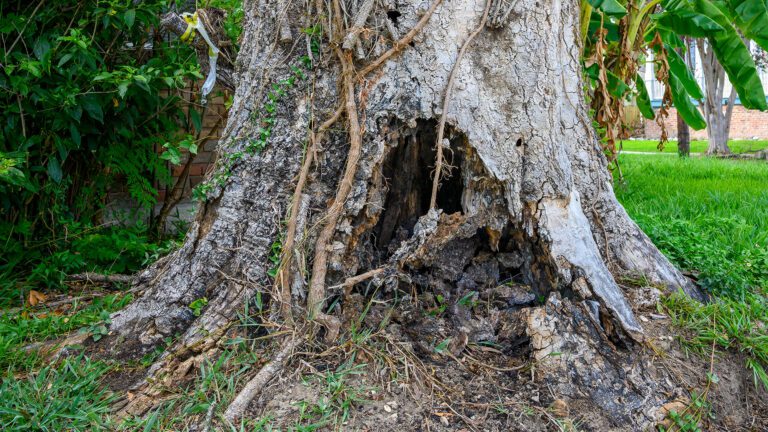
Mushrooms near the base, hollow areas, cavities or visibly decaying wood may indicate internal deterioration. A tree may still have green leaves even when portions of its trunk or root system are compromised.
4. CHANGES AROUND THE ROOTS
The root system anchors a tree. Look for exposed or damaged roots, soil lifting around the base or new movement in the surrounding ground. These signs can be especially concerning after heavy rain, when saturated soil can reduce a tree’s stability.
5. A NEW OR INCREASING LEAN
Some healthy trees naturally grow at an angle. However, a tree that has recently begun leaning or whose lean appears to be increasing deserves attention, particularly if it leans toward a house, driveway, utility line or other structure.
DON’T WAIT FOR THE STORM TO FIND THE PROBLEM
The best time to identify a potentially hazardous tree is before severe weather arrives. Walk around your property periodically, looking at the canopy, trunk and ground around each tree. If something has changed or simply doesn’t look right, a professional evaluation can help determine whether the tree needs pruning, monitoring or removal.
Being proactive can help protect your home, property, and the people around it before the next storm arrives.
Any content, resident submissions, guest columns, advertisements, and advertorials are not necessarily endorsed by or represent the views of Best Version Media LLC (BVM) or any municipality, homeowners associations, businesses, or organizations that this publication serves. BVM is not responsible for the reliability, suitability, or timeliness of any content submitted, inclusive of materials generated or composed through artificial intelligence (AI). All content submitted is done so at the sole discretion of the submitting party.