Every year, homeowners in The Villages ask the same question: Should I put my home on the market now, or wait until “peak season”?
The usual advice is to wait until winter, when seasonal residents and visitors return. More people in town should mean more buyers. However, sales data reveal an important distinction: the busiest months for closings are not necessarily the months when sellers should begin marketing their homes.
We reviewed every resale closing reported through the Multiple Listing Service (MLS) and The Villages® Listing Service (VLS) from January 2024 through August 2026. The pattern was consistent across all three years.
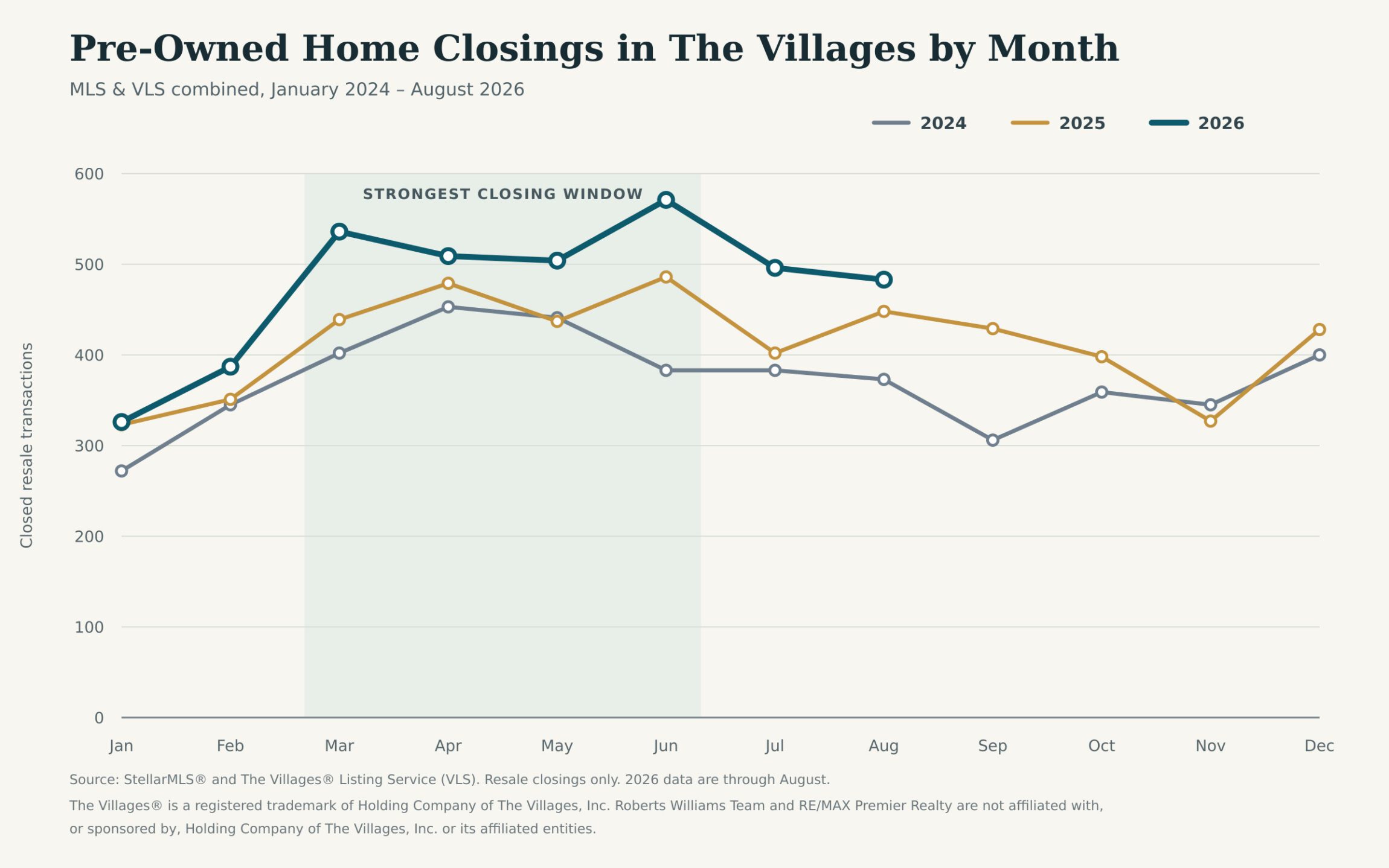
During January and February, the market averaged 334 resale closings per month. From March through June, that average jumped to 470 closings per month – an increase of approximately 41%. As the graph shows, sales activity did not peak at the beginning of the year. It built through the spring and, in some years, remained elevated into early summer.
At first glance, that might suggest waiting until March or April to list. In reality, it suggests the opposite.
A closing records the end of a transaction, not the beginning. Homes are currently taking an average of 60 to 70 days to go under contract. Once under contract, closing generally takes another three to six weeks. That means the homes closing from March through June may have first entered the market roughly three to four months earlier. In other words, sellers who want to benefit from peak-season activity should aim to be ready before the peak closing months.
Submitted photo
For many homeowners, that means using November and December to prepare: completing needed maintenance, improving curb appeal, reducing clutter, arranging professional photography and establishing a pricing strategy. Depending on the home and its competition, launching in December, January or February may provide exposure to buyers as seasonal activity is building.
By contrast, waiting until the market feels busiest can be risky. Other homeowners are watching the same seasonal patterns. By the time buyer activity is obvious, more competing properties will have entered the market. A seller who lists earlier will have an opportunity to attract buyers while their choices are still relatively limited. However, that does not mean every homeowner should rush to list. Historical closing totals alone cannot prove that an earlier listing will sell faster or command a higher price. Timing still depends on the home’s condition, its price range, the number of comparable properties available, and the seller’s own plans.
A golf-front designer home, a courtyard villa and a premier home each compete within different segments of the market. The relevant question is not simply, “How many buyers are in The Villages?” It is, “How many qualified buyers are looking for a home like mine, and how many options do they currently have?”
Still, the data challenge the idea that sellers should wait to list their homes until peak season is fully underway. If you are considering selling next year, the time to begin planning is now. You do not need to list tomorrow, but you should understand the competition, identify any needed preparations, and establish a launch date. Waiting until February, March, or April to begin this process may mean entering the market after the seasonal buying surge is already underway.
Any content, resident submissions, guest columns, advertisements, and advertorials are not necessarily endorsed by or represent the views of Best Version Media LLC (BVM) or any municipality, homeowners associations, businesses, or organizations that this publication serves. BVM is not responsible for the reliability, suitability, or timeliness of any content submitted, inclusive of materials generated or composed through artificial intelligence (AI). All content submitted is done so at the sole discretion of the submitting party.