Importance of Early Treatment
When is the ideal time for treatment? That will vary based on the needs of the patient. For most patients, the ideal time is in adolescence because the jaw is still growing. However, some patients need help earlier than that. For these patients, we offer early treatment. This treatment is designed to use the extensive growth still left for the jaw to better correct problems and avoid surgery and tooth extraction. Sometimes, the need is obvious, but not always. This is why all parents should have their child seen on or around their seventh birthday.
Why Age Seven?
At age seven, most children have their first adult molars, which establishes the back bite. This means that the doctor can see back-to-front and side-to-side tooth relationships and spot any major concerns. At this age, there is a lot of growing left to do and the doctor can use that to avoid invasive procedures.
Is Your Child a Candidate?
We cannot know this until we examine your child. These exam is easy and will help your child be comfortable with the idea of treatment if it is needed. Simply contact us to schedule your appointment.
Why Is Treatment Important?
Many people think orthodontic problems are simply aesthetic, but this is rarely the case. Problems with tooth and jaw alignment can cause problems ranging from gum disease to intestinal distress due to poor chewing. Ultimately, a healthy smile improves quality of life.
Types of Braces
Not all that long ago, there was only one type of braces. Now, there are all sorts of braces systems on the market or in development. Below are those we offer our patients.
Traditional Metal Braces
These braces are the most common type of braces used and are what most people picture when thinking of braces. Modern versions are lighter and better performing. They are made from high-grade stainless steel and use brackets and arch wires to straighten teeth.
Damon Braces
Damon braces are named for their creator, Dr. Dwight Damon. These are similar to traditional metal braces but use self-ligating technology. This makes them smaller, gentler, less visible, and more effective. Treatment tends to be much faster with Damon than traditional braces.
Ceramic Braces
Ceramic braces can either be traditional metal braces or Damon braces. Rather than metal brackets, they have ceramic ones that blend in with the teeth. They are fragile, and as such, they are only used on older patients and on teeth where the risk of them chipping is less.
Invisalign
Invisalign is a braces-like system that uses clear plastic aligners rather than metal pieces. These aligners are custom made for each patient and are removable, making everyday life easier. They work for the treatment of most orthodontic conditions.
Orthodontic Appliances:
Palatal Expander
Palatal expanders are bonded to the upper molars. The appliance places pressure on the upper jaw to widen it. It is used whenever the upper jaw is so narrow that is causes tooth crowding. This appliance works when the patient is still growing by encouraging more bone to grow between the two halves of the jaw.
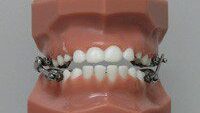
Herbst Appliance
Herbst appliances are worn when the patient has a lower jaw that is too small. This causes the upper teeth to protrude and the lower teeth to bit into the roof of the mouth. The Herbst appliance prevents the lower jaw from moving backward and encourages growth so it can catch up with the upper jaw. This appliance can be adjusted and does require the patient to change their diet.
Palatal Expander
Palatal expanders are bonded to the upper molars. The appliance places pressure on the upper jaw to widen it. It is used whenever the upper jaw is so narrow that is causes tooth crowding. This appliance works when the patient is still growing by encouraging more bone to grow between the two halves of the jaw.
Lingual Arch
A lingual arch is a space maintainer, specifically designed to hold molars in place. In general, this appliance is used in children who lose their baby teeth too early or in children whose mouths do not have enough space for their permanent teeth to emerge. It is usually removed once all permanent teeth are in place.
Before/After
Our team is proud to share the hard work and determination required to make your smile special. That’s why 100% of the amazing before-and-after transformations below are real patients treated by Dr. Rodriguez. Just imagine what your new smile could do for you!
Eating with Braces
When you have braces, you must take care of them so you get the very best results. One of the ways you care for your braces is to avoid eating foods that can damage them. Hard, sticky, and sugary foods all have the potential to cause significant issues, as do habits like nail biting and pen chewing. To help you maintain your braces, here are some foods to avoid.
Examples of Sticky Foods to Avoid
- Gum (sugar-free or regular)
- Licorice
- Sugar Daddies/Babies
- Gummy Bears
- Toffee
- Tootsie Rolls
- Caramels
- Starbursts
- Now & Later
Examples of Hard Foods to Avoid
- Ice
- Nuts
- Popcorn
- Jerky
- Hard taco shells
- French bread crust/rolls
- Corn on the cob
- Apples and carrots (unless cut into small pieces)
- Bagels
- Chips
- Jolly Ranchers
- Pizza crust
- Hard pretzels
Examples of Sugary Foods to Minimize
- Cake
- Ice Cream
- Cookies
- Pie
- Candy
Be sure to check your appliance often for any damage. If you find problems, call us immediately 305-754-5081.