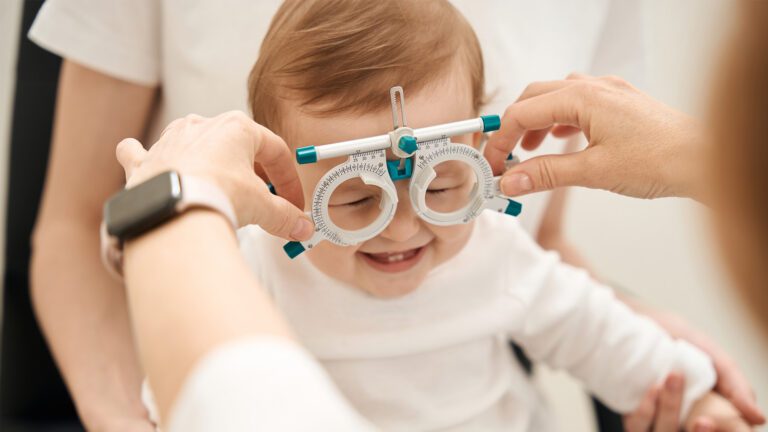
A new class of eyeglass lens — Essilor’s Stellest — aims to change how clinicians manage childhood myopia. Market-authorized by the U.S. Food and Drug Administration on Sep. 25, 2025, Stellest is the first spectacle lens to receive FDA marketing authorization for a myopia-slowing claim after randomized clinical testing, and it’s already available in many countries where myopia control is part of routine pediatric eye care.
What Makes Stellest Different?
At first glance, Stellest looks like an ordinary single-vision lens: it gives clear distance correction in the central field. The difference is a carefully engineered pattern covering most of the lens surface outside a central 9 mm clear zone. That pattern is a constellation of 1,021 tiny, highly aspheric “lenslets” arranged in 11 concentric rings. Essilor calls the approach H.A.L.T. (Highly Aspherical Lenslet Target) technology — a design meant to create a volume of myopic defocus on the peripheral retina that, according to current theory and experimental evidence, signals the eye to slow axial elongation and therefore reduce progressive myopia.
How it Works – Simplified
Traditional single-vision spectacles correct focus at the central retina but leave the mid-peripheral retina relatively under-focused, a condition associated with stimulation of eye growth. Stellest’s aspheric lenslets add controlled zones of purposeful myopic defocus (images focused slightly in front of the peripheral retina). Laboratory modelling and clinical data suggest the lenslet constellation produces a continuous three-dimensional volume of this defocus across gaze positions, so the myopia-slowing signal is present across much of a child’s normal visual field — during distance viewing, near tasks and while the eyes move. The design aims to provide myopia control without noticeably degrading central vision.
What the Clinical Evidence Shows
Essilor and independent groups have published and presented prospective randomized data. In a multicenter, randomized, double-masked clinical trial that supported regulatory authorization, children wearing Stellest showed substantially slower myopia progression than peers wearing conventional single-vision spectacles. Reported headline results include roughly a ~71% reduction in spherical equivalent progression and a ~53% reduction in axial elongation over 24 months versus single-vision controls. Other published and conference studies report consistent reductions in progression and generally good tolerance with minimal effect on distance and near acuity when lenses are fitted properly.
Visual Performance and Tolerability
One of the practical questions for parents and clinicians is whether the lenslets cause ghosting, blur, or problems with reading, sports, or binocular vision. Clinical reports and manufacturer data indicate that most children adapt quickly: the central 9 mm clear zone preserves sharp central vision while the surrounding lenslets have been engineered to minimize subjective visual disturbances. Standard clinical fitting rules (correct centration, appropriate frame choice, and accurate prescription) are recommended; eye-care professionals should counsel families about a short adaptation period and monitor acuity and comfort. Peer-reviewed studies have specifically measured distance and near acuity, contrast sensitivity, and binocular function and found only small, clinically acceptable differences compared with single-vision lenses.
Myopia Management: Where Stellest Fits
Stellest joins a growing toolbox that includes low-dose atropine eye drops, orthokeratology (overnight corneal reshaping contact lenses), and certain dual-focus or multifocal soft contact lenses — all options that have shown efficacy in slowing myopia. Many clinicians now view spectacle-based options such as Stellest as an attractive first-line or adjunct therapy for young children because spectacles are non-invasive, carry low systemic risk, and are straightforward to fit and supervise. Some clinical teams are also studying combined approaches (spectacles plus low-dose atropine) to optimize outcomes. Decisions should be individualized based on age, rate of progression, lifestyle, and safety considerations.
- Why is myopia control so important?
As the eyeball continues to elongate unchecked during those childhood and adolescent years, it places undo stress on the retina as it has to continue to “stretch” to cover the eyeball. This “stretching” can lead to a host of medical issues, including a retinal detachment, myopic macular degeneration, glaucoma, cataracts, posterior staphyloma and even stimulate more extreme levels of myopia. - Bottom line
Stellest represents an important, evidence-based spectacle option for pediatric myopia management. With FDA market authorization in late September 2025 and growing peer-reviewed data, the lenses offer a scientifically principled way to slow progression while maintaining clear central vision. Families interested in myopia control should discuss suitability, expected benefits, and follow-up plans with an eye-care professional who can explain how Stellest compares with other available interventions and how it might fit into a child’s overall care plan.
Learn more about Sehy and Jones Community Eye Care by calling 217-342-2672 or visit us online at www.communityeyecare.com
Any content, resident submissions, guest columns, advertisements, and advertorials are not necessarily endorsed by or represent the views of Best Version Media LLC (BVM) or any municipality, homeowners associations, businesses, or organizations that this publication serves. BVM is not responsible for the reliability, suitability, or timeliness of any content submitted, inclusive of materials generated or composed through artificial intelligence (AI). All content submitted is done so at the sole discretion of the submitting party.