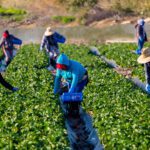
Agricultural communities in California’s Central Valley are facing increasing uncertainty as changes in federal immigration enforcement and labor policy affect the farm workforce. Many agricultural workers, including individuals with decades of experience, report uncertainty about whether they will continue working in future seasons. The U.S. Department of Labor has cautioned that labor shortages driven by reduced migration, limited legal workforce pathways, and stricter enforcement could pose challenges to agricultural production and food supply stability.
Local governments in farming-dependent communities are reporting economic impacts associated with these workforce changes. In Firebaugh, a city that typically experiences a seasonal population increase during harvest periods, taxable sales declined by 29% in the second quarter of this year compared to the same period last year, according to data from the California Department of Tax and Fee Administration. Chowchilla experienced a 21% decline over the same timeframe. Community organizations report reduced activity in public spaces and increased demand for food assistance services.
Farm operators indicate that labor availability issues are compounded by challenges within the federal H-2A temporary agricultural worker program. While the program provides a legal framework for employing seasonal workers, employers must meet specific requirements related to wages, housing, and transportation. Some employers describe these requirements as costly or difficult to implement, while worker advocates note that the standards are intended to protect labor conditions. The discussion highlights the ongoing debate over how to balance agricultural labor needs with regulatory compliance.
In October, federal agencies implemented changes to H-2A program rules that adjust wage calculations and allow certain deductions related to employer-provided housing. The United Farm Workers union has filed a legal challenge to these changes, arguing that they may reduce worker protections and limit labor availability. At the same time, families employed in agriculture are making decisions about remaining in the United States or relocating elsewhere, particularly when children are born domestically. Data from the Pew Research Center indicates that net migration has declined, with departures and removals outpacing arrivals for the first time in several decades.
These trends present operational and legal considerations for agricultural employers, workers, and service providers. Reduced labor supply can affect workplace conditions, reporting of injuries, and access to benefits. Legal professionals and advocates working with agricultural workers note that concerns related to enforcement, documentation, and family stability may influence whether individuals seek assistance. As workforce dynamics continue to evolve, stakeholders across the agricultural sector are assessing how to maintain production while ensuring compliance with labor and safety standards.
Our office is located at 4001 Atlantic Ave. We welcome walk-ins, and if I’m in the office, I will personally meet with you. Or, call or text me, I’ll answer (562)201-2630.
Any content, resident submissions, guest columns, advertisements, and advertorials are not necessarily endorsed by or represent the views of Best Version Media LLC (BVM) or any municipality, homeowners associations, businesses, or organizations that this publication serves. BVM is not responsible for the reliability, suitability, or timeliness of any content submitted, inclusive of materials generated or composed through artificial intelligence (AI). All content submitted is done so at the sole discretion of the submitting party.