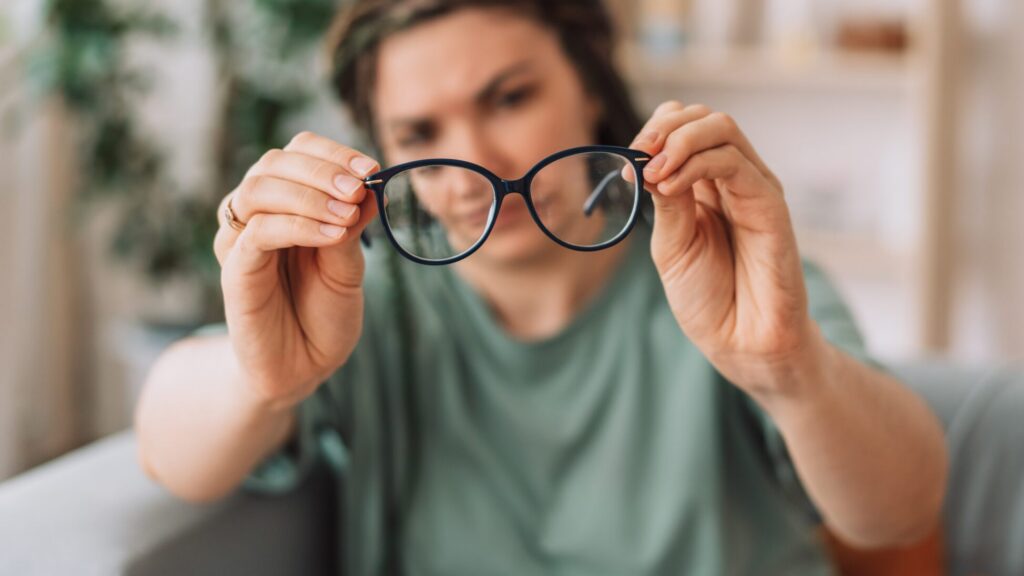
Myopia, Hyperopia, Astigmatism, Presbyopia…what is my eye doctor talking about!? These are the four major refractive errors labels that a person can live with and for which they may need corrective lenses.
What do they mean, and what would a prescription look like for each of them?
Myopia, also known as nearsightedness, occurs when the light entering the eye focuses on a point in front of the retina, making distance objects seem distorted or blurry. This type of prescriptionusually would have a negative number in the spherical portion (the first number). The higher the number is, the more refractive error there is and the more issues a person’s eye can develop. High amounts of myopia have been linked to increased risks of retinal tears, detachments, floaters, and glaucoma. Signs of myopia include squinting to see objects at a distance, holding books close to one’s face to read, or getting closer to a TV to see what’s one is watching. Trying to control the amount and speed of nearsighted changes in young people has become a huge issue, as more and more schools have changed to computer-based learning, which can cause increased nearsighted progression.
Hyperopia, also known as farsightedness, is the opposite of myopia, and is when light focuses past the retina, causing near objects to seem blurry. This type of prescription usually would have a positive number in the spherical portion. The higher the value, the more issues a person can have with reading. If left untreated in younger people, this can cause eye turns, lazy eyes, learning disabilities, reading comprehension problems, headaches, among other things.
Astigmatism is not a disease, but refers more to the shape of the cornea on the front of the eye. Eyes that do not have astigmatism have a round cornea, like a baseball. When light enters the eye, it bends at the same rate and comes to one fine focusing point. Eyes with an astigmatism are more oval/football-shaped. The long side bends light differently than the short, causing the image to focus at several different points, so that the image is never really clear. This causes lights to have halos and streaks, road signs to have a second set of floating “shadow” letters behind them, words on a computer screen to look like they are shaking, increased light sensitivity, headaches, and has been linked to attention deficit and dyslexia. The prescription would show another set of numbers, normally with a negative value followed by an axis vector, to know what direction on your eye the astigmatism needs to be corrected.
Presbyopia, the fourth refractive error, and great equalizer, has more to do with one’s birthday…Somewhere around 40-45 years of age, the focusing system in the eye loses flexibility, and reading anddistance vision begins to separate from each other. This causes people to start “playing the trombone” to find that perfect reading distance, and leads to the dreaded bifocal prescription.
Fun fact, it is more normal than not for one person to have a mix-and-match hodgepodge of these four different refractive errors and they can continue to change throughout life! The best way to know where your vision stands is to have an annual exam with an eye-care professional, who will not only assess the refractive error, but also look at the overall health of the eye and make sure to follow up on any other conditions that can affect how your vision can be maintained at its optimal level.