2025 is now in the books, and what a wild ride it was for the San Carlos residential real estate market. There were several events that profoundly influenced it, both negatively and positively, with the net being that the number of new listings and closed sales both increased substantially over 2024. Let’s look back to 2025 and forward to what 2026 may hold.
First, the real estate market almost always takes a pause every four years when there’s a Presidential election. This disruption is even more pronounced when there’s a wholesale change in the party that will be assuming power, because that usually means there are much more dramatic policy changes in store.
That was the case in 2025.
The most negative impact on the real estate market nationwide was the widespread and aggressive implementation of tariffs, which started in earnest on April 2. The immediate result of this policy was a staggering drop in the stock market, with the Dow tumbling 1,700 points in the blink of an eye and the S&P 500 losing $5 trillion in market value in just 48 hours.
For a real estate market that relies so heavily on a healthy stock market, this massive downward shift in wealth paralyzed our spring real estate market — a period when more homes are traditionally put under contract than at any other point of the year. Luckily, the market recovered most of its losses in about 4-6 weeks, but the constant threat of more tariffs kept consumer confidence on edge and kept many buyers on the sidelines.
Across San Mateo County, the median price of a single-family home dropped by nearly 6% between April and July, and the number of homes that sold dropped by 4%, so the pain of the tariffs was very real.
The job market also created some speed bumps for home sales. The lightning-fast shift to Artificial Intelligence forced many tech companies to rapidly retool their respective workforces to compete, and whenever the tech market shifts that quickly, you can count on there being turmoil and chaos. Some companies (Amazon, Intel, and Microsoft) were literally shedding thousands of employees in legacy divisions, while at the same time adding thousands of jobs in their AI divisions. That situation does not create confident buyers.
On the positive side, home mortgage interest rates slowly inched downward in 2025. While they did not achieve the “mid 5%” range that the optimistic experts predicted, the overall stability of rates convinced many buyers that the market “is what it is” and probably will be that way for several years in the future and encouraged some fence-sitters to get back into the market.
Total Sales Volume Up.
Despite the challenges noted above, the total sales volume for all San Carlos residential real estate, including condos and single-family homes, actually increased in 2025 compared to 2024. On one hand, that’s surprisingly good news. Considering that 2024 registered the lowest sales revenue in seven years, the bar was very low to begin with.
Prices Hit All-Time High.
If you were shopping for a home in San Carlos last year, then you were painfully aware that bargains were very few and far between. That’s because the average sales price of $2,746,167 and the median sales price of $2,645,000 for a single-family home were the highest ever recorded in San Carlos for a full year. That’s right — even higher than 2022, the last year that ultra-low home mortgage interest rates fueled the market.
The average and median sales prices jumped 7% and 10%, respectively, over 2024, and nearly 15% in just two years.
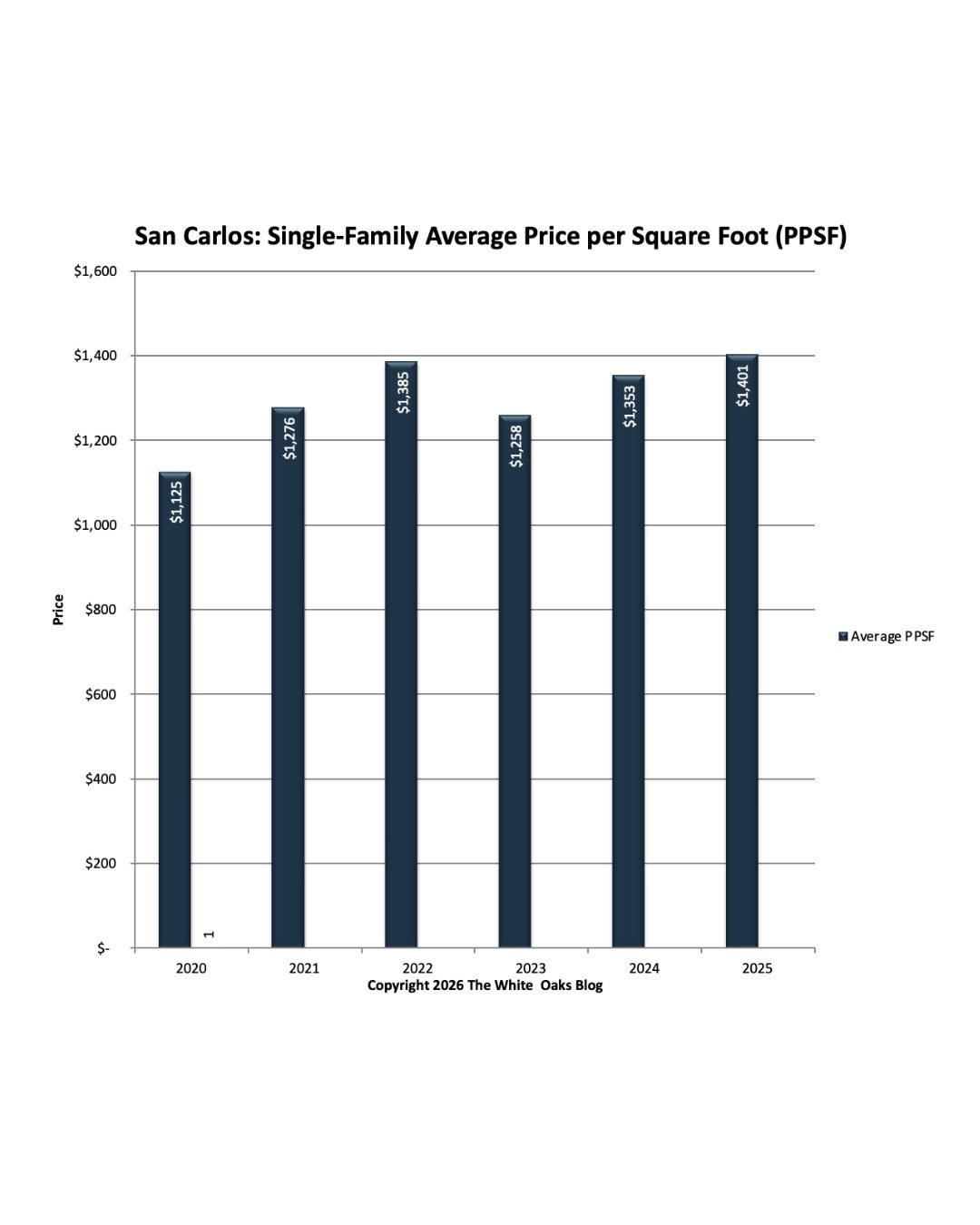
Another metric I often use to gauge price appreciation is the average price per square foot (PPSF). This graph tends to mirror the direction of the average and median sales price graphs, and this year is no different.
Unit Sales Increase.
If you had to pick the best news in the data, it’s probably this: The number of new listings and closed sales both increased substantially over 2024, thus marking the end of a painful three-year skid that saw the lowest number of home sales in several decades.
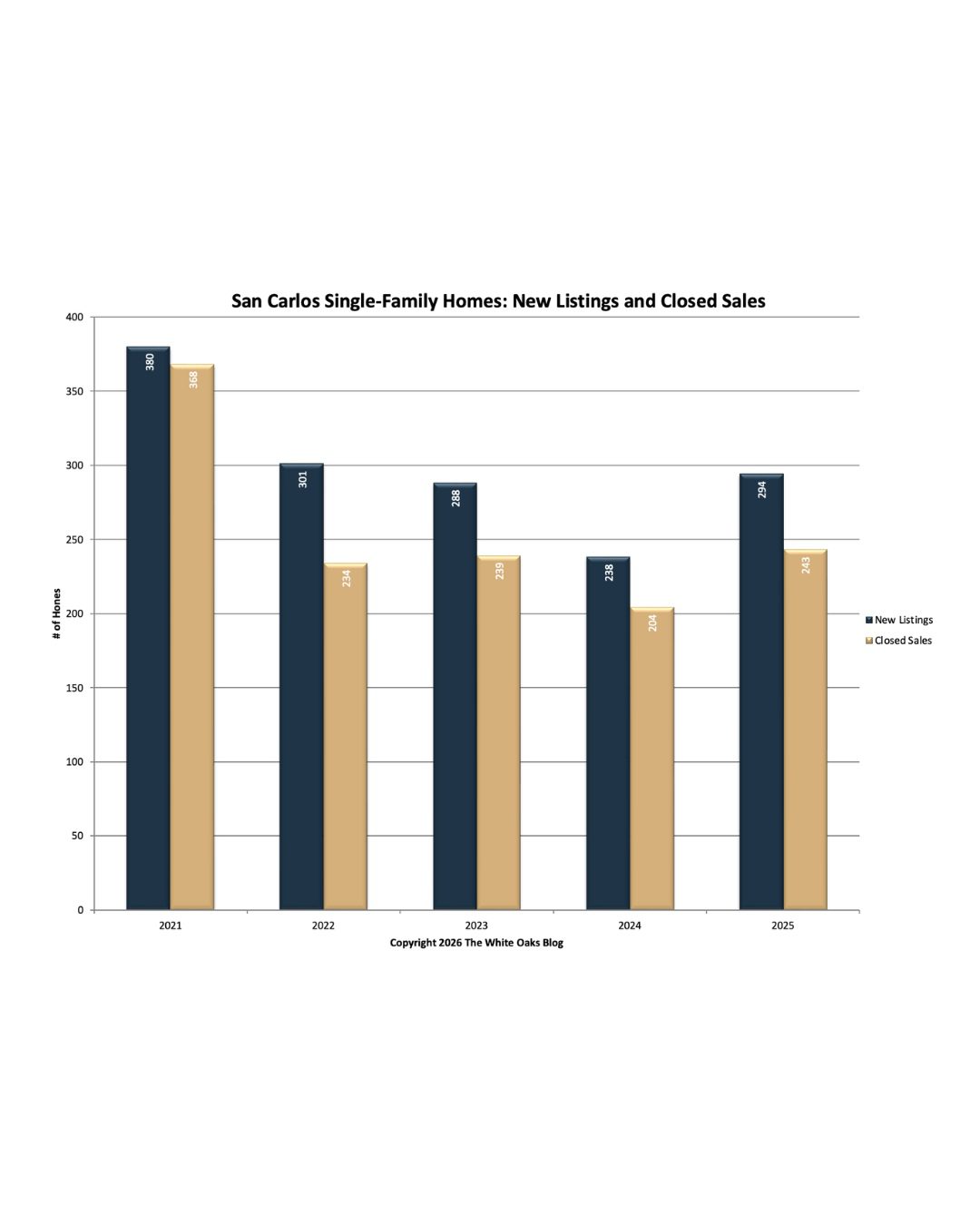
The number of new single-family homes listed in 2025 jumped by 24% over 2024, and the number of closed sales rose by 19% over the same period. While these figures are nowhere near historical averages, they are an indication that we’re slowly climbing back into a more active and balanced real estate market.
I believe that the results achieved in 2025 were largely the byproduct of stability. What we saw was an attitude of resignation — “it is what it is” — and those buyers and sellers that were waiting on the sidelines for something that was clearly not going to happen finally climbed back on board.
What to Expect in 2026
Looking ahead, here’s my take on a few key issues that will define the 2026 real estate market:
- Interest Rates. This will likely be the #1 topic in the first half of the year, because the current Fed Chairman’s term expires in May, and he will almost certainly be replaced by someone more in line with the administration’s wishes (lower interest rates). I believe we will see a modest improvement in interest rates this coming year. We will likely never see another period of 3% home mortgage rates in our lifetime, but it’s quite possible to see the high 5s by this time next year, and that will bring more buyers to the market.
- Unit Sales: More of the same attitude that drove the increase in sales in 2025 will continue this year. Sellers are coming to grips with the fact that rates aren’t going to change appreciably, so those who have been holding out will decide to sell in 2026. Overall, I expect a modest 5% increase in the number of homes sold in San Carlos this year.
- Home Prices: It’s safe to assume that prices will remain near all-time highs. Even if we experience a substantial increase in the number of new listings this year, it won’t be nearly enough to offset the decades-old imbalance of too many buyers looking for too few homes.
Any content, resident submissions, guest columns, advertisements, and advertorials are not necessarily endorsed by or represent the views of Best Version Media LLC (BVM) or any municipality, homeowners associations, businesses, or organizations that this publication serves. BVM is not responsible for the reliability, suitability, or timeliness of any content submitted, inclusive of materials generated or composed through artificial intelligence (AI). All content submitted is done so at the sole discretion of the submitting party.