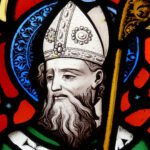
Every March, shamrocks appear everywhere — on clothing, storefronts, and parade floats. St. Patrick’s Day is full of fun, music, and community celebration. Yet behind the familiar symbols is a real man whose true story is far more meaningful than the myths often associated with him.
Long before the parades, in the year 432 AD, St. Patrick was quietly changing the course of Irish history. Known in ancient Christian tradition as “The Enlightener of Ireland,” Patrick’s life was shaped not by magic or folklore, but by courage, prayer, and a deep trust in God.
From Captive to Calling
St. Patrick was born around 385 AD in Britain, the son of a Roman official. He was not Irish by birth, and his first journey to Ireland was anything but voluntary. At just sixteen years old, he was kidnapped by raiders and sold into slavery.
For six long years, Patrick worked as a shepherd in the cold and isolation of the Irish countryside. Those years were difficult, but they became the turning point of his life. In his own writings, Patrick later shared that he prayed constantly during this time. Alone on the mountainside, his faith grew stronger, and he learned the Irish language — something that would later help him connect deeply with the people of Ireland.
After a dream guided him to escape, Patrick made his way back home to Britain. He could have stayed there safely, leaving his painful past behind. Instead, he experienced another powerful dream — one in which he heard the voices of the Irish people calling him back. Against all odds, Patrick returned to the land where he had once been enslaved, this time with a message of hope.
A Message of Light
Patrick returned to Ireland around 432 AD as a missionary. His work was often dangerous, and he faced resistance, yet he responded with patience, compassion, and creativity.
Many people have heard the story that St. Patrick drove the snakes out of Ireland. Historians widely understand this as a symbol rather than a literal event. What Patrick truly did was far more impactful — he worked to replace fear and darkness with faith and light.
One of the most well-known traditions connected to St. Patrick is his use of the shamrock. He used the familiar three-leaf plant to explain the Christian belief in the Holy Trinity — Father, Son, and Holy Spirit — three distinct persons united as one God. It was a simple image, rooted in everyday life, and it helped people understand a profound spiritual truth.
A Life of Humility
Despite his lasting influence, St. Patrick never saw himself as a hero. In his personal writings, known as The Confession, he spoke openly about his weaknesses and struggles. Rather than boasting about the thousands he baptized or the churches he helped establish, he called himself “a sinner” and credited all good works to God’s grace.
His humility is one of the most inspiring parts of his story — and one that still resonates today.
An Ancient Faith, Still Relevant
St. Patrick died on March 17, 461 AD. He lived during a time when Christianity was still young and united, and his life reflects the faith of the early Church.
As we celebrate St. Patrick’s Day this month, we’re invited to look beyond the shamrocks and legends and remember the real man — a former captive who forgave his captors, a missionary who returned in love, and a humble servant who gave all credit to God.
If you’re curious to learn more about the ancient Christian faith that shaped St. Patrick’s life, we invite you to come and see.
On Monday, March 9th — Father Arkady Migunov will be visiting the Wood County District Public Library to talk with those interested in the Orthodox Christian faith. Meet on the 2nd floor near the computers & tables (up the stairs, on the right) as early as 5:30 PM, the discussion will begin at 6 PM.
Any content, resident submissions, guest columns, advertisements, and advertorials are not necessarily endorsed by or represent the views of Best Version Media LLC (BVM) or any municipality, homeowners associations, businesses, or organizations that this publication serves. BVM is not responsible for the reliability, suitability, or timeliness of any content submitted, inclusive of materials generated or composed through artificial intelligence (AI). All content submitted is done so at the sole discretion of the submitting party.