Here in Southern California, we are blessed with the kind of weather that allows year-round outdoor activity. We have an abundance of beaches, lakes and pools, and the ability to swim is a necessity for the safe enjoyment of any water-related activity. Having spent most of my almost 56 years in and around the water, I am amazed by the fact that approximately half of the population in this country does not know how to swim. It is this sad fact that contributes to drowning as being one of the leading causes of accidental death nationally. The ability to swim is not a guarantee that one will never drown, just as the ability to drive a car cannot guarantee that one will never become an accident victim. However, it is certainly reasonable to assume that with strong swimming skills, adherence to safety rules and use of common sense, the risk of drowning would be significantly reduced. How one goes about developing those skills is what I would like to share with you in this article.
Learning to swim is a gift of life…for life. This is an activity that can (and for some does) begin at birth and can continue throughout life. In my 58 years of teaching swimming, I have seen almost every way imaginable to teach this skill. I learned how to swim at the Marine Corps Air Station at El Toro as a nervous five-year-old in the unheated pool. There were 20 other nervous five-year-olds and our teachers standing on the deck with long bamboo poles for us to hold onto as they barked out instructions and dragged us through the water. Thank goodness there have been some improvements in teaching methods and philosophies since 1953. Today there are many types of programs available for learning to swim. The American Red Cross and YMCA have been sources of instruction for decades. Parents and private instructors have also filled the need. I have been part of another source and that is the private swim school. As with so many things in life, the choices we make are influenced by location, cost, quality and availability. There are many factors to consider in searching for swim lessons.
Infant and toddler programs are usually found at private swim schools. The instructors should have specific training and understanding of appropriate child development characteristics for this age (under three years). The pool facility should be clean and in compliance with all health and safety codes. The water temperature should be warmer than 88 degrees which provides a more comfortable learning environment. Little ones’ skin temperature is around 91 degrees, and we lose body heat in 80-degree water at about the same rate as 40-degree air temperature. This is one of the most important factors for infant-toddler lessons.
The class format may vary from private, semi-private to parent and me groups. Progress in this age group is influenced by many factors including age, personality, number of lessons, frequency and duration of lessons and the amount of reinforcement that is provided. Lessons for infants and toddlers should develop a foundation of skills that progress steadily to increased ability. Learning to swim is a process, not an event and should be considered as an ongoing part of a child’s growth and development process.
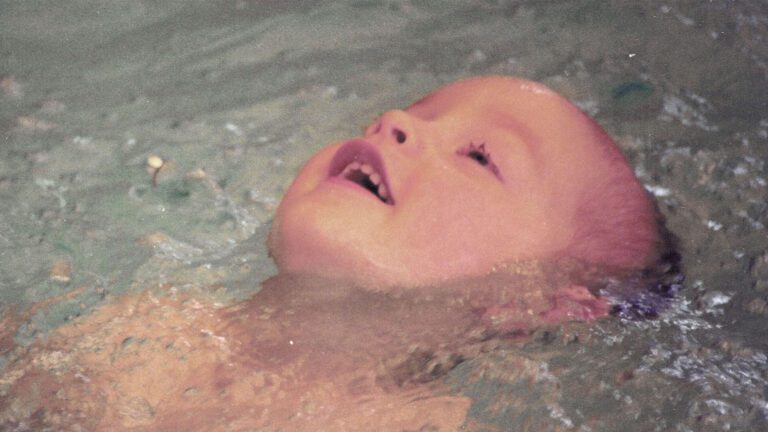
What a child in this age group can be expected to learn is dependent on all of the above factors. I have seen infants that can float on their backs and toddlers that can swim across a pool getting a breath on their own and climb out of the pool unassisted. I have worked with frightened five-year-olds that are afraid to put their face in the water and have had two-year-olds that have swum in our swim meets.
Parents that are interested in lessons for this age group should talk to friends that have participated in lessons, visit and observe programs and choose the one with which they are most comfortable.
Any content, resident submissions, guest columns, advertisements, and advertorials are not necessarily endorsed by or represent the views of Best Version Media LLC (BVM) or any municipality, homeowners associations, businesses, or organizations that this publication serves. BVM is not responsible for the reliability, suitability, or timeliness of any content submitted, inclusive of materials generated or composed through artificial intelligence (AI). All content submitted is done so at the sole discretion of the submitting party.