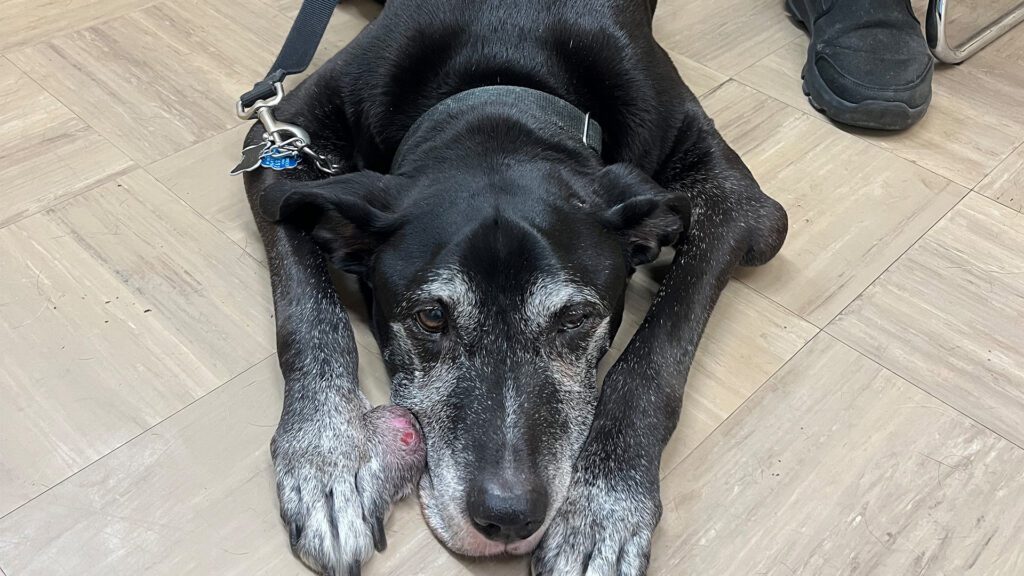
About once a week, we get a client that comes in with their aged or very sick pet asking this question. In my 32 years of practicing in private practice, I can’t say I have the perfect answer. It is more of an individual, case-by-case situation, that I come up with the guidance in the best interest of both, the pet and the pet parent.
They say deciding to put your long-time pet companion to sleep is probably one of the most difficult decisions that anyone sometimes needs to make. In this article, I’m specifically focusing on when to let go of an older pet—or even a younger one—who is suffering from a non-treatable condition or disease, when their quality of life comes into question.
In order to more effectively guide our clients, I refer to the pet Quality of Life Scale by Dr. Alice Villalobos, a renowned veterinary oncologist. There are 7 key indicators each graded on a scale of 1-10. The key indicators are; hurt, hunger, hydration, hygiene, happiness, mobility, and more good days than bad; a total of over 35 represents an acceptable quality of life to continue with treatment; less than 35 points would recommend an unacceptable quality of life.
I believe this is a great tool to more objectively answer the question of So when is it time to say goodbye? However, it still is very difficult to accept and take action when the suggested answer is less than 35.
I usually share an experience I had with my own sister. My sister had two dogs, Isis, a female 10 year old beagle mix and Chance a 12 year old German Shepherd. At this age, both were slowing down due to arthritis but appeared to be generally healthy. One day my sister found Isis underneath the kitchen table in her bed, deceased. Although my sister was very sad, she accepted that Isis was older and died of natural causes. Then, fast forward three years, Chance was 15 years old and had severe hip dysplasia to the point where he would not go outside to pee or poop and would just soil in his bed and hardly eat at all. I personally assessed him to be way less than 35 on the Quality of Life Scale. My sister could not come to terms, even for Chance’s sake, that it was time to say goodbye. My sister was waiting and hoping and praying that, just like Isis, Chance would just die in his sleep. This never happened. Chance just kept eating just enough not to die; he was dragging his back legs all over the house with feces and urine scalding his legs. This is when I had to clarify for my sister that part of my oath, as a veterinarian, is to end pets’ pain and suffering and suggested that it was time to say goodbye, more so for Chance’s benefit.
At this point my sister allowed me to perform a Home Compassionate Euthanasia. I first gave Chance an injection of a tranquilizer in order to relax him. After about 5 minutes, I then gently placed an iv catheter and secured it in. At this time, my sister and brother-in-law gathered close to Chance. Hugged, kissed him and said their goodbyes. I reminded my sister and brother-in-law that they gave Chance a wonderful long life filled with love and happiness. That Chance was happy and that he also loved them. I then injected an anesthetic and Chance literally went into a deep sleep (anesthetic means no pain). After about 30 seconds, I then injected the euthanasia solution that immediately stopped Chance’s heart. Chance then crossed over The Rainbow Bridge. I then stepped out and gave them the opportunity to spend some time with Chance.
My sister and brother-in-law were so happy and relieved that Chance was no longer suffering, thanked me and gave me one of the biggest and warmest hugs ever! I took Chance’s remains with me. And to this day, my sister has Chance’s ashes and Clay paw print with his name over their mantle right next to Isis’s.
I am always so honored to help alleviate a pet’s pain and suffering and help a pet parent through this difficult situation especially when I go to perform a Compassionate at home Euthanasia; at the pet’s home, in their happy place, surrounded by all the people who love them, so peacefully.
Any content, resident submissions, guest columns, advertisements, and advertorials are not necessarily endorsed by or represent the views of Best Version Media LLC (BVM) or any municipality, homeowners associations, businesses, or organizations that this publication serves. BVM is not responsible for the reliability, suitability, or timeliness of any content submitted, inclusive of materials generated or composed through artificial intelligence (AI). All content submitted is done so at the sole discretion of the submitting party.