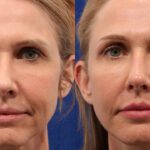
In my 25 years of practice as a facial Plastic Surgeon, I have seen the biggest shift in how facelifts are done in the last three years as creative new thinking and techniques have become the standard.
Celebrities such as Courtney Cox and Kylie Jenner have made headlines by dissolving their facial fillers in favor of a more natural look. Meanwhile, others are choosing to undergo facelifts at an earlier age to achieve a refreshed, youthful appearance while avoiding fillers altogether. Lindsay Lohan and Christina Aguilera are both rumored to have had deep-plane facelifts to achieve the sought-after “Forever 35 Face”.
What is the “Forever 35 Face”? It is the face that never seems to age maintaining a look of someone in their late 30s.
The “Forever 35 Face” was first described in The Cut in 2025 as the trend of the deep-plane facelift. This movement is started in New York, where many patients are opting for facelift surgery at the first signs of aging. By choosing surgical intervention early, these patients address a sagging jawline and jowls directly, rather than undergoing years of repetitive energy-based and filler treatments. This shift is driven by modern techniques that rejuvenate the face through structural repositioning rather than distorting it through over-tightening.
The Changing Treatment Paradigm
Aesthetic medicine is shifting. For years, the first-line approach to early facial aging relied on injectables (fillers, neurotoxins) and energy-based skin tightening (ultrasound, radiofrequency, lasers). Now, a growing number of surgeons and patients favor earlier surgical intervention—most notably the deep-plane facelift—to produce longer-lasting, structurally based rejuvenation.
Why the Paradigm is Changing:
- Limitations of fillers and energy devices: While fillers restore volume and energy devices tighten the surface, they do not reliably reposition descended facial tissues or correct ligamentous laxity and sagging. Repeated filler layering can distort anatomy, and non-invasive devices often provide modest results that may not meet expectations for jawline and neck definition.
- Desire for natural, long-lasting results: Patients increasingly prioritize outcomes that look both natural and durable. Many prefer a single, definitive intervention with predictable anatomic correction over ongoing maintenance visits and incremental filler additions.
- Preserving anatomy through earlier surgery: Surgeons argue that addressing structural descent before severe skin redundancy or massive volume loss occurs, allows for better tissue repositioning with smaller scars and less radical skin excision.
What is the Undetectable Deep-Plane Facelift?
- Plane of dissection: The deep-plane technique releases and repositions facial tissues beneath the SMAS layer and along deeper retaining ligaments. Instead of simply relying on tightening the skin, it mobilizes the cheek fat pad and midface as a single unit, re-draping them superiorly and posteriorly.
- Structural repositioning: By freeing deeper attachments, the surgeon restores cheek projection, smooths nasolabial folds from beneath, and improves jawline contours with minimal tension on the skin.
- Preservation of natural movement: Because the technique focuses on deep fat pads and leaves the facial muscles un-touched, it preserves natural facial animation and avoids the “pulled” look associated with traditional facelifts.
- Invisible Incisions: By carefully hiding the incisions around the ear and along the hair lines, it is possible to have an undetectable scar even with hair pulled up or back. This is part of the artistry of the undetectable Facelift.
Clinical Advantages of Early Intervention:
- Longer-lasting correction: Addressing the root cause of tissue descent produces results that typically outlast fillers or energy-based tightening. A well performed deep plane facelift should last for 15 years.
- Reduced filler dependency: Restoring underlying support decreases the need for large-volume fillers to “prop up” falling cheeks or mask jowls.
- Enhanced neck and jawline definition: Deep-plane lifts are highly effective at treating early jowling and submandibular laxity before skin redundancy becomes extensive.
Recovery and Outcomes:
- Procedure: Performed under sedation or general anesthesia; involves deep dissection and repositioning with conservative skin re-draping and hidden incisions.
- Recovery: Initial swelling and bruising typically last 1–2 weeks. Most patients return to social activities by week three, with strenuous activity restricted for up to six weeks.
Conclusion
The “Forever 35 Face” concept reflects a broader movement toward earlier, structurally focused facial rejuvenation. We have seen increased patient satisfaction and improved more natural outcomes in our patients who have chosen this approach to facial rejuvenation.
Any content, resident submissions, guest columns, advertisements, and advertorials are not necessarily endorsed by or represent the views of Best Version Media LLC (BVM) or any municipality, homeowners associations, businesses, or organizations that this publication serves. BVM is not responsible for the reliability, suitability, or timeliness of any content submitted, inclusive of materials generated or composed through artificial intelligence (AI). All content submitted is done so at the sole discretion of the submitting party.