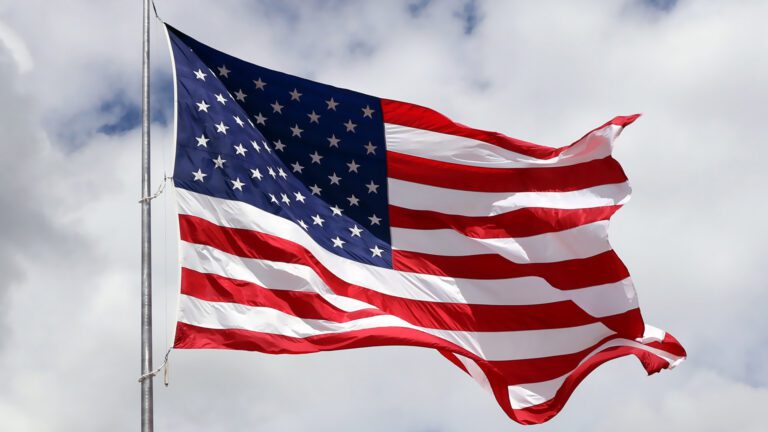
Who are “We the People?” We come from every human inhabited terrain on earth. We represent every human language and culture in the world. We are members of a single nation, a nation of federated states exclusively founded on the belief that there is a Creator God, and this Creator has bestowed upon each of us certain natural rights. These rights do not exist based upon human works. They simply exist as a gift of “Nature and Nature’s God.” We are citizens of the United States of America.
July 4, 1776, was the first time in the history of humanity that a nation was founded on such principles and beliefs, and it was established in a document entitled, The unanimous Declaration of the thirteen united States of America. Today, it is simply referred to as the Declaration of Independence, and our nation is referred to as the United States of America, the United States, or simply America.
We declared independence from being British colonies but had to fight a war against the strongest empire on earth at the time, against every odd and likelihood. Our Declaration was profound, but we needed to use a document called the Articles of Confederation during the war with Great Britain to run our fledgling government. After the war ended, those articles proved unworkable and needed to be replaced with something more stable and sustainable.
There were great debates, but it was decided to return to the principles of the Declaration of Independence for inspiration and guidance.
Our Declaration of Independence is arguably one of the most significant documents ever constructed by the human mind and stated much more than the American reasons for separation from England. It was a statement about the rights of the individual person and was far more profound than many of the founders of our country understood at the time.
Our founders understood history and how various systems of government have come and gone. They took this knowledge and created a constitutional republic with a written constitution that establishes the rule of law over the rule of individuals, organizations, societies, and governments.
With our justification for existence at the ready, our founders put together a group of representatives who worked out a United States Constitution and Bill of Rights to establish a newly structured society of representative government. These framers of the Constitution were brilliant in their construction of a basis for government that has endured almost 250 years.
Even so, there were already in existence many cultural problems that our new country inherited from colonization. A central problem was that only white, Anglo, Protestant males were recognized as having the inherent substance to be free with full constitutional rights and responsibilities. All others were seen as much less, ranging from subservient (women, children and ethnic minorities) to slaves (Native Africans and African Americans).
Over eighty years later, it took a civil war that claimed hundreds of thousands of lives and the destruction of countless properties and resources, to rectify one of many flaws inherited by our society. It has also taken many more years to fully realize the ideals of the American constitutional system, with an ongoing process to make it inclusive for all people within our borders, sharing in its protections.
Our Freedom Charters are terms I am using to illustrate a model and conceptualization of We the People. The Charters of Freedom are the physical parchment documents upon which were written the Declaration of Independence, the U. S. Constitution, and the American Bill of Rights.
Our Freedom Charters are the “spiritual body” of these documents. They are the accumulation of influences that began with the creation of humanity and have continued forward since.
They are the products of all human experiences on Earth with each person’s innate desire to be free of persecution and oppression, desiring life, liberty and the pursuit of happiness for themselves and for others. Our Freedom Charters live inside each of us and are an ongoing work. They are the “Spirit of America,” inside every person who has the desire to live free.
While they have been instrumental in the justification, establishment, and continuation of the United States of America as a free and prosperous constitutional republic, their influence and impact has far more reaching consequences on the human condition, individually, collectively, and globally. This is due to their unique significance in elevating the rights and powers of the individual person while limiting the powers of government entities.
Since 1945, the United States has been a world superpower with a global effect, and while its creation only dates to 1776, its development can be traced much further back in time to the beginnings of human civilization.
This connection with the past is rarely recognized but it is essential to fully understand the immense undertaking that was, is, and will be required for its present existence and future preservation.
Today, the United States of America is considered a distinctly modern, Western nation geographically and culturally but, in reality, is much more complicated. This single nation of separate states is pieced together from thousands of years of human experience in countless societies throughout human history. Understanding the efforts and intents that have produced this extraordinary country is also instrumental to its current greatness and future success.
To fully appreciate the founding philosophy and internal workings of our Freedom Charters, one must understand their original source, fundamental premises, and systematic processes. Most essential is the belief that people possess inherent natural rights, and these rights are not derived from other human beings or government entities, but from a conscious creator of nature and humanity.
For the previous two millennia, Western civilization has conceptualized nature’s God as the God of Abraham, known in Judaism as The LORD God, in Christianity as God the Father, and in Islam as The God. The God of Abraham is the “first sovereign” and the architect of eternal and divine laws. These laws give substance to the laws of nature, natural law, which in turn should be emulated by human-made laws, human law. Following this model, human law should be specifically designed to safeguard the inherent rights of people through an established system of legal protections and due process.
While the laws of nature are inherent from creation, natural laws alone do not grant human beings the best chance for self-preservation (life), self-determination (liberty), and the pursuit of one’s desires (happiness). Therefore, the establishment and enforcement of a system of human laws, applied equally through a system of due process, becomes essential.
Decisions made by “We the People,” an informed citizenry, must be responsible for the direction of our cities/townships, counties/parishes, states, and country. Collectively, we sovereign individuals form a popular sovereign entity, American society, and consolidate into sovereign legal entities such as private and public organizations. We decide who will lead certain aspects of our sovereign governing entities through a series of free and transparent elections.
Another premise of our Freedom Charters is that human beings are created with free will. Free will is the power to think and act independently of fate, destiny, and the will of others. Humans specifically possess rational minds, and the ability to reason. Each human being also has a duty to use reason to make independent choices that respect the general life, liberty, and happiness of themselves and others.
Free will is fundamental for our informed people to follow their conscience and is essential for the most basic natural right, self-preservation. From this starting point, free will and the desire for self-preservation control many human actions and inactions, as self-determination blooms in the process of making personal choices for the pursuit of one’s desires.
Natural rights also provide every person with personal responsibilities to themselves and to others because, as choices are presented and decided upon, those actions produce consequences, positive and/or negative. Consequences can be immediate or occur over time, but these consequences can affect the life, liberty, and pursuit of happiness of the decision maker and others. Therefore, every American has some level of personal responsibility to themselves, their community, society, their state, and the nation.
Furthermore, having been created in God’s image, every individual person can exercise his or her free will as an individual sovereign. While the concept of sovereignty is ancient and historically rooted in religion or a political/social class of people, our Freedom Charters are the first documents to illustrate that sovereignty begins with our Creator God and is gifted to each individual person through nature. So, unlike other societies in history, individual Americans have a right to individual freedoms, which are rooted in being children of our Creator God and citizens of the constitutional republic created by our Freedom Charters.
They are not granted, limited, or owed by a birth status, such as servant or subject from a lord, king, pope, or other potentate.
While individual sovereignty is vital to these American ideals, other sovereign entities provide a counterbalance to abuses that can be perpetrated by the individual person. These entities are private and public organizations, society at large, and government entities, each of which has certain rights and responsibilities addressed in our Freedom Charters and work as balances and counterbalances to each other. If any of the four fall out of balance, abuses and crimes against the other(s) can occur.
Because human experience has demonstrated that this is a likely occurrence and extremely undesirable, our Freedom Charters assign certain rights, responsibilities, and limits to all entities.
This means there must also be great care toward the inherent rights of individuals, private and public organizations, society, and government entities if human laws are going to promote justice and provide all entities with a humane and prosperous environment in which to exist and thrive.
Any content, resident submissions, guest columns, advertisements, and advertorials are not necessarily endorsed by or represent the views of Best Version Media LLC (BVM) or any municipality, homeowners associations, businesses, or organizations that this publication serves. BVM is not responsible for the reliability, suitability, or timeliness of any content submitted, inclusive of materials generated or composed through artificial intelligence (AI). All content submitted is done so at the sole discretion of the submitting party.