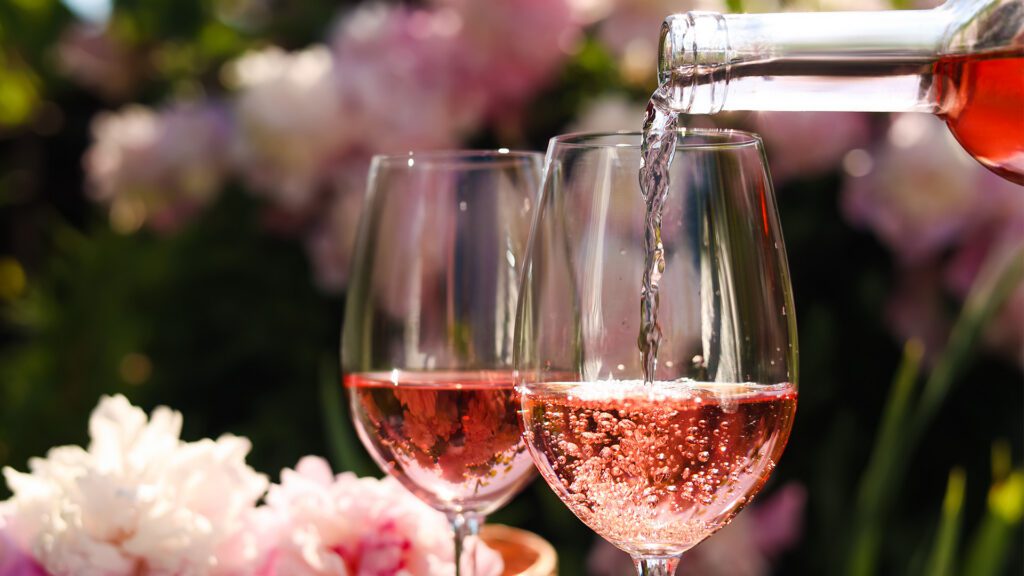
As the weather gets warmer, two wine trends start their annual unfurling: white wines get back into the rotation, and people rediscover their love of rosé.
Pink wine, or rosé, is a perfect choice year-round, but its subtle flavors and beautiful colors get people thinking about sun, the beach, boating, and sitting outside with friends enjoying light fare and good conversation.
Many people believe that rosé is sweet, based on their introduction to the category with White Zinfandel. While this style is deliberately made to be a sweet wine, the vast majority of rosé wines, especially those you’ll find at the store and at restaurants, are, in fact, dry (not sweet).
Rosé wine can be made from any black grape (think Pinot Noir, Merlot, Sangiovese, etc.) as all of the color of the wine comes from its skins. Rosés can be made in three different ways: a bleeding method, short maceration, or blending. For the bleeding method, red wine producers who are looking to concentrate the color of their heavy red will “take off the top” juice from the soaking skins and use that lighter wine to make a rosé.
For the short maceration method, which is the most common method for making rosé, the grapes are harvested, crushed, and cold soaked for several hours to extract a little bit of color from the skins before it is pressed, fermented, and bottled for sale. With this method, it is the short time of color extraction that gives the wine its signature color. If the skins were left in the must for much longer (days), you would have a red wine.
The final method is blending: mixing a white wine with a red wine. This is the least expensive and lowest quality method. However, when making a sparkling rosé, such as a Champagne or Prosecco, the wine maker will first produce the base wine (make the white wine and red wine separately), and then mix the two in different proportions to create one wine with that signature rosé hue. Then, that mixture is fermented again to create the bubbles.
Rosé wines can be light-bodied to full-bodied, lightly or intensely expressive in aromatics and flavor, and light to dark pink in color. Typical aromas and flavors can range from watermelon, strawberry, cherry, raspberry, and pomegranate, to dried herbs, bell pepper, chalk, or rose water.
Great food pairing with rosés include seafood, salads, chicken dishes, cheeses, and even certain fruit-forward desserts. The acidity of the wine (mouth-watering sensation) allows for its versatility and is what makes it a great warm-weather wine. Cheers to Sunshine Season!
Derrik Kennedy is the Owner and Master Sommelier at Sip Wine Bar, which can be found at 85 Main St. and is, of course, our Expert Contributor! He is always available along with his staff to talk about all things wine. Derrik has recently been named a Valpolicella Specialist, making him the first and only person in the State of CT with that title. Sip WIne Bar is open 3-10 T-F, 2-10 Saturday.
Any content, resident submissions, guest columns, advertisements, and advertorials are not necessarily endorsed by or represent the views of Best Version Media LLC (BVM) or any municipality, homeowners associations, businesses, or organizations that this publication serves. BVM is not responsible for the reliability, suitability, or timeliness of any content submitted, inclusive of materials generated or composed through artificial intelligence (AI). All content submitted is done so at the sole discretion of the submitting party.