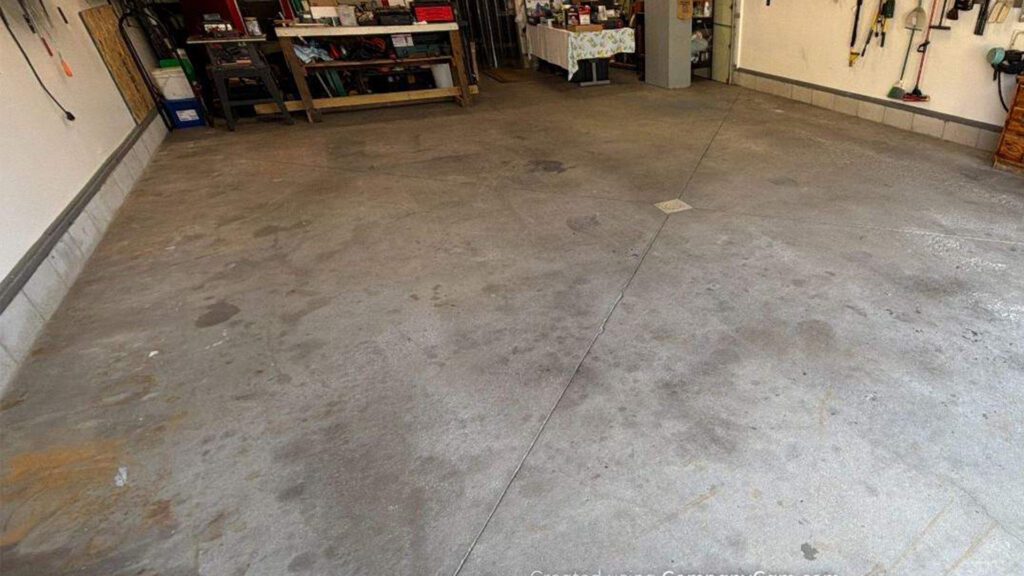
If you’ve ever seen a garage or basement floor that’s peeling, chipping, or fading after just a year or two, you’ve witnessed a common issue in the coatings industry: failure caused by shortcuts. While many coatings may look similar on day one, the long-term performance of a floor comes down to two critical factors—surface preparation and product quality.
Let’s start with preparation, because this is where most failures begin.
Concrete is not a smooth, sealed surface—it’s porous and often contaminated with oils, dirt, and moisture. Simply “cleaning” the floor or using an acid etch is not enough to properly prepare it for a long-lasting coating. Professional-grade systems require mechanical grinding using industrial equipment to open the pores of the concrete and create a surface profile that allows the coating to properly bond. Without this step, even the best product will struggle to adhere, leading to peeling or delamination.
Moisture is another major factor. Concrete naturally allows moisture vapor to pass through it, and if this isn’t addressed correctly, it can push coatings off the surface over time. This is why high-quality installations often include a moisture vapor barrier or specialized primer designed to mitigate this issue. Skipping this step may save time or money upfront, but it significantly increases the risk of failure.
Now let’s talk about the coatings themselves.
Not all products are created equal. Many lower-cost systems use water-based epoxies or DIY kits that are thinner, less durable, and more prone to wear. These products may look good initially, but they often lack the strength and chemical resistance needed for real-world use—especially in environments like garages where vehicles, salt, and temperature swings are constant factors.
Higher-quality systems, such as industrial-grade epoxy combined with polyaspartic or polyurea topcoats, are designed to withstand heavy traffic, impacts, and UV exposure. They provide better adhesion, longer lifespan, and a more consistent finish. While the upfront investment may be higher, the long-term value is significantly greater because the floor performs the way it should for years—not months.
Another overlooked factor is installation expertise. Even the best materials can fail if they’re not installed correctly. Timing, mixing ratios, environmental conditions, and application techniques all play a role in the final result. This is why experienced professionals follow a system—not just a product—to ensure consistency and durability.
At the end of the day, a floor coating is only as good as the process behind it. When corners are cut on preparation or cheaper materials are used, the result is often a floor that fails prematurely. On the other hand, when proper preparation, high-quality products, and skilled installation come together, the result is a floor that not only looks great but stands the test of time.
If you’re considering a floor coating for your home, don’t just compare price—ask about the process. Because when it comes to coatings, what’s underneath matters just as much as what you see on the surface.
Any content, resident submissions, guest columns, advertisements, and advertorials are not necessarily endorsed by or represent the views of Best Version Media LLC (BVM) or any municipality, homeowners associations, businesses, or organizations that this publication serves. BVM is not responsible for the reliability, suitability, or timeliness of any content submitted, inclusive of materials generated or composed through artificial intelligence (AI). All content submitted is done so at the sole discretion of the submitting party.