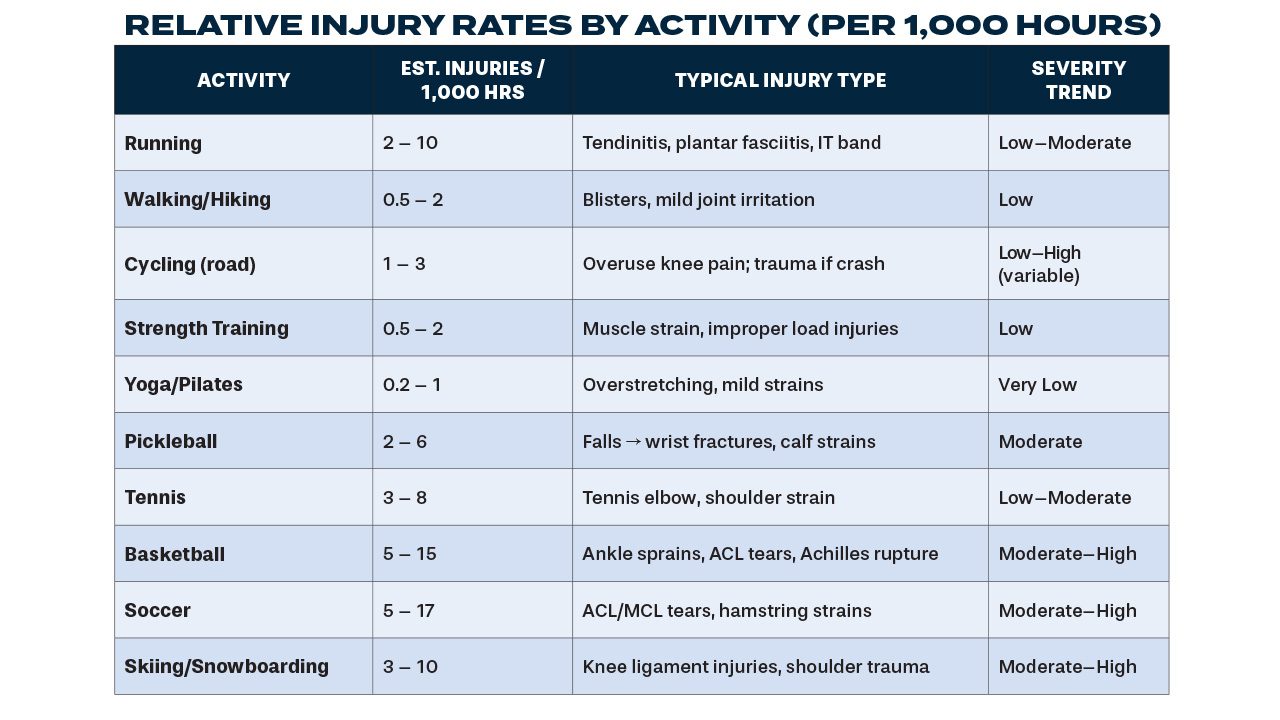
If you’ve ever compared your sore knee to your neighbor’s torn ACL and wondered, “Which activity is actually riskier?”—you’re not alone. Sports medicine often uses injury rates per 1,000 hours of participation to compare activities. It’s a handy way to level the playing field between the daily jogger, weekend pickleball enthusiast, and once-a-week basketball player.
But here’s the twist: the type of injury matters just as much as how often it happens.
Take running. It often shows a higher injury rate—roughly 2 to 10 per 1,000 hours. But most running injuries are overuse issues: Achilles tendinitis, plantar fasciitis, or IT band irritation. They creep in gradually, are annoying, but usually manageable.
Basketball and soccer tell a different story. Picture a Sunday morning rec league game: a quick cut, a planted foot, and a dreaded “pop.” These sports may show similar or slightly higher injury rates—5 to 15+ per 1,000 hours—but the injuries are often acute and severe: ACL tears, ankle sprains, or Achilles ruptures. Less frequent than a runner’s aches, but far more disruptive when they happen.
Pickleball offers a unique twist. Its rate sits in the middle, about 2 to 6 per 1,000 hours, but the demographic changes the picture. Many players are older adults, and when falls happen, wrist fractures are common. One classic scenario: a player lunges for a shot, loses balance, and instinctively reaches out to break the fall—ouch, fractured wrist. Same sport, very different risk profile.
Cycling tends to be lower risk—1 to 3 per 1,000 hours—mostly overuse knee or back complaints. But road crashes, while rare, can be high impact. So cycling is low frequency, occasionally high severity.
Strength training and yoga are generally safe, with injury rates under 2 per 1,000 hours. Most injuries stem from poor technique or overdoing a lift or stretch. A common tale: the gym-goer reliving college lifting days or a yogi pushing too deep—preventable with attention and pacing.
Walking is arguably the safest of all, with injury rates well under 2 per 1,000 hours. Most complaints are minor: blisters, mild joint irritation, or the occasional misstep. Not exciting, but reliably low risk.
So, what’s the takeaway? Don’t just look at numbers—consider what kind of injuries you might face. Running is frequent but usually minor. Basketball and soccer are less common but can be serious. Pickleball shows how age and demographics influence injury patterns.
At the end of the day, every activity carries risk. The goal isn’t to avoid it—that would mean avoiding movement entirely. Instead, it’s about understanding the trade-offs and taking precautions.
As one weekend warrior said after running a half marathon and playing basketball in the same month: “The run made me sore. The game made me nervous.” That pretty much sums it up: different risks, different stories, same fun in staying active.
Any content, resident submissions, guest columns, advertisements, and advertorials are not necessarily endorsed by or represent the views of Best Version Media LLC (BVM) or any municipality, homeowners associations, businesses, or organizations that this publication serves. BVM is not responsible for the reliability, suitability, or timeliness of any content submitted, inclusive of materials generated or composed through artificial intelligence (AI). All content submitted is done so at the sole discretion of the submitting party.