If you have had a loved one experiencing memory or cognitive changes, you may have seen a clinician ask them to complete this simple exercise. At first glance it may not seem significant, but drawing a clock can reveal a great deal about how the brain is functioning. What many people do not realize is that there is a meaningful connection between performance on the Clock Drawing Test and driving safety.
The Clock Drawing Test is widely used to help detect cognitive impairment, including early signs of dementia. It evaluates several important brain functions at once, including memory, attention and concentration, executive function such as planning and decision-making, and visual-spatial skills, which involve understanding space and positioning. These are the same abilities required to drive safely. Research supported by the National Highway Traffic Safety Administration and the American Medical Association has shown a strong association between poor performance on the Clock Drawing Test and impaired driving ability. In practical terms, difficulty drawing a clock may reflect difficulty navigating the road.
While the Mini-Mental State Examination is another commonly used screening tool, studies published by the Canadian Medical Association Journal suggest that the Clock Drawing Test can detect problems with executive function even in individuals who perform well on the Mini Mental State Exam. This makes it a particularly useful tool when evaluating real-world skills like driving.
When I work with seniors whose families are concerned about their driving safety, I always do the CDT. I ask the individual to draw the face of a clock, including all the numbers, and set the time to ten minutes after eleven. I make sure they understand the instructions, and then I observe whether all numbers one through twelve are present and in the correct order, whether the numbers are spaced appropriately within the circle, whether there are exactly two hands, and whether the hands correctly point to eleven and two.
In Senior Care Authority’s “Beyond Driving with Dignity” program, we take the stance that failure to do any or all of the above with the CDT means that the person is at an elevated risk to be in a vehicle accident and that they should retire from driving immediately.
Below are examples of Clock Drawing Test results that would be considered concerning:
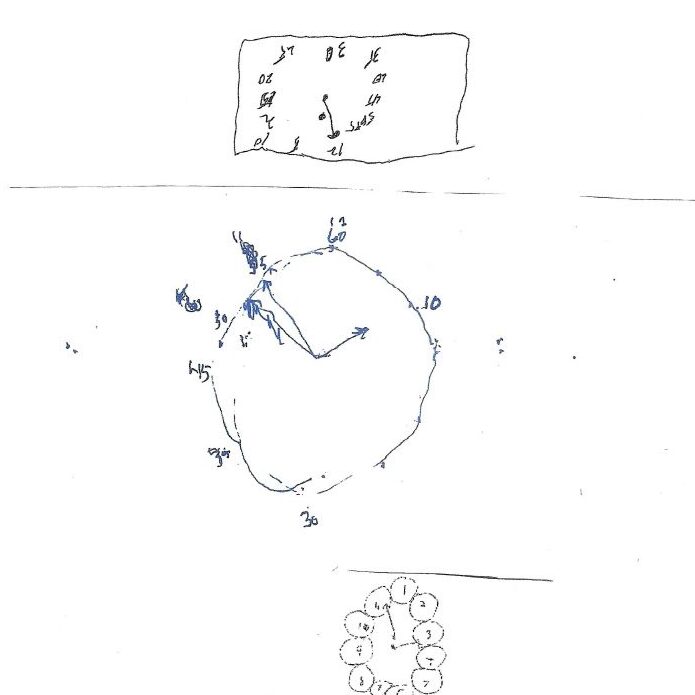
If someone draws a clock like these examples, should they be driving? With “Beyond Driving with Dignity”, we take the approach that driving requires constant processing of information, quick decision-making, and accurate interpretation of the environment. If someone struggles to organize a simple clock face, it raises a critical question about how they will manage a busy intersection, changing traffic signals, or unexpected hazards.
The bottom line is that difficulty with the Clock Drawing Test can signal challenges with processing information, making decisions, and reacting appropriately, all of which are essential for safe driving. If you are concerned about a senior driver in your life, the Clock Drawing Test can be a helpful starting point for discussion.
For more information about Senior Care Authority of New Jersey’s Beyond Driving with Dignity program, call (201) 564-7997 or visit www.seniorcareauthority.com/newjersey.
Any content, resident submissions, guest columns, advertisements, and advertorials are not necessarily endorsed by or represent the views of Best Version Media LLC (BVM) or any municipality, homeowners associations, businesses, or organizations that this publication serves. BVM is not responsible for the reliability, suitability, or timeliness of any content submitted, inclusive of materials generated or composed through artificial intelligence (AI). All content submitted is done so at the sole discretion of the submitting party.